
Montana man who allegedly plotted Chico attack sentenced for building Molotov cocktails
A federal judge sentenced a Montana man to 10 years in prison after investigators found Molotov cocktails inside his trailer amid a homicide investigation.
Kadin Hawkeye Lewis, of Park County, previously pleaded guilty in U.S. District Court to possession of unregistered destructive devices. At his sentencing Wednesday, Judge Susan P. Watters said especially aggravating in the case were journal entries and messages written on the walls of his trailer in which he showed a fascination with mass shooters and wrote that he has his own “mission” to attack a local hot spring and a high school.
Before issuing her sentence, Watters acknowledged that Lewis was being sentenced solely for possession of the Molotov cocktails, and the 24-year-old never admitted to planning any kind of mass shooting or attack. But, she said, Lewis was “thinking about them enough to write them down,” and the Molotov cocktails indicated he’d already taken steps to carry out what he’d written.
In September 2022, members of the Park County Sheriff’s Office were called to a camper in Pray, a small community along U.S. Route 89 between Livingston and the northern entrance to Yellowstone National Park. The RV was parked on a man’s property off East River Road, according to reporting from the Bozeman Daily Chronicle. Inside the camper, they found the body of 32-year-old Casey Anderson.
Anderson had been shot through the top and the back of his head “execution style,” according to federal court documents. A day after the discovery of Anderson’s body, court documents said, Lewis' mother walked him to the sheriff's office. Lewis was arrested and charged with deliberate homicide in Park County District Court. Nearly two years later, after an investigation conducted by the PCSO and the Montana Division of Criminal Investigation, prosecutors dismissed the charge against Lewis.
“While the State maintains to a probable cause level that the Defendant killed (Casey Anderson),” prosecutors wrote in their motion to drop the charge without prejudice, “after evaluating and reevaluating the evidence against the defendant, the State does not believe it can prove beyond a reasonable doubt the Defendant killed Anderson.”
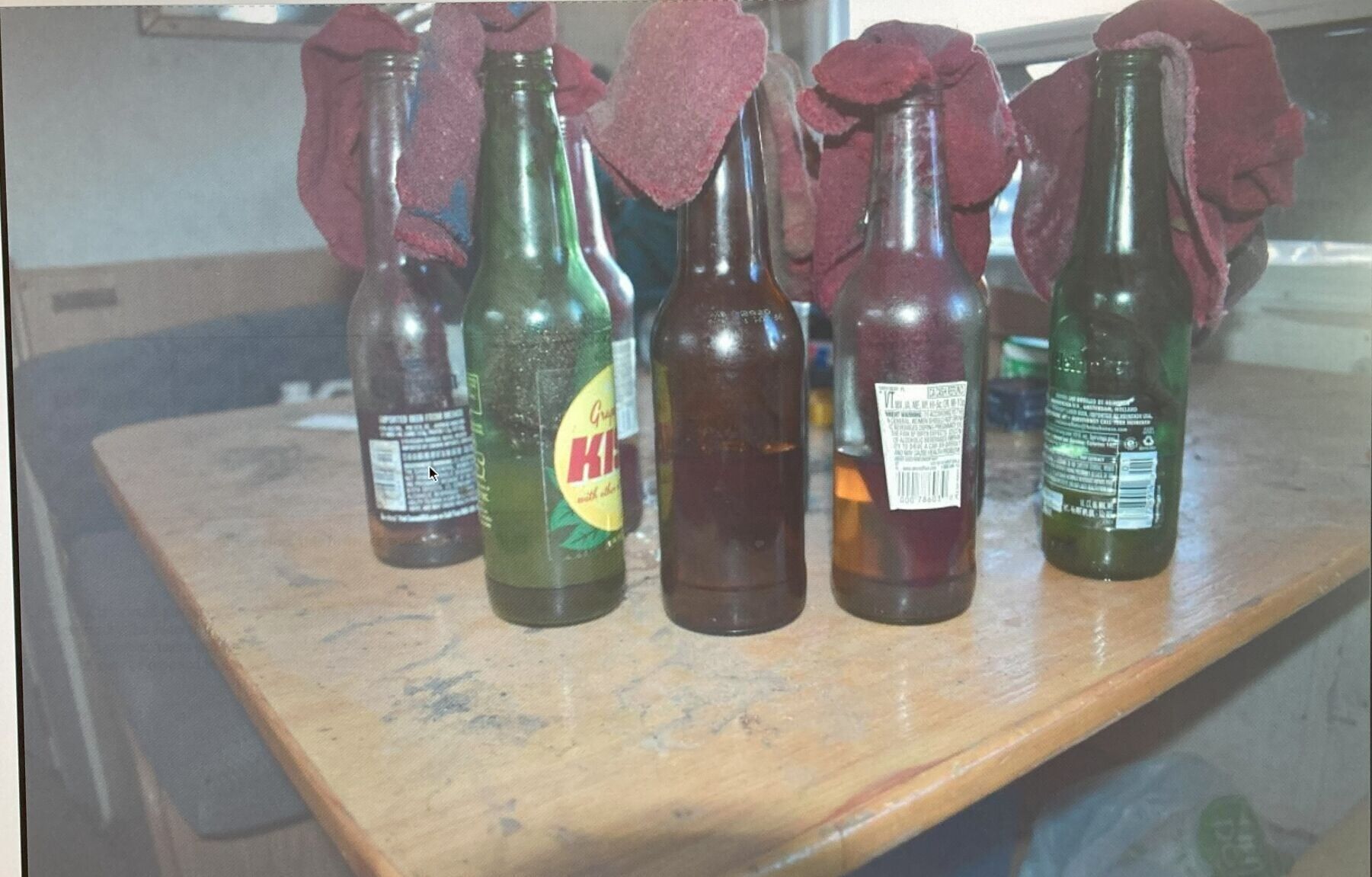
It was during the search of the RV in September 2022 that investigators found evidence that Lewis was preparing to terrorize specific public spaces in Montana, court documents said. Investigators seized eight glass bottles converted into explosives, along with a duffle bag containing a piece of paper that read, “Kadin Lewis is the school shooter.”
Elsewhere in the camper, investigators documented hate symbols like swastikas on the walls. They also found journal entries written on notebook paper that showed an admiration for mass shooters, drawings of lynchings and a desire to attack the nearby Chico Hot Springs Resort. Molotov cocktails and guns would be used, according to the entries found in Lewis’ camper, to build up a “kill count.”
“I Kadin Lewis will carry out my mission like no other,” he wrote in one journal entry, per federal court documents. “I’m a good looking guy why can’t you women just give me a chance?”
Federal prosecutors filed an indictment against Lewis in December 2023. Lewis has been in custody since his arrest in September 2022. He was eventually charged with possession of unregistered destructive devices, attempted malicious use of fire and explosives and carrying explosives during the commitment of a felony.
Lewis reached a plea agreement with United States attorneys earlier this year after a lengthy back and forth between federal prosecutors and Lewis’ defense in which his attorneys attempted to have swaths of evidence dismissed from the case. In exchange for his guilty plea, prosecutors dropped the counts of attempted malicious use of fire and explosives and carrying explosives during the commitment of a felony. Per his plea agreement, Lewis could not appeal his sentence.
At Lewis’ sentencing hearing Wednesday, Assistant U.S. Attorney Jeffrey Starnes said the writings inside the camper could very well be just fantasizing on the part of Lewis, or the ramblings of someone with mental health issues. However, Starnes said, Lewis building eight Molotov cocktails and having enough empty bottles and makeshift wicks to construct more suggested a plan to commit a mass casualty event.
Defense attorney Steven Babcock, representing Lewis, said reports in the media that his client admitted to planning an attack on Chico Hot Springs were completely inaccurate, reiterating that Lewis only admitted to possessing Molotov cocktails. Lewis never detonated any of the explosives, Babcock said, which were “rudimentary” devices and not elaborate bombs. There was no evidence that Lewis ever visited the hot spring, he said, and while the journal entries were concerning, he asked Judge Watters to consider his client’s mental health.
Lewis, diagnosed with autism spectrum disorder when he was a boy, was living in a delapidated camper at the time of his arrest, Babcock said. The camper had no running water, no electricity and, by Babcock’s description, was “not suitable for anyone to live in.” Although his client has a lot of potential, Babcock said he was isolated inside his camper.
“The internet can do crazy things to the human mind,” Babcock said.
Two years ago, the U.S. Department of Justice published a study of radicalized violence in the U.S. over the past three decades, noting that violence on the part of those espousing white supremacist and nationalistic rhetoric has been on the rise. The study, which pulled from DOJ data dating back to 1990, concluded that “far-right extremists have committed far more ideologically motivated homicides than far-left or radical Islamist extremists, including 227 events that took more than 520 lives.”
In 2025, the Justice Department, without comment, pulled the study from the National Institute of Justice’s catalog following Charlie Kirk’s assassination. In September of last year, a gunman fatally shot the right-wing media personality during his “America Comeback Tour.” A copy of the study is still accessible through the Internet Archive.
Earlier this month, the White House published the 2026 United States Counterterrorism Strategy. Produced by the U.S. counterterrorism director, assistant to the president and talk show host Sebastian Gorka, the document lists cartels, Islamist extremists and “violent left-wing extremists, including anarchists and anti-fascists,” as the main terroristic threats to the U.S. In a stark departure from the previous presidential administration, the new federal strategy omits the threat of right-wing domestic terrorism, decries the danger of “anti-American, radically pro-transgender, and anarchist” ideologies and warns of “alien cultures” fomenting terrorism in Europe, all while lauding President Donald Trump.
A separate study, released by the DOJ in 2022, focused on the 167 mass shootings in the U.S from 1966 to 2019. Suicidality and severe childhood trauma were documented in nearly a third of all those who carried out mass shootings in that timeframe.
Prior to receiving his sentence, Watters offered Lewis a chance to speak. Lewis, dressed in jail clothes labeled “Yellowstone County Detention Facility,” apologized for making the Molotov cocktails. He said he missed his dog and his family, and had ambitions to become a cowboy, after complying with all the conditions that Watters orders.
“I was young and stupid,” Lewis said.
While Watters sentenced Lewis to 10 years in prison, the maximum punishment, she said she will recommend he be placed at the Federal Medical Center in Rochester, Minnesota. The facility would offer better long-term mental health care for Lewis, she said. After completing his prison sentence, Lewis will remain under federal supervision for an additional three years.



Comments ()