
Montana moves to settle mining violations at Zortman-Landusky gold mine
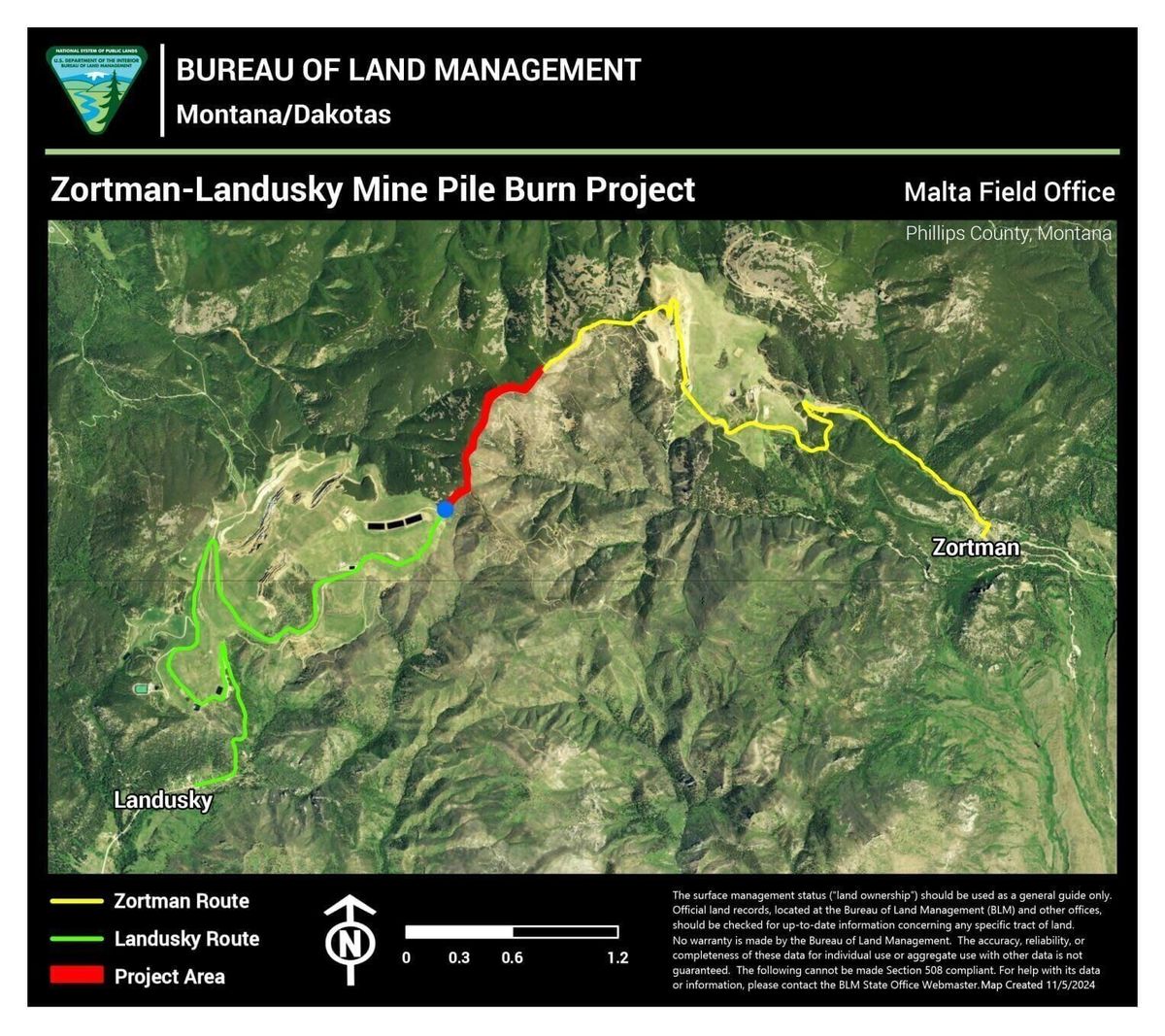
Montana regulators are proposing to settle their allegations of recent illegal mining activities at the former Zortman-Landusky gold mine by requiring a payment of less than half the original fine.
The consent decree would require a $200,000 settlement to the Department of Environmental Quality (DEQ), but no admission of guilt. It was immediately opposed by the adjacent Fort Belknap Indian Community, which has for decades been burdened by extensive water pollution from the shuttered mining complex.
The DEQ in July 2022 issued a fine of more than $500,000 to Luke Ployhar, Owen Voigt and their companies for what it then called a “violation of major gravity that has compromised reclamation work at the site and represents a risk of acid rock drainage.” Satellite images showed unpermitted exploration activity had previously occurred, the DEQ alleged.
Ployhar, Voigt and their companies have denied wrongdoing. They were ordered in 2022 to halt exploration and mining activities until they secured needed exploration permits. They had previously applied for and received a permit, but it was blocked by a state court after being challenged by the tribes and other groups.
Reached Tuesday, both referred questions about their work and the case to a statement from Ployhar, who purchased the property more than 25 years ago after the original mine closed. It notes they continue to deny wrongdoing and “we firmly believe that our conduct — in all respects — complied with applicable law.”
“Along with Montana DEQ, we jointly proposed this settlement to avoid further costly litigation and to bring resolution to the parties involved,” continued the statement, in part.
Filed May 22 in Phillips County District Court, the proposed consent decree also requires the men to withdraw their exploratory mining permit, but allows them to reapply for a new one.
Fort Belknap Indian Community President Randall Werk Sr. said the settlement fails to address “long-term impacts of the environmental issues associated with the Zortman-Landusky site.”
“This area lies within our ancestral homelands, and we have a responsibility to protect our lands, waters, cultural resources and future generations,” Werk wrote in a statement Tuesday.
“Significant environmental concerns remain unresolved, water treatment continues indefinitely and important questions regarding the full scope of environmental damages have not yet been fully evaluated. We believe additional accountability, environmental review and meaningful tribal involvement are necessary before this matter is resolved.”
Earthjustice, which is representing the tribes in the case, stated they plan to file their opposition to the consent decree.
A DEQ spokesperson said the agency does not comment on ongoing litigation.
The $200,000 settlement would be used for remediation and water treatment at the mine site, under the consent decree.
The state’s account to pay the Zortman mine’s cleanup costs is on the verge of running out, DEQ Director Sonja Nowakowski told lawmakers last August. But DEQ spokesperson Madison McGeffers wrote in an email Tuesday that the dire account balance was incorrect.
An accounting error failed to include money from metal mine taxes that had not been transferred to the cleanup account, McGeffers wrote. The balance in that account currently stands at $7.6 million.
In August, Nowakowski also said her agency had requested financial help from the federal Bureau of Land Management, which already pays about half of the annual $3 million cost of operating the site’s six water treatment systems. The federal agency has not formally responded to that letter, according to the DEQ.
In a state pockmarked with the toxic scars of past mining practices, the former Zortman-Landusky mine has become something of a posterchild for the far-reaching impacts of mining practices. For about two decades, the open-pit mine extensively used cyanide heap-leaching, a once-common gold mining process that has since been banned in Montana by popular referendum.
By the time the mine’s owner, Pegasus Gold, closed the mine and filed for bankruptcy in 1998, its operations had extensively degraded the 1,200-acre mine site at the foot of the Little Rockies mountain range. Acid mine drainage and heavy metal contamination have heavily polluted surface and groundwater in the area.
It’s also among a number of Montana’s mining sites that may never be fully remediated. Montana requires mining companies to pay a bond on par with the estimated costs of cleanup, an attempt to guarantee taxpayers don’t get stuck with the bill.
But due to Pegasus’s bankruptcy and the state drastically underestimating the bond needed for cleanup, Nowakowski said taxpayers have, to date, spent more than $63 million on cleanup at the Zortman site since 1999. Federal taxpayers have covered $20 million of that total, while state taxpayers have spent $39 million.
The company’s failure to clean up its mess resulted in it and its executives being banned from working in Montana, under the state’s “bad actor” mining law. Since then, Montana has also updated its bonding laws in an attempt to more accurately forecast the costs of mine reclamation.


Comments ()