
Montana youth argue for 9th Circuit court to allow climate change case to proceed
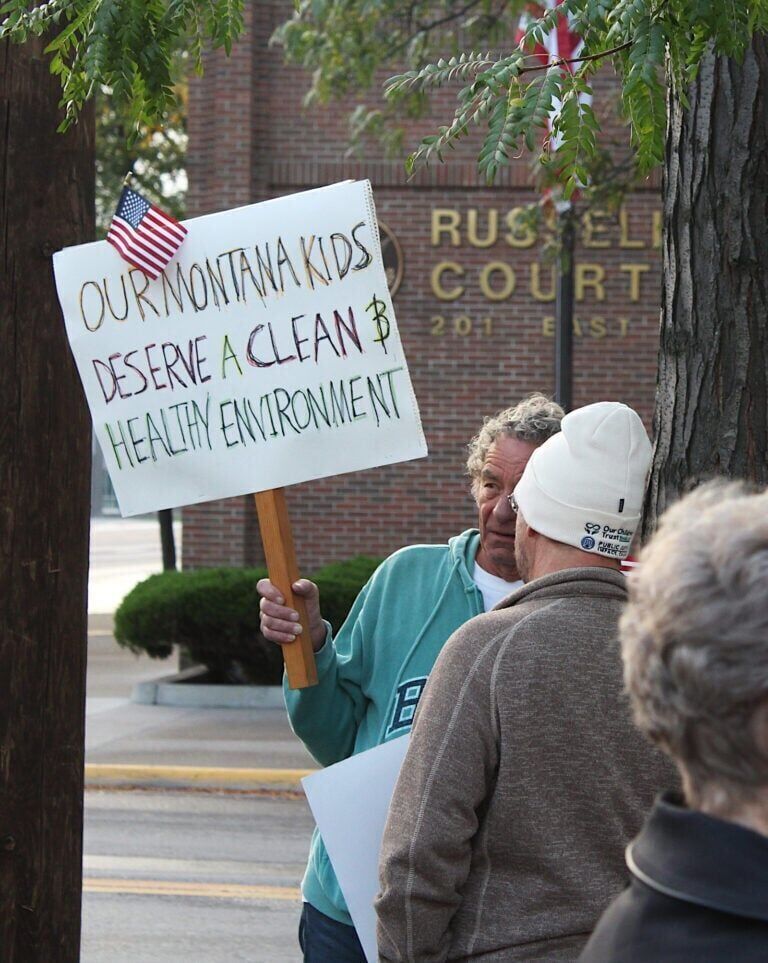
Attorneys for a coalition of youth who challenged a series of President Donald Trump’s executive orders related to energy and climate change last year argued before the Ninth Circuit Court of Appeals to allow their case to move forward.
The U.S. District Court in Montana, which dismissed the claims in Lighthiser v. Trump, erred by ruling it did not have jurisdiction to offer sweeping relief in reviewing the legality of the executive orders, argued attorney Julia Olsen with Our Children’s Trust, the nonprofit law firm representing the youth.
“Beyond question, the federal judiciary retains the authority to adjudicate constitutional challenges to executive action,” Olsen said, citing recent circuit court decisions. “And so we think there’s a clear power of Article Three here to provide redress and to remand for the merits.”
Attorneys for the federal government and Montana pushed back against Olsen’s arguments during the April 13 hearing, saying rolling back the three executive orders would not not provide the plaintiffs with any relief and that the court correctly ruled it did not have the power to take up the issue.
“This court cannot enjoin the executive branch from exercising expressed congressional authority,” federal attorney John Adams said.
“The relief plaintiffs seek here requires a balancing of competing economic, social and political forces that must be made to our elected officials, both within the legislative branch and within the executive branch.”
Lighthiser v. Trump is one of a series of youth-led climate change lawsuits brought by Our Children’s Trust, an Oregon-based advocacy law firm. The case involves a group of youth plaintiffs from other climate change lawsuits, including Juliana v. United States and a landmark Montana case, Held v. Montana, along with youth from Florida, California Hawaii and Oregon.
The youth sued the Trump Administration over three of the president’s executive orders issued last year aimed at supporting the fossil fuel industry, curbing renewable energy and suppressing climate science.
During a two-day hearing in September before a federal judge in Missoula, attorneys for the plaintiffs argued for an injunction against the three orders, as well as an order halting roughly a dozen federal agencies from implementing any policies related to the orders.
But the Justice Department, backed by several states including Montana, which joined the lawsuit, argued the district court should dismiss the case, saying the plaintiffs lacked standing and were asking a court to set federal environmental policy.
Judge Dana Christensen “reluctantly” dismissed the case, saying the scope of the requests made by the 22 young plaintiffs was “an unworkable request” and outside the jurisdiction of the court.
The plaintiffs appealed Christensen’s decision to the Ninth Circuit, asking it to reverse the lower court decision and allow their claims to proceed on the merits of the arguments.
Olsen compared the case to similar climate change related cases, including the federal case Juliana v. United States, which was repeatedly dismissed by federal and circuit courts, but drew the distinction that Lighthiser has a narrower, focused scope.
“The plaintiffs filed suit here to prevent prospective harm and seek declaratory injunctive relief against those three specific orders,” Olsen said. “(Juliana) was not about specific executive orders that are being actively implemented today.”
Adams disagreed with the specificity of the case, saying that Lighthiser, compared to other cases that have challenged executive orders, such as those imposing tariffs, does not deal with an “immediate and automatic effect” on the plaintiffs, which doesn’t exist in the energy and climate-related orders.
Instead, challenging the executive orders is far removed from any action that could be deemed illegal, Adams argued. The orders create agency actions, which would prompt private industry to produce fossil fuels that would create emissions that could allegedly cause climate change, which the plaintiffs argue is harmful.
“That is a causal train that is too attenuated,” Adams said. “They challenge executive orders that… are not the substantial part of their claimed injuries.”
Montana solicitor general Christian Corrigan further argued that the plaintiffs lack the standing to argue that the president had exceeded his constitutional power by issuing executive orders, and that the executive orders lack enough detail to qualify for a review by the courts.
But Olsen made the argument the circuit court should allow the case to move forward on its merits and let the district court make the decision of whether the president’s actions are allowable under the Constitution.
“We could lose on the merits,” Olsen said. “The court might decide, ‘Oh, he has adequate authority to do all this.’ But what we’ve alleged, based on our extensive review of the law, is that he has acted outside of his statutory authority.
“… What we’re talking about is the right to life and liberty of these children,” Olsen continued. “And some of them have suffered life-threatening harm because of pollution and heat. And we’re not just talking about climate change. We’re talking about the direct air pollution that harms their lungs and their lives.”
In a statement released after the hearing, lead plaintiff Eva Lighthiser said the district court had acknowledged there is a “children’s health emergency,” even as it dismissed their claims.
“Today, we asked the Ninth Circuit to do what the judiciary is meant to do: protect our rights,” Lighthiser said. “The executive branch’s actions are putting us in danger, and many of us are too young to vote or participate in the political process, so we are turning to the courts to ensure our constitutional protections are upheld.”
The challenged orders included Trump Executive Orders 14154, “Unleashing American Energy,” 14156, “Declaring a National Energy Emergency,” and 14261, “Reinvigorating America’s Beautiful Clean Coal Industry.”




Comments ()