
MSU hosts National History Day State Contest
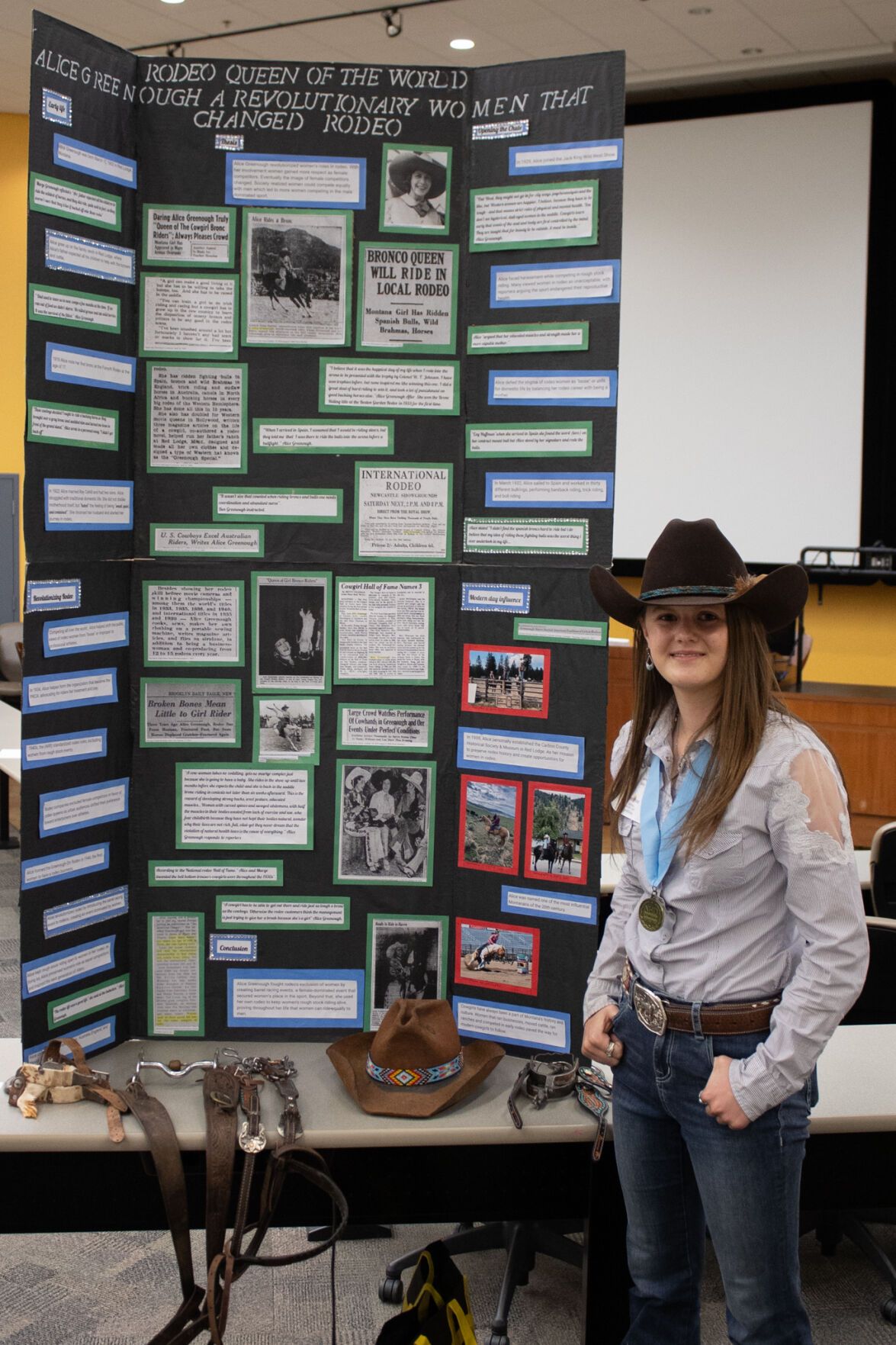
MSU hosted the National History Day in Montana (NHD MT) State Contest last Saturday, rallying competitors in grades 6 to 12 from across the state.
NHD MT is an educational outreach program co-sponsored by the MSU Department of Education and the Montana Historical Society. The program’s co-coordinators are Hailey Hancock, an assistant teaching professor in the Department of Education and Melissa Hibbard, an interpretive historian in the Montana Historical Society.
The contest was sponsored by the College of Letters and Sciences and allowed students to showcase historical research projects, with the top two entries in each category proceeding to the national competition.
Students were divided into two divisions: the junior division, grades 6 to 8, and the senior division, grades 9 to 12. There were approximately 180 participants. Each project had to follow this year’s theme: “Revolution, Reaction, Reform in History,” according to the NHD MT website.
One of the contest judges, recent MSU graduate Camille Sampley, said she decided to return for the 2026 competition after her positive experience last year.
“It was a really good experience and a good way to meet other Montana kids and see the stuff they had been working on,” she said.
Sampley, who now teaches second grade, said she focused on judging poster boards, but projects included websites, exhibits, performances, papers and documentaries.
“Today, one of my poster boards I was judging was about dog tags and how they came to be used from so many people dying and not being identified in war,” she said. “I thought that was really cool and [was] something I never thought about.”
Sampley also commented on the importance of learning history from her perspective as a teacher.
“The big one that us teachers say always is, ‘you don’t want to repeat the past,’ and knowing what happened can help us make better choices in the future,” she said.
The competition allows students to dive into specific historical events, which Sampley said is critical in presenting history as a learning opportunity.
“National History Day forces these students to really see the implications of this event in history, whatever they're studying, how something like that can maybe happen today,” she said.
Lila Ruffatto, a participant and sixth-grader from Lolo Middle School in Lolo chose to do a project on Virginia Hall, an American spy during World War II (WWII). She said she decided to attend the state contest for fun after making it through her local school competition.
“I found it really amazing that she was one of the first women spies during WWII,” she said. “I learned a lot about the sexism in that time and how people underestimated her.”
According to Ruffatto, she chose to do her project on Hall because of a picture book she had read.
“My favorite part about my project was when she went undercover as a milkmaid,” she said.
Kailayla Villaluz, a junior at Wolf Point High School in Wolf Point, did her project on the forced sterilization of Indigenous women, a human rights violation and genocide that occurred throughout the 1970s, according to the National Library of Medicine.
“I never learned about it in any history course throughout high school or middle school,” she said. “So I thought it would be a great chance to know about it.”
Villaluz said she struggled with presenting and incorporating visuals in her project, but she enjoyed the writing section.
“I like writing, so voicing it out was difficult and doing the pictures. But writing, I was able to, just like [organize] everything completely,” she said.
Villaluz said that her favorite part of the event was the keynote speaker in the morning: Hasan Davis, an author and history performer.
“He told the story of York and Lewis and Clark, so I got to learn something and I got to see another way to give out history,” she said.
Villaluz was one of two qualifiers for the national competition in the senior individual documentary division.
Next year’s state contest will be held on Saturday, April 24 at MSU. The theme is “Innovation in History,” according to Hancock.


Comments ()