
MT House Speaker delays bill to define 'sex' to avoid litigation, blames 'activist judges'
House GOP leadership said Monday they are using a procedural loophole to keep a contentious bill defining sex as binary out of court.
Senate Bill 437 sailed through the 2025 Montana Legislature with the support of almost every Republican, but will not be sent to the governor’s desk to be signed into law — at least for the time being.
Sponsored by Kila Republican Sen. Carl Glimm, SB 437 defines sex as binary in all parts of Montana law. According to the bill, those two sexes are male and female, determined by a person’s reproductive systems. SB 437 is remarkably similar to legislation that was passed and signed into law in 2023, but has since been blocked by multiple legal challenges.
Procedurally, once a bill passes the Legislature, it is signed by the House speaker and Senate president and then sent to the governor’s desk for a veto or passage into law.
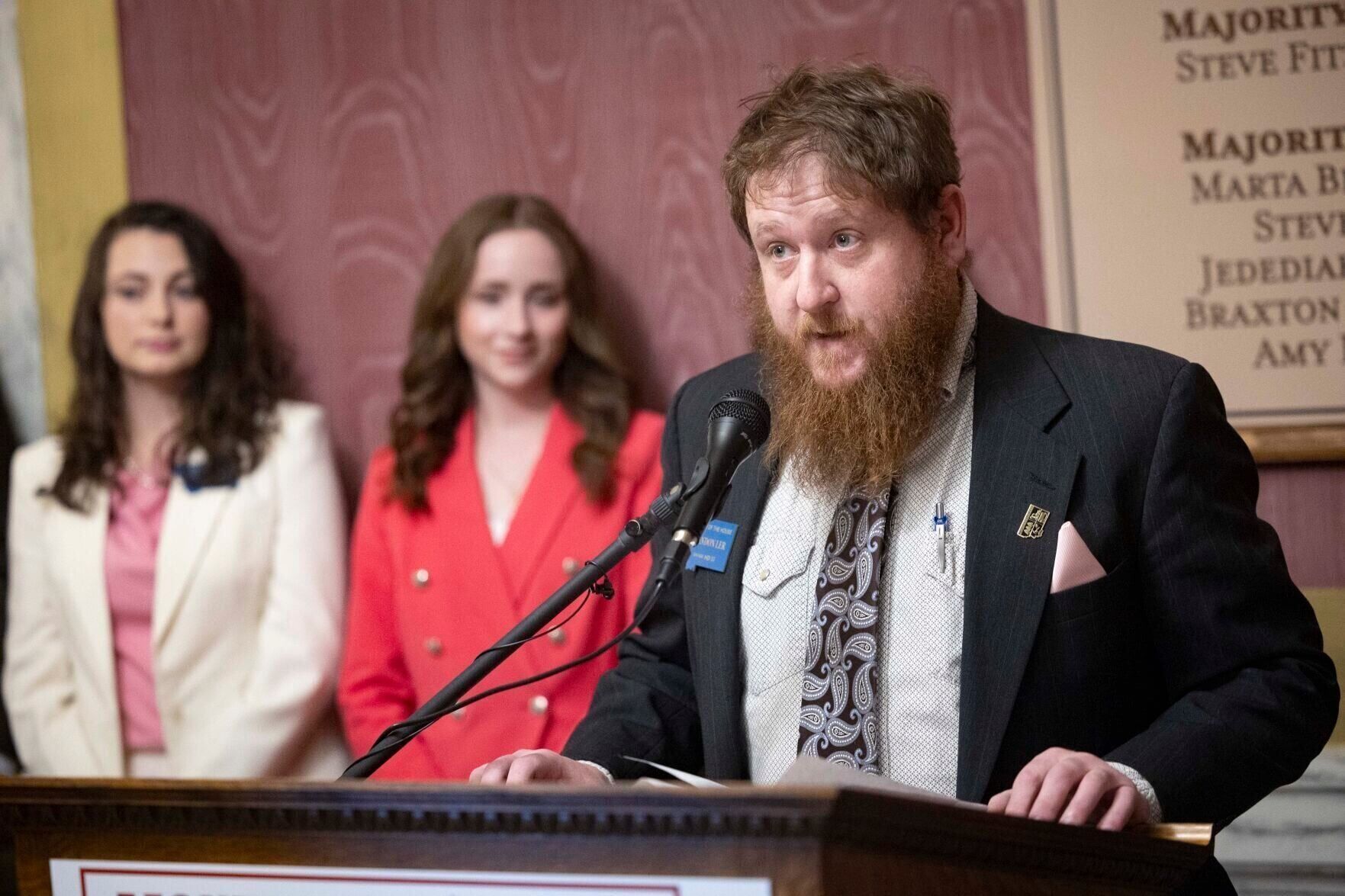
But SB 437 has been sitting with House Speaker Brandon Ler, R-Savage, for nearly four months, making it the last bill of the 2025 legislative session whose future has yet to be decided by Republican Gov. Greg Gianforte. By holding SB 437, it can’t be signed into law by Gianforte, and therefore cannot get wrapped up into the ongoing litigation against the similar bill from 2023.
“Let’s be clear: the problem isn’t lawmakers doing their job. The problem is a judiciary that has become more interested in playing politics than upholding law,” House Speaker Brandon Ler, R-Savage, said in a press release Monday. “By holding SB 437, we’re making sure this legislation has the strongest chance to stand. We will not sit back while partisan judges try to erase what the people’s representatives have enacted.”
Republicans in Montana have been battling with the courts for years, voicing their displeasure with the courts striking down the often controversial laws they’ve passed with broad majorities in both chambers. This year, Gianforte and GOP lawmakers were aligned on a plan to require judicial elections to be partisan affairs. However, every bill that aimed to do so in some fashion was killed off by a bloc of Democrats and more-moderate Republicans.
The 2023 law that sought to define sex, also sponsored by Glimm, has been permanently enjoined by two Missoula district court judges in separate cases, which critics bemoan as moves by an overzealous judiciary looking to scuttle conservative priorities. Those legal challenges were filed by the ACLU of Montana and Upper Seven Law, respectively.
First, Missoula District Court Judge Shane Vannatta ruled last summer that its title was too vague to meet constitutional muster. Then, District Court Judge Leslie Halligan ruled in February, while the 2025 legislative session was ongoing, that Senate Bill 458 violated equal protection and privacy guarantees in the Montana Constitution.
In her ruling, Halligan noted that SB 437 “bears remarkable similarity to SB 458” and used it as proof that the threat of harm “remains prevalent” despite the 2023 law being struck down. Halligan’s order prohibited the state from enforcing SB 458 “or any law with the same effect.”
SB 437 was introduced six days after the February injunction was ordered by Halligan.
While the attorney general’s office protested Halligan’s ruling, in April, after Senate President Matt Regier signed the bill, attorneys for the plaintiffs emailed lawyers for the state saying they intended to file a complaint looking to invalidate SB 437 “assuming the Governor signs the bill into law,” according to a Montana Supreme Court filing.
Molly Danahy, an attorney with Upper Seven Law, the firm representing the plaintiffs in the SB 458 case, confirmed Monday the plaintiffs’ intent was to file a challenge to SB 437 in the same case so the two laws could proceed as part of one case. But a bill cannot be challenged until it becomes state law.
With the district court case on pause and the bill sitting in Ler’s desk, Attorney General Austin Knudsen on July 25 filed a petition with the Montana Supreme Court asking it to intervene and vacate Halligan’s order, alleging the judge had committed an error in her order by ruling “based on the prospect of a future law.”
“Implicitly weighing on what is squarely within the Legislature’s domain is an affront to foundational separation of powers,” Knudsen’s request said.
But a four-justice panel quickly denied that request, saying the AG’s Office had not shown any urgency or emergency reason why the court should take up the case, nor why the office could not begin the typical appeal process.
“Petitioners’ impatience with the litigation process is an insufficient basis to constitute urgency or emergency factors that make the normal appeal process inadequate,” the panel wrote.
According to Danahy, during a status conference on Aug. 20, plaintiffs’ attorneys told the judge they would prefer to challenge both bills in the same case, but the state wanted the initial case resolved so it could be appealed.
She said Halligan asked Upper Seven to proceed with its brief asking the court for attorney’s fees in that case and that she would take the issue over SB 437 under advisement.
Danahy believes the state does not want to defend the new bill before the same judge that struck down the 2023 version.
“The majority is so hell-bent on denying some Montanans’ rights, they’re willing to waste taxpayer money bringing the same legal issues to Court again and again,” she said. “Rather than respecting the Constitution and putting our hard-earned money to good use providing infrastructure and opportunity, they’re politicking over the same tired issues.”
A spokesperson for Gianforte on Monday said the governor looks forward to signing the bill when it makes it to his desk, but declined to comment on the strategy to avoid litigation.
House GOP leadership hopes this delay tactic will strong-arm the courts into hearing the two laws in separate suits.
“Montanans sent us here to make law, not to let activist judges tear it down the moment the ink dries,” Ler said. “We refuse to hand the judiciary an easy path to lump these cases together and stall the will of the people. That’s why we are being deliberate with the timing on SB 437.”
Glimm said he had been kept in the loop on the thought process behind holding the bill for now.
“I appreciate that and support it,” he said. “I’m fine with the bill being temporarily held back in light of the inappropriate judicial activism we’ve seen.”



Comments ()