
Painting a picture of Cory Trépanier
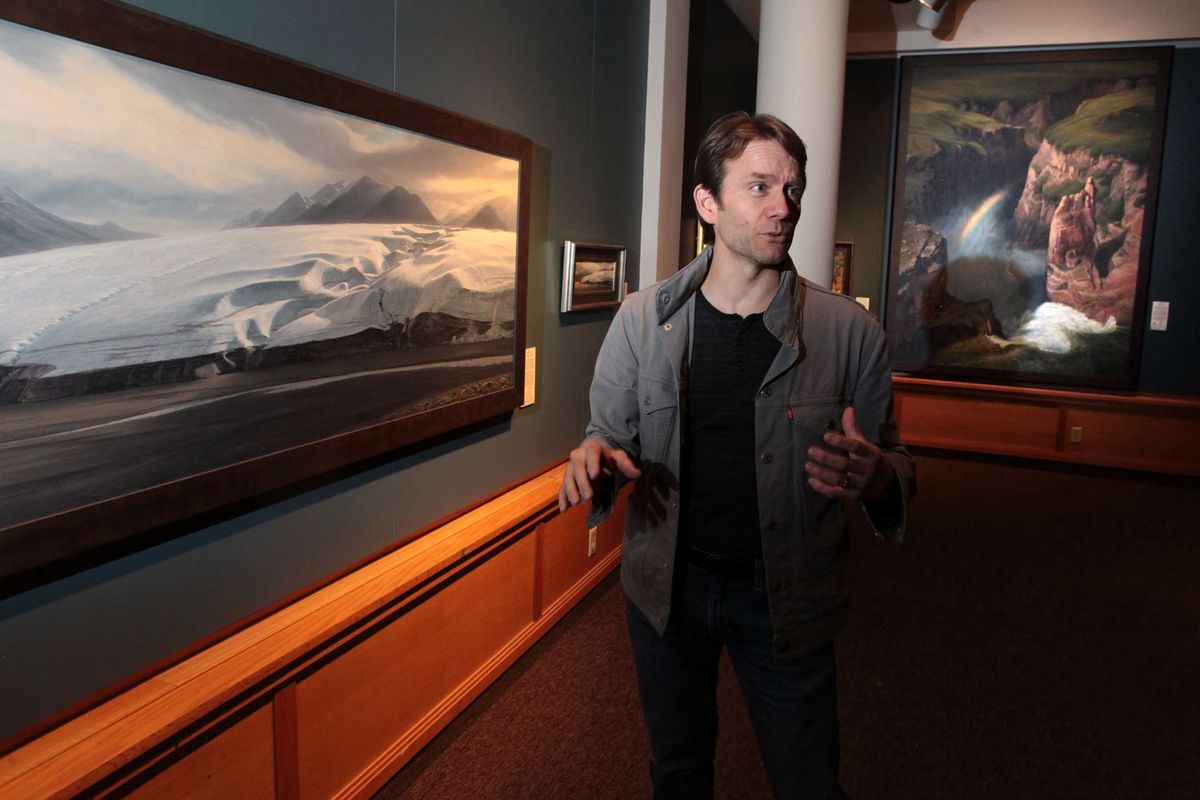
I had the chance this week to speak with Cory Trépanier, the artist behind the Museum of the Rockies “Into the Arctic” exhibit, and ask him a few questions about his work. “Into the Arctic” features landscape paintings of the Canadian Arctic completed over the course of a decade and four separate expeditions.
I was told you painted the smaller pieces on site, did you have some kind of home base or were you backpacking around with your equipment?
I’m packing around with all of my stuff. Generally, my kit I’ve brought into the field for the last decade has been a half-box French easel, my paints and some boxes I’ve made that hold 10 panels each. The first things that go in my pack are my easel and my paint panels. That takes up about the first 25 pounds. After this last expedition, though, I said to myself “never again am I bringing this thing.”
Do you ever make larger versions of your onsite works?
Yeah, you’ll notice throughout the collection that the studies that I began on location, especially for the major works, are all here next to the final pieces.
What went into making the centerpiece painting for the exhibit?
This was a study that I began from the back of Billy Arnaquq’s boat, an Inuit gentleman from Qikiqtarjuaq, and he and I got set up right near the glacier. But the boulders and rock faces hid the view of Coronation Glacier from the shore so I borrowed Billy’s boat while he made tea and took it out to where I needed it, set up my easel and started painting. I knew the view was so overwhelming that this was going to lead to a larger piece (the final painting ended up being 15 feet by 5 feet).
Is there a theme to the larger pieces on display?
There are five major pieces: the centerpiece and four other really large pieces aside from that. They’re meant to geographically tie into the Arctic in that there are pieces from the Eastern Arctic, the Western Arctic and so on. They kind of represent the furthest points in each direction that I’ve traveled to.
What’s the furthest north you’ve traveled?
I did an expedition to Ellesmere Island in 2009. It’s at the very top of North America, just about 500 miles shy of the North Pole. That was about a seven-week trip. My brother came with me for that one and we were the only two visitors to Quttinirpaaq National Park for that entire year. Just to give you a sense of context, that park is 40,000 square kilometers. That’s a lot of space to have for yourself. You get a sense of humility like you can’t get any other way, being so tiny in these huge places.
What’s the typical length of an expedition?
They range anywhere from a month to nine weeks. The very first trip we did was in 2006 and was actually a family expedition. My wife and my daughters, who were seven and 11 years old at the time, came north with me from our home in Ontario and we didn’t come back for two-and-a-half months. We drove as far as we could past the Arctic Circle to a little town called Inuvik and from there flew another hour to a 300-person town called Paulatuk. Afterwards, we got on four-wheelers and drove across the tundra for 11 hours. Oh, and there was a boat ride, too.
I’ve noticed some of the studies are slightly different from the larger works. Why is that?
So what happened was, I started this piece on location [at Mount Thor] right down in amongst the rocks. When I decided I wanted to create a larger work from it, I found that these boulders in the foreground became too prominent and I wanted to focus on [Thor Peak]. It’s the highest sheer rock face on the planet. The view of the foreground is actually two or three kilometers upstream from the original location and I kind of married the two together. Technically, you can’t go to this physical spot because it doesn’t exist. It’s a compilation of my experiences there, and that to me is one of the big differentiating factors between photography and painting.
What is one event that stands out from your expeditions?
Being surrounded by three arctic wolves with my brother in our tent and no one around for miles was pretty awesome. I’ve got to say, that was a real heart-beating thrill. I’ve also seen a lot of polar bears. Fortunately, I didn’t have any of those come to the tent.



Comments ()