
Public Things Project hosts bipartisan panel on elections, campaign financing and the Montana experience
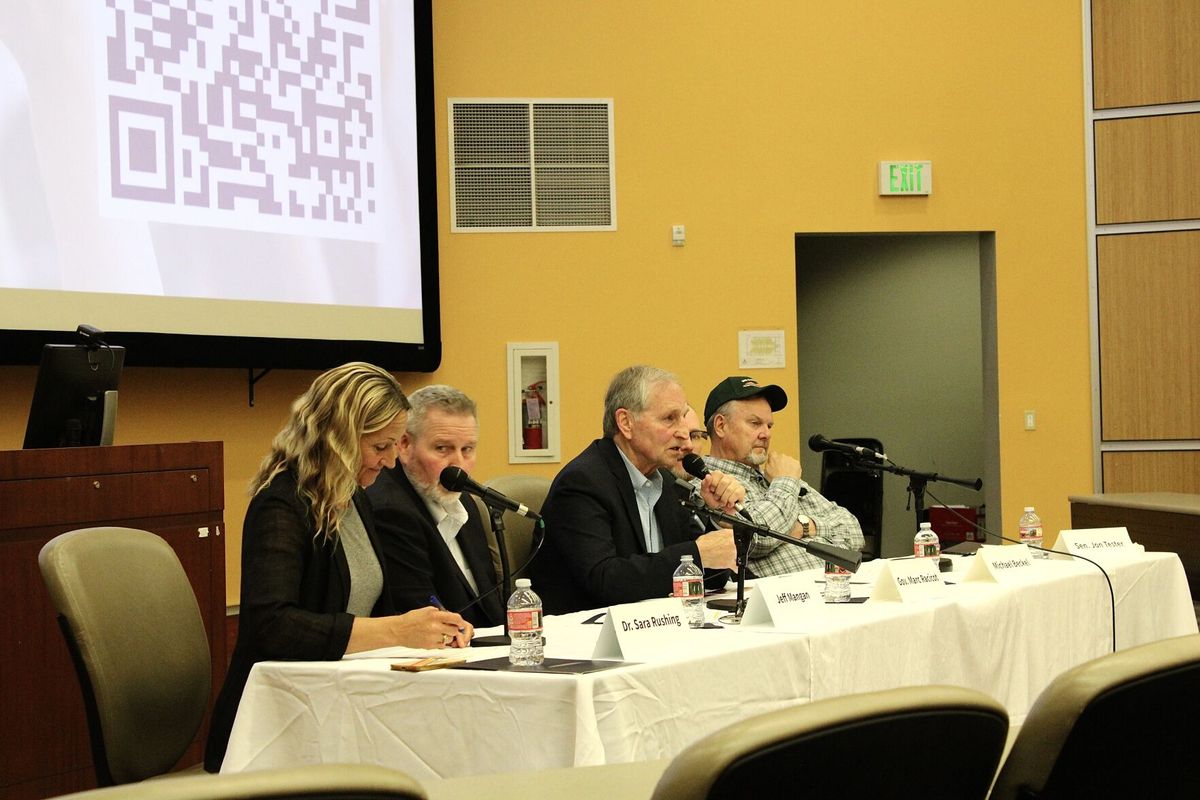
The Public Things Project brought together individuals from across the political spectrum — including former Republican Governor Marc Racicot and former Democratic Senator Jon Tester — for a public panel centered on transparent elections, money in politics and the Montana experience.
The panel was hosted last Friday in Gaines Hall and moderated by political science professor Sara Rushing.
Two other panelists joined Tester and Racicot to present their thoughts on trust and democracy: Jeff Mangan, founder of the Transparent Election Initiative (TEI) and Michael Beckel, a representative for the bipartisan nonprofit public advocacy group Issue One.
The Public Things Project started as a grant for interdisciplinary faculty research at MSU, according to a June 2025 article by the University News Service. This panel represents the final event in the project, which was led by Rushing and Earth sciences professor Julia Haggerty.
This project has featured a year-long series on public things — things that people have in common — such as participation in campaigns and elections. According to Rushing, these shared experiences are at risk in American democracy right now because people have little trust in them.
“There should be a lot of consensus on reforming this public thing, so we can trust our campaigns and elections. So, that is why we wanted to do it,” said Rushing during an interview after the event.
During the panel, Racicot mentioned how embracing public things such as these will help resolve issues such as anonymous corporate funding in political campaigns.
“This effort that we’re talking about tonight is like a floodgate. We want to shut off the river of those corporate funds, and that we believe eliminates those tributaries and it cuts off the snake of corporate funding that leaves our system dirty and disrespected,” he said
Beckel stressed the importance of following the money.
“Dark money in politics makes it impossible to follow the money. When you have wealthy individuals and special interests trying to obscure their involvement, it makes it impossible for voters to know who is trying to bend the ear of our government officials, who’s trying to get pet policy outputs for the amount of money they are putting into the system,” he said during the panel.
Dark money refers to money that is given to 501(c)(4) organizations, which are tax-exempt nonprofits designed to support social welfare, according to an article by Beckel published onpublicwelfare.org in Jan. 2016. Unlike 501(c)(3) groups, companies with the (c)(4) designation can lobby and support political candidates, and do not have to disclose their donors.
“They take that money and they either support or oppose a candidate or an issue without coordinating, without working with that candidate,” Mangan said during an interview before the panel. “Independent expenditures have increased over 2,800 percent since 2008 to 2024,” he said.
Mangan said that the TEI was founded to address this very issue. During the panel, he talked about The Montana Plan, which would restrict corporations from being able to fund political campaigns.
“I put together [the TEI] to combat corporate and dark money in our elections,” he said during an interview before the panel. “As a part of that work, we’re promoting The Montana Plan and similar efforts in not only Montana but across the country.”
Tester expressed support for the TEI’s efforts.
“What this initiative does is it just basically eliminates corporations from donating campaigns because they’re not people,” he said.
Tester emphasized the importance of limiting corporate donations partially because they create more advertisements. “What we've also seen go along with that is very little control of getting ads off the air that are not true,” he said.
For sophomore mechanical engineering student Daniel Shults, hearing Racicot and Tester speak was a highlight of the event.
“Not only their voices are entertaining, but their opinions and thoughts are quite valuable and I greatly am thankful for the experience,” he said.
Attendee Dan LaFrance said he supports the TEI.
“I’m in favor of it because I think that all of our politics should be transparent and we’ve lost a great deal of that. And as Marc Racicot pointed out in his earlier part of discussion, it didn’t used to have to be a concern,” he said.
Rushing concluded the panel by encouraging a different mindset toward democracy.
“Bring joy to the party. Democracy should be fun and joyful and it wouldn't kill you to have dance parties for democracy,” she said.



Comments ()