
'The roulette wheel is spinning': Quammen on the future of pandemics and politics

Science journalist David Quammen predicted the pandemic era eight years before COVID-19. Now, in a year of multiple viral outbreaks worldwide, he warns that the next pandemic scares him less than the paranoid and politicized American public that would have to survive it.
“My prediction is that there will be more scary viruses in the next 10 years,” Quammen said. “If we’re lucky, we can stop them. If we’re not lucky, and if we’re stupid, then we will have a pandemic worse than COVID.”
Quammen was supposed to be in the Republic of Congo this week working on a biography on the late Jane Goodall. He had interviewed Goodall several times while reporting for National Geographic, and had hoped to return to the African forests where they’d first met.
Then, on a Friday morning in May, his computer was suddenly blowing up with news of an Ebola outbreak in the Democratic Republic of Congo, a neighboring country.
“Nobody knew how long it had been going on, maybe weeks,” Quammen said. “And the cases were already numbering in the hundreds.”
The DRC and Uganda Ministries of Health have reported more than 600 cases and 117 deaths, as of June 8. Quammen’s trip was off, and he found himself back in a familiar role.
“These dangerous viruses seize people’s attention and scare them and make headlines,” Quammen said. “The news wants talking heads, and I’m one of the talking heads on the rolodex.”
When the Ebola outbreak hit, Quammen had just wrapped up press appearances about the cruise-ship hantavirus scare from April, where he was repeatedly asked the same question: how worried should people be?
“If you’re not on that cruise ship, you should worry about something else. For instance, bird flu or measles killing children now that they’re not being vaccinated. Or the Ebola virus,” Quammen said. “I was saying this in April, and then boom, a new Ebola virus outbreak starts.”
After years of viral outbreaks sparking international attention, Quammen has grown weary of the news cycle. Not because he doesn’t take outbreaks seriously, but because he rarely feels the stations hosting him do the subject justice.
The hantavirus outbreak, he said, was a case in point.
While the fatality rate is high, especially on a crowded cruise ship, the transmission rate has always been low. By early June, the CDC ended its 42-day monitoring period with no cases detected and no further follow-up necessary. That outcome, Quammen said, was highly predictable but not the narrative mainstream news was looking for.
“It’s frustrating when people just want to hear what the death count was from yesterday, and if it’s going to come to the US to get us,” Quammen said.
Even the Ebola virus is not as contagious as some may believe. The deadliness of the current outbreak, as well as the outbreak of 2014-15 in Western Africa, is undeniable. But Quammen said that has more to do with the circumstances surrounding the virus than the virus itself.
“There was inadequate health care, and a shortage of health care resources and professionals. There had been civil war in those countries for 20 years,” Quammen said. “Because of those circumstances, it became a horrible Ebola epidemic (in 2014).”
During the 2014 Ebola outbreak, nine people carried the virus into the U.S. after traveling to the affected region. Those nine cases never became an outbreak here, and Quammen said there’s a reason why.
“They got top-notch health care under isolated circumstances,” Quammen said. “So they didn’t spread it to anybody else.”
For much of the past half-century, public health infrastructure and pandemic preparedness were generally treated as nonpartisan priorities among politicians and the public. In the past decade, Quammen said that’s no longer the case.
“We are less prepared now in most senses to deal with a pandemic than we were when COVID started,” Quammen said. “We have not just crippled our medical science and public health institutions in this country. We have also had a spread of science denial and demonizing of science.”
Since taking office for the second time, the Trump administration has moved to slash funding and staffing across the federal public health apparatus, including the CDC and National Institute of Health, while also withdrawing from the World Health Organization. A pending rule from the White House budget office could go further still, giving political appointees rather than scientific peer reviewers final say over federal research grants.
But the seeds of the science denial, Quammen said, were planted before Trump’s first term.
He experienced it personally during the 2014-15 Ebola outbreak. On a CNN appearance, Anderson Cooper asked him whether the U.S. should ban flights from Liberia, one of the countries hit hardest by the virus.
For Quammen, there was an obvious answer. Liberia exists because of American slavery in the 1840’s and 1850’s, and he said turning our backs on the country now would be unconscionable.
“Anderson Cooper didn’t blink, the conversation went on,” Quammen said. “Then the next morning a friend called me and said, ‘Dude, do you know that Rush Limbaugh is lighting up his base at your expense?’”
Suddenly, Quammen was crowned Limbaugh’s favorite “liberal moron.” Now, as another Ebola outbreak spreads in Africa, he realizes that the new generation of conservative pundits might label him similarly for pointing out that Trump’s cuts to USAID, which funded treatment efforts in the region, has made things worse.
Quammen is not bothered by the label. Virology is not a political issue, Quammen said, and it hasn’t always been treated as one. He pointed to the President’s Emergency Program for AIDS Relief, an initiative that delivered HIV/AIDS treatment to millions in Africa, as evidence.
“It was a wonderful program, and it was essentially founded by two people: Tony Fauci and George W. Bush, working together,” Quammen said. “So this is not a Republican versus Democrat thing.”
Quammen’s view of science as a casualty of politics isn’t just a national story to him. Closer to home, two researchers at Rocky Mountain Laboratories in Hamilton were charged on June 2 with conspiracy to smuggle monkeypox into the U.S. and giving false statements to federal law enforcement.
On Jan. 25, Customs and Border Protection at Detroit International Airport stopped Virus Ecology chief Vincent Munster and research fellow Claude Kwe as they returned from studying a Republic of Congo Mpox outbreak. Inside their luggage, agents found 113 vials of biological material claimed to be “diagnostics.”
The vials were later found to contain inactivated monkeypox and chickenpox DNA, including regulated Mpox Clade 1 samples. Both face a maximum of five years in prison for failing to declare the materials and lying to federal agents.
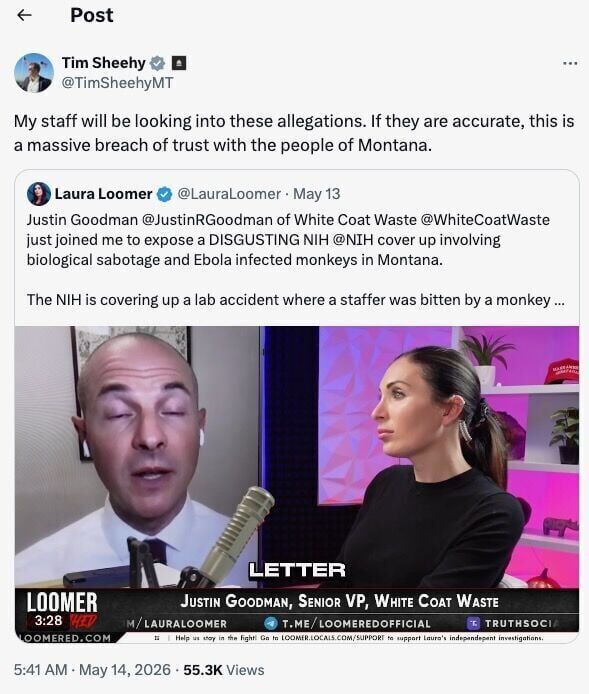
The lab was already drawing political attention before the charges were filed. In a May 17 post on X, conservative activist Laura Loomer alleged that “Fauci holdovers” were planning to “unleash Ebola in America” and pointed to a whistleblower letter claiming a cover-up of “illegal virus smuggling” and a separate monkey bite incident at RML.
Montana U.S. Senator Tim Sheehy responded on social media, then sent a letter on May 26 to HHS’s inspector general calling for an investigation into the lab’s safety and security practices.
“We don’t want Montana to be the next Wuhan,” Sheehy wrote in a May 26 post that included his letter.
Quammen has previously argued the opposite of Sheehy’s implication, writing in a 2023 New York Times Magazine piece that COVID almost certainly didn’t come from a lab leak.
“That narrative is dramatic and conspiratorial,” Quammen said. “It allows people to get angry without understanding things very well, and have a noisy opinion. And that is causing the government to blind us to the infectious disease dangers that we face on this planet.”
Quammen knows one of the two Hamilton researchers personally and said the scientist has always had a good reputation in his field. He doesn’t dispute that what was brought in could carry consequences, but he argued the materials, since they were inactivated, posed no outbreak risk, comparing them to “a box of butterflies.” What troubles Quammen more is the response.
“If the accusations are accurate, he might have gotten in some trouble, but this reaction is not an ordinary reaction to that kind of a situation,” Quammen said. “This reaction looks much more political.”
As the political climate keeps the study of viruses in flux, the viruses themselves remain unpredictable, Quammen said.
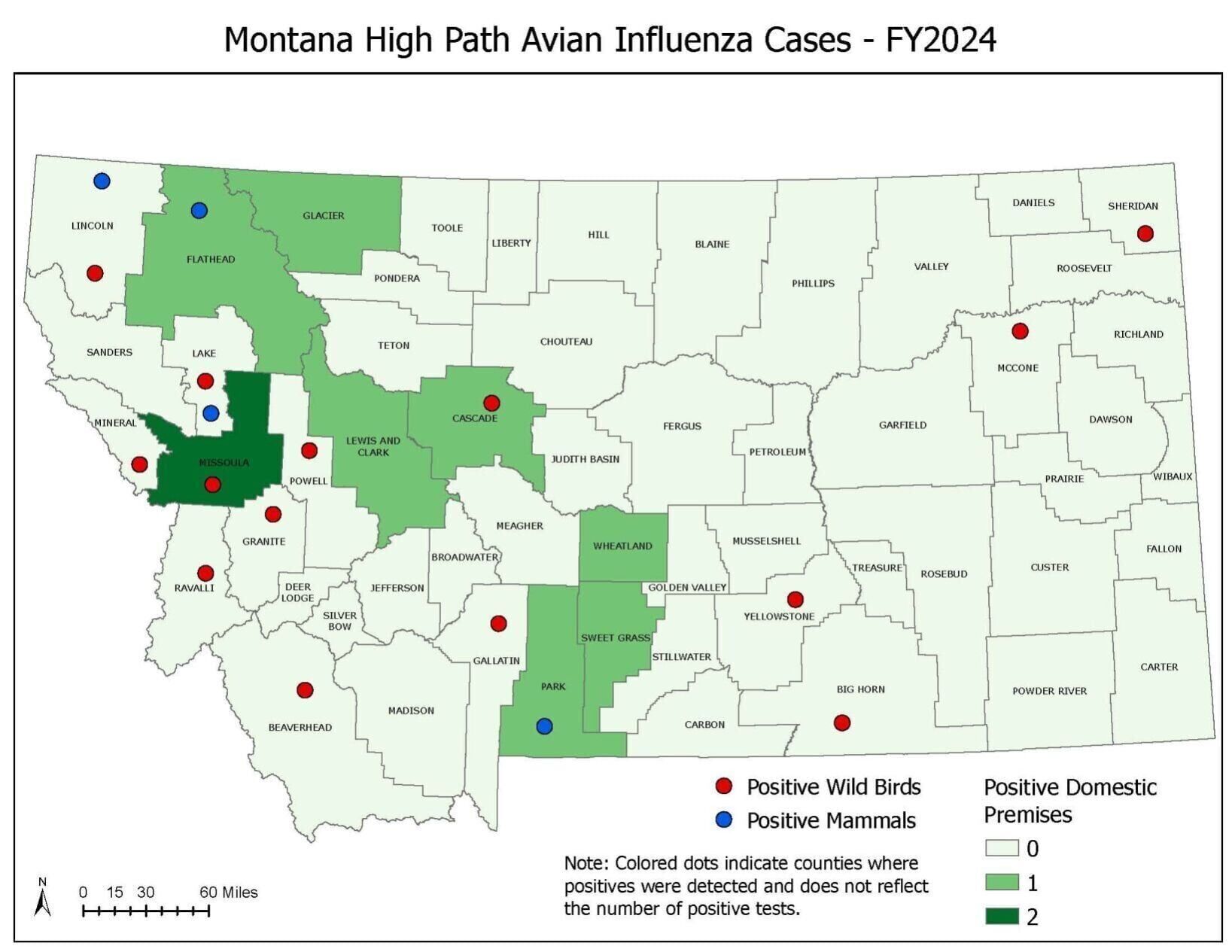
For instance, Bird flu isn’t the virus at the top of today’s headlines. Currently, it rarely spreads to humans, and no person to person spread has been identified.
But as it continues to rip through millions of wild bird populations and domestic flocks, Quammen said its evolution is like spinning a roulette wheel. Spin it once, and the chances of landing on the predicted slot are unlikely. But spin it a million times, and those odds change.
“The roulette wheel is spinning trillions and trillions of times as those viruses replicate and mutate,” Quammen said. “So the chance that it becomes infectious in humans, and transmissible from human to human, starts to become reasonably probable.”
It’s the same wheel Quammen described in his 2012 book. Back then, he warned it was spinning towards a widespread pandemic. Now, he says, no one’s watching it closely enough to know when it stops.




Comments ()