
The unconventional journey of professor Max Maxfield
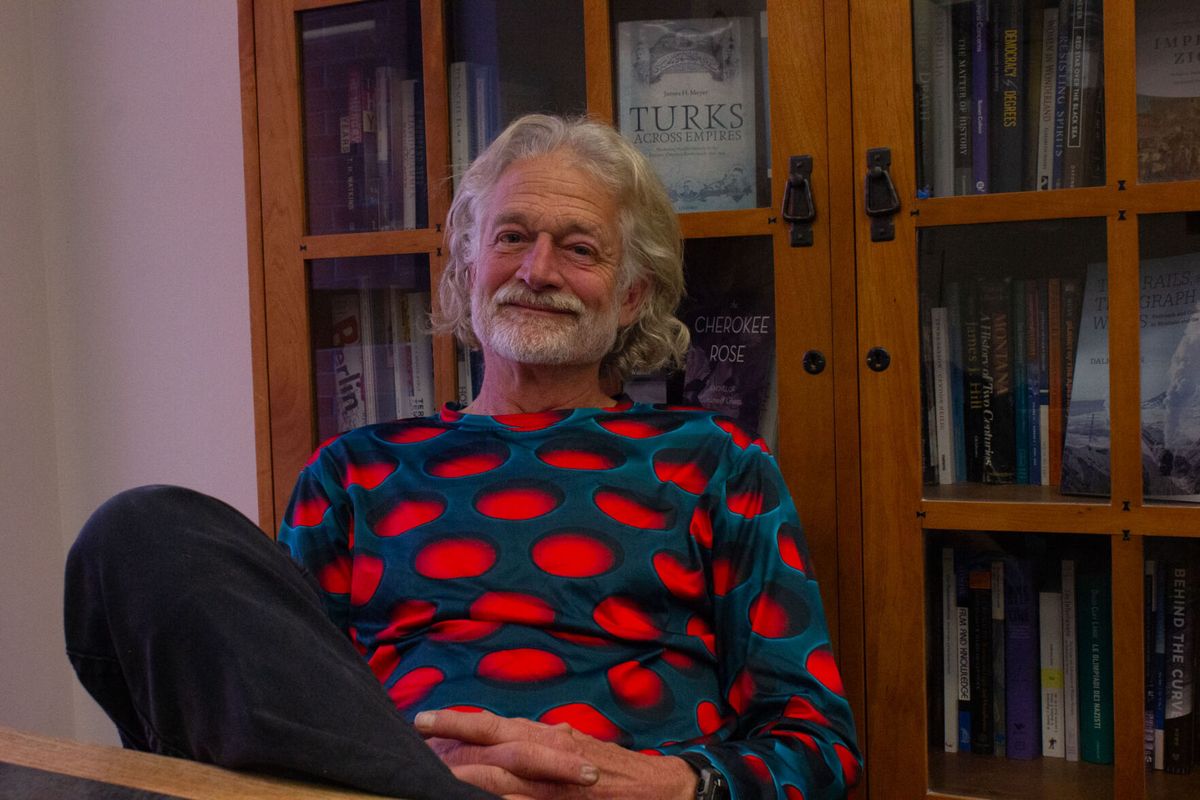
Within the walls of Lewis Hall, discussions of art, technology and life's profound philosophical questions take center stage this semester. Rows of wooden chairs fill the classroom where curious students gather under the guidance of philosophy professor Max Maxfield — recognizable by his signature collection of quirky graphic t-shirts featuring everything from cats to watermelons. However, there’s more to Maxfield than his teaching style and colorful wardrobe — he’s also spent a lifetime as a builder, runner, farmer and nature lover.
In 1958, on the plains of the Midwest, Maxfield was born into an unconventional religious household where the teachings of Edgar Cayce — an American clairvoyant from the late 1800s — were followed. Maxfield continued his education and attended Lawrence University in Appleton, Wisconsin.
“I went to Lawrence believing what I believe about the world because that was what I was taught. So I fell really hard. I fell out of religion in college and became nihilistic in some ways,” Maxfield said.
Maxfield explained that during this time, he distanced himself from religion. His mornings — once devoted to prayer — turned into solitary walks where he would speak aloud, reflecting on the nature of existence and his place within it. Eventually along this path of existential questioning, Maxfield found a new sense of direction in the natural world.
It was the early ‘90s, and Maxfield and his partner were in their late twenties. He recalled just drifting through the seasons, with an eagerness to move closer to family. At the time, his parents were also looking to relocate into the countryside where they could garden and build a geodesic dome to live in. In this search for its location, they happened to stumble upon a small town called Decorah in the northeast corner of Iowa that Maxfield was sold on in a heartbeat. Here, he spent over ten years building the dome, which spanned over 4,000 square feet.
“The owner of the local co-op gave us a tour of the area and it turned out there was this vibrant back-to-land community of people who were trying to grow their own food, build their own structures and live lightly,” he said. “With this sort of, use-it-up, make-it-do or do-without motto.”
In 1995, Maxfield, along with his kids and now former wife, joined the back-to-land community and stayed there for seventeen years. Within the community, there was homeschooling, pagan based religious ceremonies, men and women's groups and, according to him, a deep feeling of connection. With a background in teaching, Maxfield and his partner at the time naturally became involved with the alternative form of schooling.
“We all took turns with our various gifts and specialties holding classes for the kids,” Maxfield said. “It was for various ages, but the kids could all be at my place making bird houses or something like that. So, that was rich. There were no grades or anything like that.”
Through living with the land and sharing its teaching, Maxfield explained that his connection with nature deepened. Which only grew when he was exposed to the public land in the West while on a trip in his late twenties by a dear friend from graduate school and fellow philosophy professor, Don Demetriades.
“I didn’t even know what [Bureau of Land Management] land was, and I [was] just thrilled that as a physically active person, we can just go hiking here across the land without permission? That was a shocking revelation to me and a feeling of freedom and exploration,” Maxfield said.
Maxfield spent years exploring the West with Demetriades — often without maps — wandering trails and bushwhacking through rugged terrain. In 2011, Maxfield officially moved to Pony, Montana, where he curated an organic vegetable farm called Pony Produce from 2013 to 2020.
“I now spend most of my day really close to a flock of [guineafowls,] a flock of geese, some pigs, cats, dogs, chickens — and they are my people. I talk with them,” Maxfield said about his current living situation on his friend’s land outside of Boulder, Montana. “Do I think I’m really talking with them? Well, you tell me. We are one amongst them.”
For Maxfield, this closeness to the natural world is more than a lifestyle; it’s a spiritual practice. It’s not rooted in the supernatural, but in a deep reverence for the interconnectedness of all things.
“I’ve come to think that so much of the cultural and technological turn that humans have made is not in our own best interest. It’s not in our genes. We left the savannah yesterday. We aren’t wired for the kind of urban existence we lead,” he said.
This is reflected in his lifestyle today, one centered around building his tiny house, caring for his plants and being a friend to his animals.
Comments ()