
‘You can really have an impact’: ASMSU looks ahead to new academic year
The Associated Students of MSU (ASMSU) is often overlooked by most students despite its crucial role in shaping campus culture and the student experience. Its elections draw only a small fraction of the student body, with only 6.34 percent of eligible students voting in the Spring 2026 elections.
The Associated Students of MSU (ASMSU) is often overlooked by most students despite its crucial role in shaping campus culture and the student experience. Its elections draw only a small fraction of the student body, with only 6.34 percent of eligible students voting in the Spring 2026 elections.
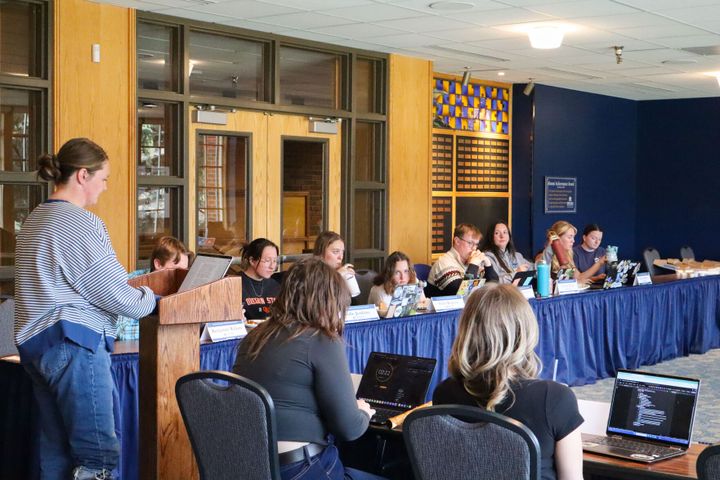
Further, the Student Senate meets every week, often without attention from the thousands of students it represents. Between the emails students sometimes skim and the various campus events students attend, many are not thinking about the team of students working behind the scenes.
This year, ASMSU is trying to answer a difficult question: How do you make a university feel like it belongs to the students? For ASMSU President Ben Wilson, the answer begins with community and for Chief Justice Andy Watanabe, it begins with accountability.
The two occupy very different positions within ASMSU, but their jobs converge around a similar goal.
Wilson — a senior studying liberal studies and environmental economics and policy — serves as the primary student representative on many of the University’s major boards. Alongside the Vice President Josey Blazer, he spends much of his time meeting with campus administrators and offices, learning how the University works and carrying student perspectives into those conversations.
“Our job is basically being that student mediator between the University administration and the ASMSU Senate,” Wilson said.
According to Wilson, this position puts him in a place where he can see the University from several angles at once — moderating between administrators, senators, student organizations and campus programs — trying to connect the different pieces of a university that can sometimes feel fragmented.
He said he has always had a desire to help people, and his time at MSU has helped him understand how he can do that. “I was really motivated to do this because I wanted to help support people on projects or ideas or whatever it is that they’re doing and help them get from point A to point B,” he said.
This philosophy is the centerpiece of Wilson’s intentions; rather than a single pivotal moment or act of government, Wilson finds that a concerted effort addressing student voiced issues will have a lasting impact.
“You can really have an impact,” Wilson said “Look, I want to have a conversation about this, and change can happen.’”
The biggest issue facing students, in his view, is not necessarily one particular academic or financial problem, rather it is the difficulty of finding a community in the first place. “How do you find your people? How do you fit in? How do you feel at home on campus?” Wilson said.
For him, those questions are not merely social. Community can influence whether students remain in school and their academic success, as well as their overall experience.
Wilson said there were times when he struggled to find his own community at MSU. Once he did, he noticed a significant difference. “Once I found it, that’s when it was completely game changing in terms of my experiences, how I was doing in classes,” he said.
This experience has shaped the way he thinks about ASMSU’s roughly $1.2 million yearly budget. Student fees can be directed toward clubs, events and services which creates opportunities that Wilson believes will have a direct effect on student life.
He points to programs such as CatTracks and the Streamline as examples of how student government can produce changes that eventually become part of the broader community.
“There’s an avenue to where you can actually express your opinions.” Wilson said.
Point being — for Wilson it's not simply that ASMSU spends money. It is that ASMSU is a government of students created for students.
This is also why he — and the rest of ASMSU — are concerned about voter turnout.
The most recent ASMSU elections saw a 5 percent drop from the 2025 cycle.
Wilson said increasing that number is less about convincing students that voting is inherently important, but more about showing students what they control. “We have a $1.2 million yearly budget, which is highly determined by students. And students can change how that goes,” he said.
Under his leadership, Wilson wants ASMSU to pursue active tabling and outreach rather than simply waiting for students to seek the organization out. “There’s one thing where it’s like, ‘Hey, we have a resource, stop by, look, here we are. We are here for you — please come talk to us, even if it’s just saying hello,” he said.
If Wilson’s vision is about bringing students into the conversation, Andy Watanabe’s role is about making sure the people already in that conversation play by the rules.
Watanabe is a junior studying psychology and political science. His parents both met while working in national security, and he said he and his brother grew up civically engaged and interested in government.
Watanabe is now considering law school and potentially a career in the bureaucratic or legal side of government. His understanding of government, however, has changed over time.
He grew up in Park City, Utah where he viewed himself as a proponent of small government and felt misrepresented by government institutions.
But as he got older, he said he began to see disengagement as an enemy of progress.
According to him, student government is one of the most accessible ways for students to make lasting change. “Real civic engagement is the only way to make things better,” Watanabe said. “Don’t run from your problems. If you don’t like the way government’s doing something, get involved.”
As chief justice, Watanabe oversees ASMSU’s Supreme Court, which acts as the judicial authority within the student government. The court reviews legislation passed by the Senate to ensure it does not exceed the Senate’s authority or violate the ASMSU constitution or bylaws.
Unlike the president or senators, Watanabe said the chief justice has to maintain a certain distance from the people around him.
He compared the responsibility to the traditional image of Lady Justice, blindfolded and unable to see who stands before her.
“I have to be friendly, but I can’t be a friend to anyone,” he said. “I have to be on this kind of perch above everyone else.” That impartiality can be difficult when the decisions being made affect Watanabe himself as a student.
Last year, Watanabe attended Law Day, where members of the Montana Supreme Court spoke about the importance of putting the law before oneself. The lesson stayed with him. “[In the ASMSU Supreme Court], you’re viewing the law through almost empirical eyes rather than subjective eyes, and applying only the law,” Watanabe said.
He also relies on the other six members of the Supreme Court to challenge individual biases.
“Everyone’s going to have a little bit of bias,” he said. “But seven people can kind of check each other enough.”
While Wilson sees community as the foundation of student life, Watanabe sees civic participation as the mechanism for protecting it. He believes universities have a responsibility to prepare students for that reality, whether through restrictions, education or new ways of teaching students to work alongside emerging technology.
But ultimately, both students return to the same idea: the student body needs to recognize that they have influence.
And that begins with simply walking through the door.
For more information on ASMSU, visit https://www.montana.edu/asmsu/.

Comments ()