
50th Anniversary event celebrates Montana Constitution
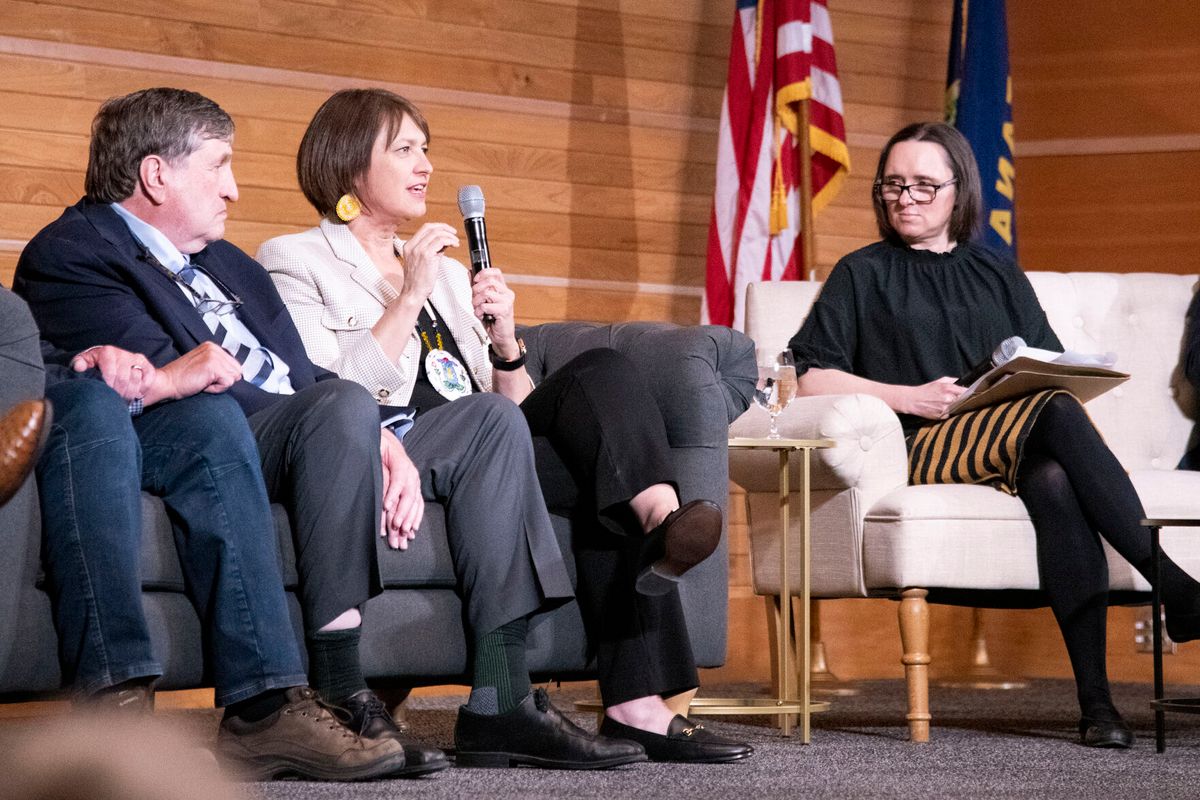
This week 50 years ago, a delegation of 100 Montanans gathered in Helena to sign into law a new constitution for the state of Montana — a historical event commemorated on Tuesday, March 22, by a panel discussion reflecting on the document with Montana elected officials, journalists and members of the Constitutional Convention itself.
Sponsored by Montana Free Press (MTFP) and MSU, the event was the culmination of a project by author and MSU alumna Sarah Vowell and journalists from MTFP that recorded interviews with Montanans involved in the convention, known as “Con-Con” for short, which will be archived for the public at MSU’s Renne Library. The Con-Con was convened in 1972 to replace the state’s previous constitution — which was ratified in 1889 when Montana was officially granted statehood — strengthening the power of the state’s government and laying new groundwork for transparency, environmental protection and Native American cultural education.
The new constitution was developed over 60 days of discussion and research by the delegates and ratified on June 6, 1972. Elected officials were barred from participating in the convention, so the people who created Montana’s governing document were ranchers, lawyers, business owners, students, veterinarians and even a beekeeper.
As the convention began, the delegates were seated in alphabetical order to minimize differences in political orientation.
“That was a tremendous influence,” said Mae Nan Ellingson, the youngest delegate and a graduate student at the University of Montana at the time, in one of the newly-archived interviews. “It made all the difference in the world.”
Ellingson was a member of Tuesday night’s panel, which also included former U.S. Ambassador and convention staffer Max Baucus, former Governor Mark Racicot, former Public Instruction Superintendent Denise Juneau and AP journalist Charles Johnson, who covered the convention extensively during his career. The discussion, led by Vowell and MTFP Editor-in-Chief John Adams, explored the structure and key provisions of the constitution and contextualized the document in today’s political atmosphere.
A key characteristic of the document, according to the panelists, was that it established more flexibility for the Montana legislature to create and enforce laws by framing big-picture principles for governance rather than attempting to codify minute lawmaking details. “It allowed the legislature to legislate,” Ellingson said.
Con-Con was a unique and “welcoming” place compared to Montana legislative sessions because all but one executive meeting was open to the public, Johnson said. The delegation accepted proposals and suggestions from members of the public and heard public comment as the draft was being created. Tyerra Roan, a Hilleman Scholar at MSU, read one statement from Fort Peck High School student Mavis Scott that led to the Constitution’s requirement that students be educated about Native American culture.
Describing the “rich and diverse ethnic groups making up the people of the state of Montana,” Scott told the delegates, “We hereby request the state of Montana to recognize the need for the inclusion of culturally sensitive curricula within the public education system adapted to the ethnic groups within the area of the school district.”
Juneau said the advocacy of students like Scott, who addressed a delegation that did not include a single Native American, was powerful. “We owe a lot to those young women and young men who were coming to the Constitutional Convention to advocate to see themselves reflected in this document,” she said.
The panel also highlighted the Constitution’s unique “right to know” provision, which requires citizens to be able to view government documents and watch meetings of government and public agencies unless individual privacy demands otherwise. Prior to the convention, Johnson said transparency was more difficult to come by and could be hidden behind closed door meetings, for example. “I would argue it’s a critical part of the Constitution,” he said. “People need to know what their government is doing to know if they support the government, don’t support the government, or whatever.”
“When you know that everything you say or do is subject to being printed rightfully and as a matter of due course, you don’t say or do anything that you don’t want printed,” Racicot said.
The Constitution would likely not have had a right to know provision if elected officials had been eligible for the delegation, Baucus said, a testament to “the wisdom of the Montana Supreme Court,” which was the court that ruled these officials ineligible for the convention. He also said a resolution about legislative transparency he passed during his tenure in the U.S. Senate was inspired by the provision.
Racicot said the delegates created not only a physical social contract but a “spirit” of confidence in and respect for one another, and that the delegates were bound by a “moral code that includes dignity and decency and consideration of everyone on Earth.”
“We are at a moment in the history of our country where we are facing significant turmoil and challenge, and sometimes it feels like we’re abraded at the edges and being torn apart at the seams,” Racicot said. He asked the audience to reengage with each other to recenter on the spirit of the Constitution.
In addition to the oral history project, which will be available at the Renne Library, MTFP is publishing a series about the history and future of the Constitution in its newsletter throughout the week.



Comments ()