
Alpha Sig sparks lawsuit and zoning backlash
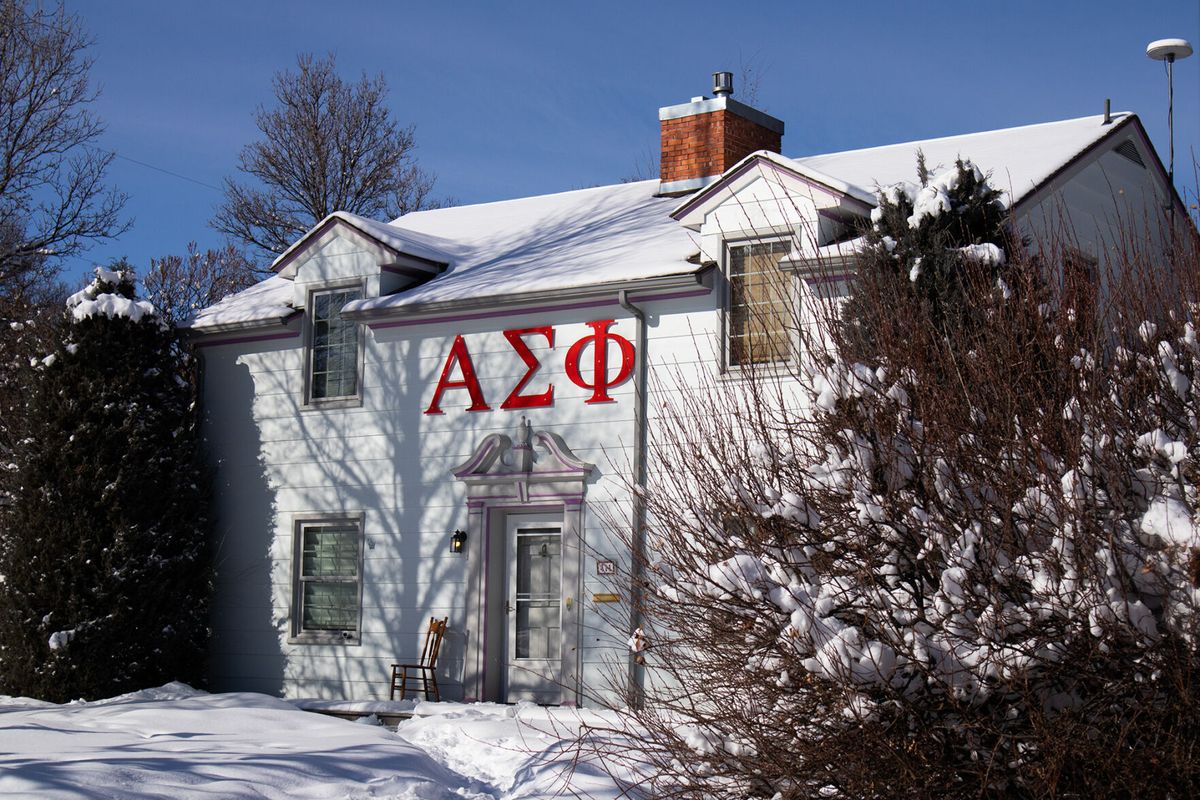
Within a single year of moving into 411 W. Garfield, the MSU chapter of Alpha Sigma Phi has been accused of hazing and underage drinking, suspended by the Dean of Students Office and placed on “alcohol-free” status.
Yet, that may be the least of the problems facing the embattled brothers, whose frustrated neighbors have not only sued them but are attempting to restrict future Greek houses with changes to city zoning.
“Nothing has boiled over like I’ve seen with Alpha Sigma Phi,” said Matt Caires, MSU’s dean of students.
The fraternity’s neighbors have proposed a zoning amendment to the City of Bozeman’s Unified Development Code that would ban any new fraternities or sororities in low-density neighborhoods citywide. The amendment would not affect existing Greek locations such as those east of campus. However, no new Greek houses could ever be established in that neighborhood again.
Many of the same neighbors have also sued Alpha Sigma Phi, the chapter’s landlord and the City of Bozeman itself. All defendants are accused of “nuisance and aiding and abetting nuisance.”
The City of Bozeman is additionally charged with “failure to enforce zoning regulations,” as well as “arbitrary and capricious actions regarding zoning regulations,” according to court documents obtained by the Exponent from Montana’s 18th Judicial District Court in Gallatin County.
“It’s clear the neighbors are not pleased with having these guys living in this house operating as a fraternity,” said Caires. “I’ve asked the fraternity to think about what’s a better location for them.”
Neighbors aim to zone fraternities out
Kathy Powell is one such neighbor.A retiree living near 411 W. Garfield, Powell is named as the applicant on a proposed zone text amendment currently under consideration by the City of Bozeman. Her proposal argues that single-family homes are simply too small to house a fraternity.
“It doesn’t have a central area to meet. But they have 50 members. So if you have members, you want to get together, that’s the point right? They need to have a house that can accommodate their members instead of in the front yard,” she said.
The Unified Development Code currently classifies fraternities and sororities as “group living,” according to a statement provided by City of Bozeman spokesperson Takami Clark. “Group Living is permitted in all zoning districts except UMU, BP, M-1, M-2, and PLI,” according to Clark.
The proposed zoning amendment would reclassify Greek organizations as a distinct category to restrict them to high-density zones such as “R-4, R-O, B-2, B-3, REMU zoning districts as principal uses, and conditionally in the R-3 zoning district,” Clark said.
Most of the neighborhoods to the north and east of campus consist of low-density zones like R1 and R2, according to the Community Development Department’s GIS map service. These areas would be off-limits to future Greek chapters.
The Montana Code Annotated stipulates that a proposed zoning amendment will be reviewed by city staff and the community development advisory board. Both parties will give their recommendations to the city commission, with whom the decision ultimately lies.
“The city commission is the ultimate arbiter of the proposed change and makes the final decision” according to city spokesperson Clark. “If approved, an ordinance is created to formally adopt the change(s).”
Powell’s amendment proposal was heard by the community development advisory board on Jan. 23, when the board was originally expected to vote on the issue. However, as of Feb. 14, the group has been granted two “continuances,” the latter of which is “unspecified” in duration, according to the meeting’s minutes.
This means the neighbors will have more time to refine their proposal to better meet the requirements of city staff before it is eventually voted on by the city commission.
“We’re hopeful they can find a solution to it in the [development code],” Powell said.
Powell herself is not one of 14 plaintiffs named by the lawsuit against Alpha Sigma Phi. However, several of those who gave public comment in support of her zone text amendment are.
Parties pose a nuisance
According to a complaint filed in court by attorney James H. Goetz, his clients are homeowners who “enjoy the pleasures and benefits of a beautiful, leafy and peaceful neighborhood,” one with “attractive well-maintained yards and quiet streets.”
However, that all changed “sometime in the late winter of 2021” when “the quietude of the neighborhood was interrupted by loud throbbing noise, which some might call ‘music’,” according to Goetz’s complaint.
The complaint describes the plaintiffs' main grievance against Alpha Sigma Phi: a series of parties that escalated over the course of 2022. These parties resulted in serious noise and parking nuisances for the plaintiffs, especially at late hours, read the complaint.
“For those gainfully employed, as well as those retired, a good night’s rest each night is critical. The meetings and parties of a men’s fraternity tend to be nocturnal,” the complaint said.
As relief for the nuisances they endured, the plaintiffs seek that the Gallatin County Court order Alpha Sigma Phi to vacate the premises at 411 W. Garfield by the end of 2023 and that the fraternity end all gatherings before 10 p.m. in the meantime.
Furthermore, the plaintiffs seek “mandamus and injunctive relief against the City of Bozeman” for its alleged mishandling of zoning regulation. This would involve Gallatin County Court ordering the city of Bozeman to reinstate language regarding Greek organizations in the development code prior to 2018.
The plaintiffs claim this would “prohibit the establishment of fraternities in residential neighborhoods.”
MSU is not a named defendant in the lawsuit, however Goetz’s complaint mentions the university. The document describes a meeting the plaintiffs had with Caires and members of the fraternity in the spring of 2022, months before the lawsuit was filed.
“At that meeting, the neighbors aired their grievances, fraternity members attempted to placate those concerns and the MSU Dean of Students, and other officials attempted to mediate,” the complaint reads. “After that meeting, the fraternity tamped down on its raucous activities” for the remainder of the spring semester.
However, a series of particularly boisterous parties the following fall led the neighbors to further doubt MSU’s control over the fraternity. The plaintiffs were unimpressed with the response of University Police, who allegedly “sometimes do not even get out of their vehicles,” according to the lawsuit.
The plaintiffs were equally displeased with the university’s “Fraternity and Sorority Function Notification” registry, claiming that a loud party occurred on Oct. 8, even though an MSU associate dean informed them none would be taking place.
These incidents led the plaintiffs to conclude that “MSU has either turned a blind eye to the activities of Alpha Sigma Phi house or lacks the necessary will and resources to enforce MSU’s fraternity regulations.” They filed their suit just 13 days later on Oct. 21, 2022.
“It’s important to remember that filling in a lawsuit presents only one side of an issue,” said University Spokesperson Mike Becker. “MSU does not intend to weigh in on a suit it isn’t party to. The courts will decide on the matter in due course.”
The case is currently awaiting a “partial summary judgment hearing” according to Goetz. The court will have the option to issue a limited ruling on certain charges against the City of Bozeman only, potentially averting a full-blown trial.
Limited authority restricts MSU intervention
Caires said the university can’t weigh in much further than it already has unless there’s an issue that poses a threat to students’ lives.
“I think originally the neighbors were expecting me to shut them down,” he said. “I’ve had to work with the neighbors to understand that we don’t shut fraternities down for playing ping pong, being loud and drinking beer.”
Although he was sympathetic to the neighbors' concerns, Caires said there were limitations on his office’s authority. “We don’t own fraternities, we don’t control them. They are off-campus properties,” he said. “Anytime we take any adverse action — disciplinary action — it’s under our authority in the conduct code.”
Caires said he does not have the authority to evict fraternities on his own. He can only do so with the support of the fraternity’s national chapter, as he did with Sigma Alpha Epsilon in 2018.
“It gets really uncomfortable if the university says ‘Alpha Sigma Phi violated our rules and we’re kicking them out’ and their national organization says ‘no, we’re going to continue to recognize them’. Then we have an unrecognized fraternity in our community which gets even more dangerous,” he said.
Instead, Caires has disciplined Alpha Sigma Phi for violating the student conduct code.
“We interim-suspended Alpha Sigma Phi last fall for allegations of alcohol violations and hazing. They are currently on alcohol-free status as a result,” he said.
According to Caires, the responsibility to enforce these restrictions falls upon the Interfraternity Council (IFC), an elected group of fraternity brothers who represent all of MSU’s fraternity chapters.
Both the IFC and Alpha Sigma Phi declined to comment. IFC President David McGinnis said the matter is still not settled and a solution could be months away.
“As we are currently a named party in a lawsuit involving this topic I cannot comment on this matter,” said Alpha Sigma Phi president Ian Crosbie, although he did give public comment about the concerned neighbor’s zone amendment.
Addressing the community development board on Jan. 23, Crosbie said things were adversarial with the neighbors as soon as the fraternity moved in. “One of the first mentions from some of our neighbors was about how they had evicted students in the past,” he said. “We were not welcome with open arms.”
“I will not admit fault, I’m not gonna say we’re innocent though,” Crosbie said. “Let the court handle it, and I say keep everybody else out of the crossfire.”



Comments ()