
American Indian Heritage Day event remembers historical violence, promotes healing
“Everything you do will affect seven generations” was a refrain Eduardo Duran returned to repeatedly as he addressed a crowd of over 100 members of the community during an American Indian Heritage Day event on Friday, Sept 30. The event was an uplifting celebration of Indigenous heritage that emphasized healing from generational trauma.
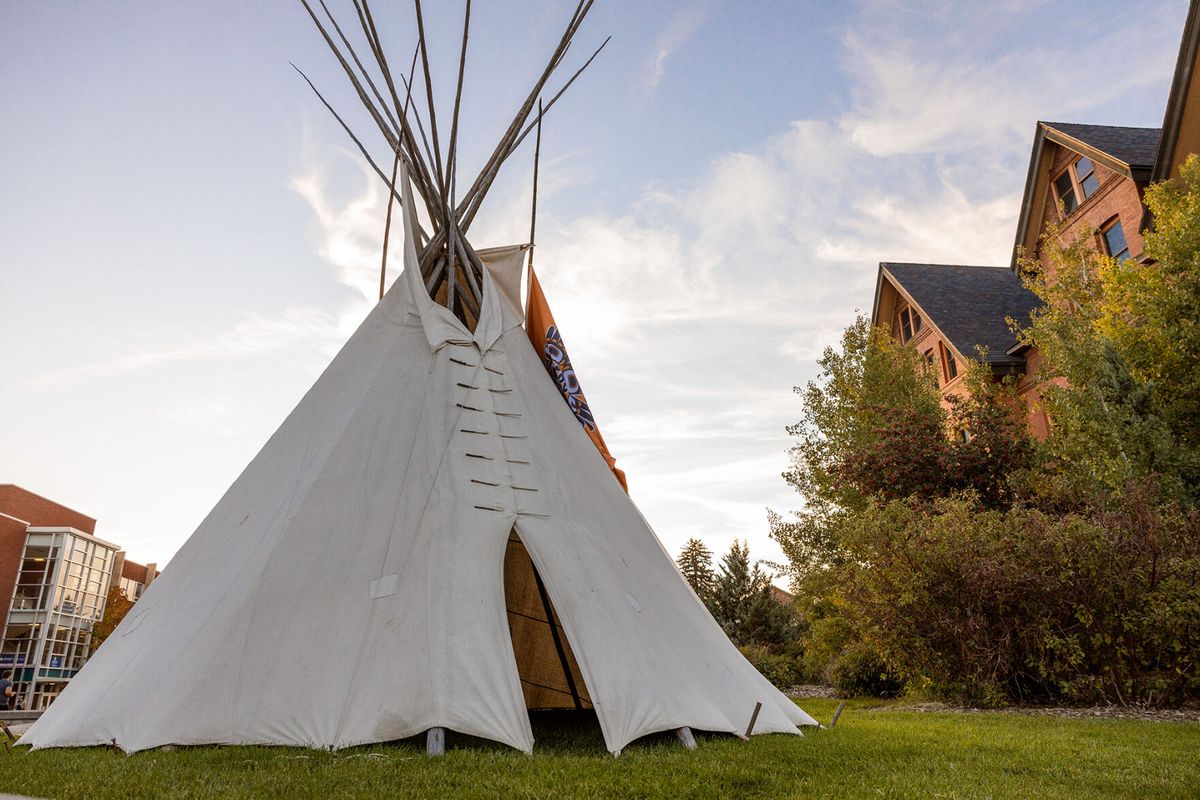
The focal point of this year’s celebration was a prayer walk through campus. The procession was led by indigenous students and faculty who proudly waved the flags of Montana’s indigenous nations overhead. Towards the end of the walk, participants paid a visit to the teepee erected in front of Montana Hall. The teepee was adorned with an orange flag in honor of missing and murdered indigenous youth.
This year’s celebration of American Indian Heritage Day was the first ever to take place in MSU’s American Indian Hall. The newly constructed facility serves as a home not only to the American Indian Studies program but for MSU’s indigenous community in general. In alignment with legendary Lakota visionary Black Elk’s belief that “there can be no power in a square,” the new hall is round. Flexible classroom and gathering spaces surround a central lounge area where indigenous students gather to study, share meals and relax.
Janice Kai, a graphic design student and Diné (Navajo) descendant who attended the event said the intimacy of the lounge was “just like coming to your auntie or grandma’s house”. Indeed, the lounge is frequently permeated by the smell of baking bread and fresh pie.
On American Indian Heritage Day, the lounge smelled of bison stew and fresh fry bread provided free of charge to all attendees by University Culinary Services.
The majority-native space is in stark contrast to MSU’s 93% white student body and its 91% white faculty, figures reported by the Office of Planning and Analysis’ demographic statistics. Kai said she struggles with MSU’s lack of indigenous instructors, frustrated that her use of Diné iconography is not always respected by white professors.
“A lot of stuff that I put in my designs is very sacred to my culture. [Professors] would either purposefully misinterpret it or just brush it off,” Kai said.
The mood at the event was generally celebratory, but at times quite somber. Attendees viewed an educational installation along the hall’s walls which recounted the painful history of residential schools. Residential schools were a crucial tool in the United States’ oppressive quest to “kill the Indian, save the man.” The installation described how residential schools—many of them Catholic — relied on humiliation and violence to assimilate young natives into their newly colonized world and isolate them from their indigenous heritage.
Duran dealt with the legacy of these schools, and colonialism at large through his work as a psychologist in remote reservation communities. A Vietnam war veteran of Apache and Tewa heritage, Duran began his psychology career in the military but grew weary of his work “integrating a human into a weapon system.” His familiarity with victims of PTSD informed his later work developing what he now calls “trauma-informed counseling.”
While pursuing his doctorate at the California School of Professional Psychology, Duran was tasked with developing a mental health program for a mountainous reservation community. This proved difficult when his western training failed to resonate with his indigenous clients.
Frustrated, Duran reached a breakthrough when he began to sense the presence of others during his clinical sessions, he said. He realized that in order to heal his clients, he would need to heal the spiritual wounds of their ancestors as well. “The only place we can heal is the realm where the injury occurred,” Duran said.
Despite witnessing “transformations in the consciousness of Indian country” during his lifetime, Duran considers his people’s healing process to be far from complete. He criticized the United States government for never issuing a formal apology to the victims of the reservation schools.
If the colonial government were to reconcile with Native communities, Duran believes “great medicine would emerge from the land itself.” However, he cautioned that “if we don’t do it now, we might not be here much longer.”


Comments ()