
Artists selected for art exhibits in the new American Indian Hall
With plans to open the new American Indian Hall on campus in the fall of 2021, a committee has chosen three artists to display major pieces of art in the new building. The committee, which consisted of representatives from across campus and members of Montana’s Native community chose Bently Spang, Robert Martinez and Stacia Goodman to exhibit their pieces.
Bently Spang is a Northern Cheyenne multidisciplinary artist, writer and curator who lives in Billings, Montana. His work has been exhibited widely in North America, South America and Europe, and it uses technology to tell timeless visual stories. “My homeland, the Northern Cheyenne reservation, is a place I draw strength from and at the same time, it needs our protection. It holds our histories, families and cultural information and is crucial to the survival of our cultures. It’s a stronghold for our identity,” said Spang. Spang plans to install a series of video monitors in the shape of a large Plains Indian war shirt in the American Indian Hall. The monitors will also display synchronized videos of fire, water and tribal communities in Montana and surrounding regions. the region.
Robert Martinez is a Northern Arapaho who is based in Riverton, Wyoming. Much of his work incorporates historical imagery, myths and stories of the West and Arapaho culture, combined with modern themes to generate images that symbolize the issues of today. His paintings in the new hall will engage the viewers by using vibrant colors and contrasting shades of light and dark to reflect the multifaceted Native culture.
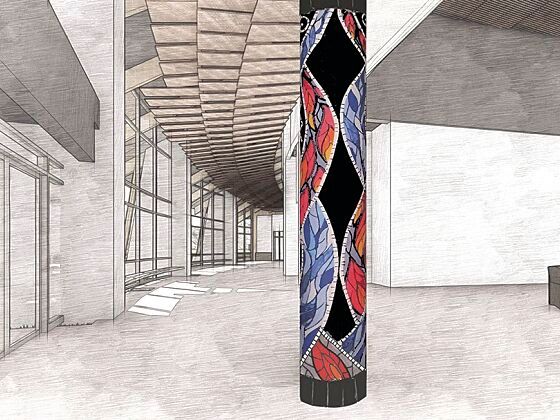
Stacia Goodman is an artist and storyteller who resides in Minneapolis, Minnesota. She pieces together thousands of tesserae to portray narratives that invite viewers to study and reflect upon themselves. These mesmerizing mosaic patterns are made with a mix of materials, including shimmering art glass, reflective mirror pieces, handmade tile and found objects. Goodman said, “I’m incredibly honored and humbled. It took years of dedicated work to make the new American Indian Hall happen, so this project is especially meaningful to me.” Goodman will be making a lively mosaic of intertwining fire and water spirits on a column from the floor to the ceiling at the main entrance of the new building.
Major Robinson, the Cultural Design Liaison for the project and part of the selection committee, said that he believes the entire building will be a living piece of art. The Native plants that will be greeting visitors outside the building, and the eagle feather canopy to the culturally-infused drum room that will be crafted from what Robinson called 100-year-old “grandfather spruce, thoughtfully harvested and preserved on site to make room for the new American Indian Hall,” will create a lively atmosphere when surrounded by the amazing art soon to be displayed.
Aside from being a center for beautiful Native art, there is heartfelt emotion behind each piece, too. Spang explained what he hopes his displays in the hall will mean for Native American students at MSU, saying, “It’s a challenge to leave the comfort and safety of our extended families and our homelands to get an education, I experienced it when I left home for college. Hopefully this piece can help the students in their transition to this new challenge in their lives and stimulate dialogue around our Native homelands, both urban and rural, and their power and the challenges they face.”
Robinson said, “Each space one passes through is an invitation for all who enter to discover more about tribal peoples and hopefully realize the value they add to Montana State University,” according to MSU News.
MSU graduate and architect Dennis Sun Rhodes proposed the American Indian Hall in 2005, and it became a reality in 2018 when MSU President Waded Cruzado announced plans to construct the building on the university’s annual Indigenous People’s Day. Currently, the American Indian Student Center is located in a 1,100 sq. ft. basement room in Wilson Hall. Soon, this center will transition to the new $20 million building that is currently undergoing construction on the eastern edge of MSU’s Centennial Mall. The building will also hold numerous classrooms, an auditorium and a room that can be used for both ceremonies and as a dance studio. Ultimately, the hall will serve as a bridge between American Indian culture and other cultures on campus.
In addition to these works of art, 26 artists have responded to requests for projects that will highlight the building’s major themes of water, fire, earth and air. A call for other artists by the committee will open next year. Although the American Indian Hall will not be completed for another year, students can watch from the other side of the fence as each component comes together.


Comments ()