
Bill McKibben speaks on fossil fuel divestment
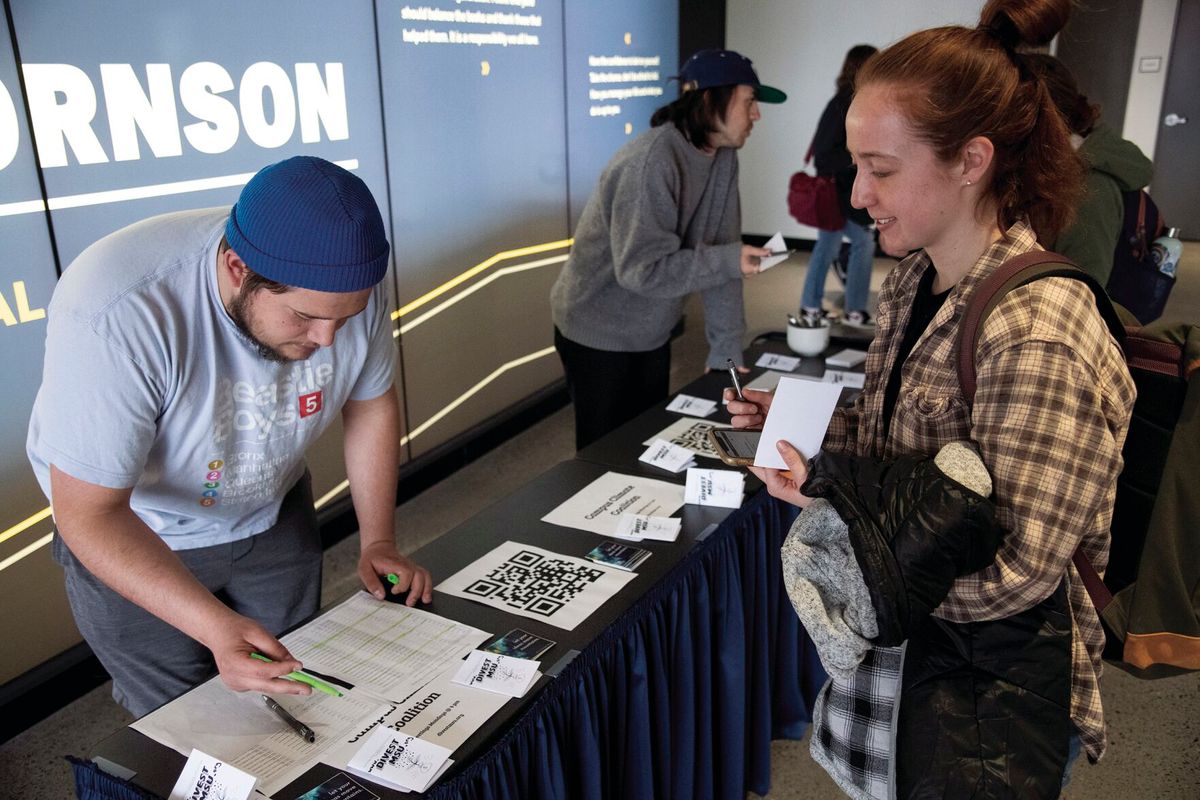
Bill McKibben, a famous environmentalist and author, participated in a discussion at MSU on Wednesday, April 6, exploring the future of investment in fossil fuels.
McKibben, author of 1989 book “The End of Nature,” which is considered one of the first books on climate change written for the public, was invited to speak by the Campus Climate Coalition (CCC), a student-led group advocating for the Alumni Foundation to divest the university endowment from fossil fuels. A working group formed in the fall by the Alumni Foundation, which manages the endowment, is studying strategies for divestment.
CCC organizers said they planned the event to be a chance for students to discuss the role of university endowments in the divestment movement, and an opportunity for “building off the idea of institutional change,” organizer and political science student Zach Knoll said in an interview prior to the event.
“I hope people see it as a learning opportunity,” Jacob Northcutt, an organizer and history graduate student, said. “To just talk through the implications and maybe even the nitty gritty of how divestment and reinvestment might happen.”
Divestment originated in the 1980s, when college students demanded companies use it to economically isolate the South African government in protest of apartheid. The fossil fuel divestment movement, of which McKibben is a leading advocate, began in the early 2010s.
McKibben began the discussion by making his case for divestment from fossil fuels, citing the recent report on mitigating global warming by the Intergovernmental Panel on Climate Change (IPCC), which identified a decrease in the cost of solar energy and wind energy since 2010 of 85% and 55%, respectively.
Human dependence on fossil fuels was the “engine that drove modernity,” McKibben said, but we’re “at a point in human history when that dependence is no longer necessary,”
A 2020 report released by the Montana Institute on Ecosystems predicted that extreme heat events, forest fires and drought worsened by climate change will damage human health across the state if fossil fuel emissions aren’t reduced.
The authors of the IPCC report wrote that, according to climate models, greenhouse gas emissions must peak before 2025 to limit average temperature rise to 1.5 degrees celsius – a threshold scientists consider necessary to avoid the most severe impacts of global warming – and that the majority of global energy production must come from low-emissions sources by 2050.
McKibben argued that MSU is “rightly proud of its commitment to greening the campus, building LEED certified buildings, and doing all that kind of work,” and that the endowment should be considered an element of campus falling under the same improvement.
Speaking from a WebEx video call, McKibben then answered questions from attendees of the event in Inspiration Hall and online about his activism. He highlighted sustainability efforts and activism by young people as one of the reasons he’s remained optimistic through years of advocating about climate change, and said this was also the reason for him starting Third Act, an organization recruiting people older than 60 to help with sustainability efforts.
“It certainly began to worry me that we were taking the most difficult problem on the planet and assigning it to 17-year-olds to solve,” McKibben said. “Like in between algebra, homework and field hockey practice, would you mind saving the world too?”
One audience member asked about the inclusion of nuclear power in low-emissions sources of energy, which McKibben believed was not cheap enough to supply clean energy at a quick enough pace, though he said existing plants should stay open.
Another attendee asked about the increased demand for mining of minerals such as cobalt and lithium, which are required to construct renewable energy devices such as wind turbines and solar panels and have created social justice issues like worker exploitation. A 2020 report by The World Bank estimated more than 3 billion tons of minerals and metals will be needed by 2050 to meet the demand for sustainable renewable energy development. McKibben’s stance was that human rights issues must be considered to “make sure that mining is as benign as possible” and that transitioning to clean energy will protect human health by averting damage caused by harmful inhalation of particles from fossil fuel combustion, for example.
As the working group discusses divestment, the Alumni Foundation has paused investments in fossil fuels and is conducting a positive environmental, social and governance screening, meaning identifying investment funds with companies that operate sustainably and transparently and commit to social justice values, for example. The working group plans to present possible strategies for divesting to the Board of Governors, which will ultimately decide what path to take, in May.


Comments ()