
“Black Montana history is Montana history”: Celebrating Black History Month
“Black Montana history is Montana history. Black people have been in Montana since before Montana was a state,” said Jasmine James, the MSU Library’s service desk bridge supervisor. “Black history is American history — from 1776 and before.”
February is Black History Month (BHM) in the U.S. The month-long celebration of Black life, history and culture can be traced back to 1915, when historian Carter G. Woodson participated in a national celebration of the 50th anniversary of emancipation, according to the Association of the Study of African American Life and History (ASALH). In the following decade, Woodson and the ASALH promoted a week that celebrated Black culture and history. The shift to a month-long celebration began in the 1950s and garnered widespread recognition in the late ‘60s primarily among college students. BHM was officially recognized by Congress in 1986.
This year, MSU clubs and organizations hosted celebrations in February for Black culture and history. While this is by no means an exhaustive index of all events that were held, the ones covered in this article were put on by the MSU community.
“Hip-Hop Bash” with the Black Student Union
To kick off BHM at MSU, the Black Student Union (BSU) hosted a “Hip-Hop Bash” to celebrate and honor Black hip-hop artists. The event was held in the Strand Union Building (SUB) on Monday, Feb. 10. Attendees were invited to appreciate different eras of hip-hop, show off dance moves and grab food.
BSU President Chanielle Rice explained that the BSU hoped to engage students with a shared love of music and provide education and tributes to the artists.
“In Black culture, our music is so important to us because it stemmed from centuries and centuries of oppression,” Rice said. “It's important for people to not only understand the history of hip-hop but of music in general, because a lot of people don't recognize where their music comes from.”
The BSU was started in 2017 and is now run by Rice. “I found BSU at Catapalooza and we’ve been locked in ever since,” she said. “[BHM] is to commemorate Black history and Black lives and celebrate our culture and I think the best way to do that and get all people together is music.”
“When we understand where things come from, we can have a deeper appreciation for them and for the people that came up with it,” she said.
“Douglass Day” with the Library
On Feb. 14, the MSU Library hosted the inaugural “Douglass Day” event in honor of Fredrick Douglass, an African American social reformer and civil rights leader.
“I would argue that Frederick Douglass was a voice for the people — a voice specifically for the unheard — because he was able to act as living proof that Black people are not inherently illiterate,” said the library’s Service Desk Bridge Supervisor Jasmine James. “He had such an interesting life.”
The event was primarily organized by James and Wendy Purnell, the library's Research and Creativity Director. “Douglass Day” was run in conjunction with the Library of Congress (LOC) and featured a crowdsourced transcribe-a-thon. Transcribe-a-thons usually involve a collaborative effort to turn physical texts into accessible online copies.
“That's the part of the crowdsourcing transcription that we really love — helping students engage directly the original materials and learn from the actual words of these people,” Purnell said.
In addition to celebrating Douglass, the library aimed to highlight the work of MSU reference librarian Lucille Smith Thompson and her sister, Alma Smith Jacobs, who was the head librarian at the Great Falls Public Library from 1954 to 1973. During Thompson’s time at MSU from 1964 to 1985, she was the only Black faculty member. She was a champion for making literacy accessible and diverse, according to the library.
Trading cards made by the library for the “Douglass Day” quoted Jacobs in a 1967 interview with the Great Falls Tribune: “I resent being thought of as a Negro librarian. I would rather concentrate on being a good librarian.”
As a result of the nationwide collaborative effort to preserve texts, the LOC’s server crashed at around 11 a.m., James said. “There were about 10,000 documents that needed to be transcribed [in] total. In the first hour, nationwide, we transcribed 5,000 documents,” they said.
”The only way to maintain continual access to items that the physical paper has wasted away is to transcribe them,” James said.
“African Cultural Night” with the African Students Association
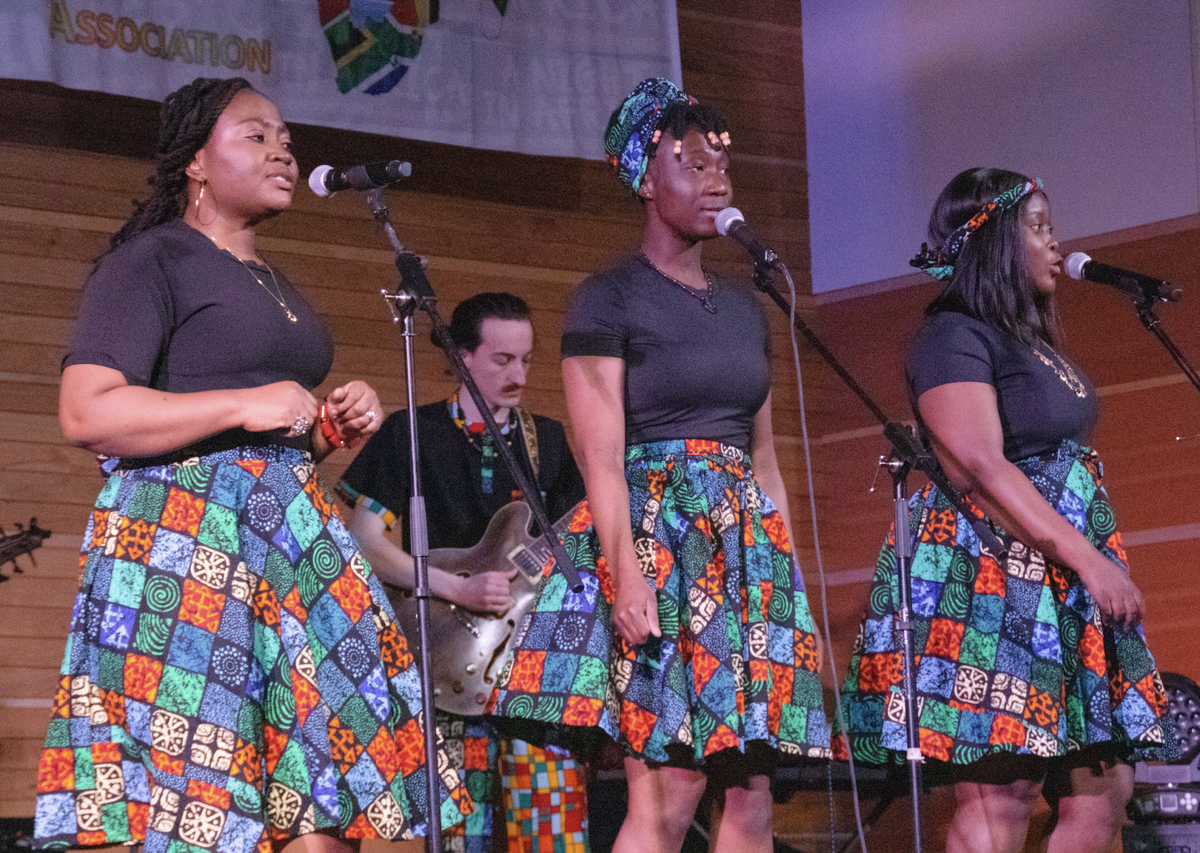
On Saturday, Feb. 22, MSU’s African Students Association (ASA) hosted its annual “African Cultural Night” in the SUB ballrooms. The evening began with food and a live rendition of The Warrior’s song “Osisiba” by the ASA.
University Police Department Chief Michael Stanley, the association's “adopt-a-cop” and guest speaker for the night, shared his admiration for the ASA and the resilience of international students. “Each one of these club members carry with them the strength of their heritage, the wisdom of their ancestors and the ambition to make a meaningful impact here at MSU and well beyond,” he said.
He encouraged students to challenge their inner biases and recognized the efforts of community members who work toward inclusivity. His speech included a brief overview of African landmarks and ended with a nod toward the ASA’s leadership and cultural impact. “Diversity is not something to be acknowledged, it’s something to be celebrated,” he said. “To [the ASA:] your leadership, your academic excellence and your cultural contributions make [MSU] a better, stronger and more inclusive place.”
The night’s performances showcased various African traditions, including a Nigerian wedding, a reenactment of an Asante chieftaincy ceremony, cultural dance performances and a rendition of Yvonne Chaka Chaka’s “Oumqombothi” by the ASA students.
Assistant professor Israel Borokini — a former international student — shared his thoughts on the difficulties he and members of the ASA have faced. “Sometimes we do get a lot of prejudice against students, a lot of racial prejudice against them, even against me as a faculty [member]. I've experienced a lot of things,” he said.
Borokini praised MSU’s support, including the funding of the “African Cultural Night,” but called for more instructional support for international students. “[These students] spend thousands of dollars traveling to come here alone, and so a little bit of encouragement will go a long way in helping them acclimatize with the environment,” he said.
“Crafting and Public Comment Training” with Forward Montana
On Tuesday, Feb. 25, Forward Montana (FM) — a youth-led civic engagement organization — hosted a “Crafting and Public Comment Training” in the Cultured Community Center in Bozeman. To celebrate BHM, FM incorporated a presentation on the significance of quilting and fiber arts in Black history.
According to Lyla Brown, a senior organizing manager for FM and co-founder of MSU’s BSU, quilting has long been a form of storytelling, resistance, activism and empowerment. “Originally, [quilting] started as a necessity. Mostly it's because [enslaved] people got scrap fabric, so they're like, how can we create something that's whole?” she said.
Brown led a presentation detailing the historical significance of quilting in Black history — specifically the role it had in the Underground Railroad (UR), a network of secret routes and safe houses used by enslaved peoples to escape slavery pre-Civil War. According to Brown, quilts served as a form of symbolic and secret communication between enslaved peoples trying to access and move through the UR.
Brown explained the significance of two important symbols: the monkey wrench pattern, which is believed to have been a symbol signaling for people to gather tools and weapons and the wagon wheel, which signaled enslaved peoples to pack all their essentials. Other symbols include the log cabin for safe houses, the north star for heading north and bow ties for a nearby clothing supply.
Brown said that as time has passed, quilting symbolism has shifted into folklore, possibly due to history being unrecorded because of widespread illiteracy at the time. “Growing up learning about quilting, I always understood it to be the truth. [My family] has quilts that have been passed down, many have some of these iconic symbols,” she said.
Whether these remaining patterns are folklore or simply lost history, Brown said she still finds significance in the concept. “It's an empowering thing that people have been verbally told about over generations,” she said.
Together, these events sought to celebrate Black history and legacy. Though Black and African American residents represent only 0.64% of the Bozeman population, Black people are an essential part of Montana’s story. In their interview during the library’s “Douglass Day” event, James noted that racial identity does not singularly define individuals within a culture.
“My favorite thing about being in Montana is that, while it is notable and sometimes uncomfortable to be the only Black person in a space, it is not the most interesting thing about me,” they said. “And it is not the thing that people latch on to when learning about me.”
To find out more about the BSU, visit
https://montanastate.campuslabs.com/engage/organization/bsu.
To read more about Thompson and Jacobs, visit https://archive.org/details/negroinmontana181970thom/page/n5/mode/2up.
To find out more about the ASA, visit https://montanastate.campuslabs.com/engage/organization/africanstudentassociation.


Comments ()