
Blood, sweat, blue and gold: How the Cat-Griz game unites Bobcats through five generations
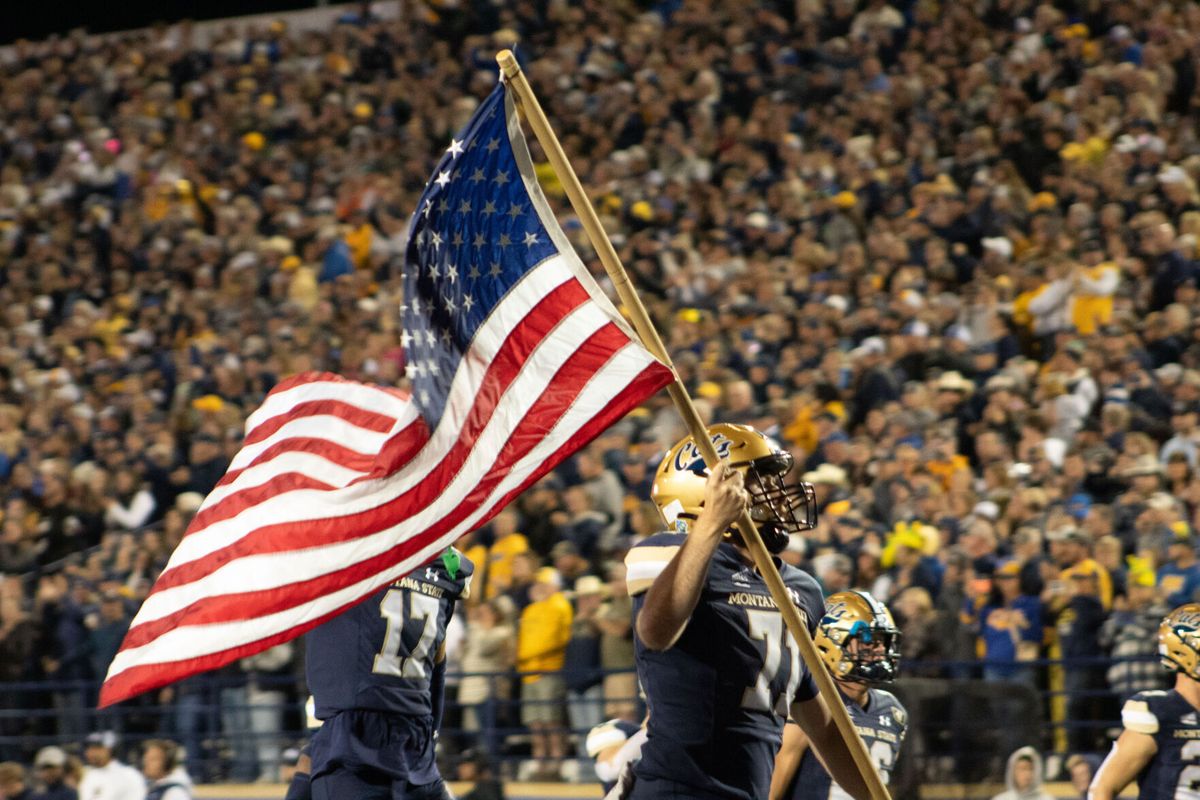
For MSU football, the game isn’t just played on the field — it’s passed down through generations.
The Cat-Griz game — which was nicknamed the Brawl of the Wild in the late 1990s — is a fiery rivalry game involving two Montana universities: MSU and University of Montana (UM). With MSU’s 11-0 record, fans everywhere hope for a twelfth triumph for the Bobcats. While this season has been successful thus far, there are decades of players who have set the foundation which fuels the rivalry today.
Born and raised in Butte, Dan Hodge began his football career with MSU in 1963. Hodge, a former running back and defensive back, has been inducted into multiple halls of fame — including the National Coaches Hall of Fame and Butte Sports Hall of Fame — previously wore jersey number 43. The current player tasked with carrying on Hodge’s legacy — along with those who previously wore 43 — is linebacker McCade O’Reilly.
“The one thing I’ve always done since I have played — I always know who’s wearing number 43,” Hodge said.
Though the rivalry between MSU and UM is well known today, Hodge explained that in the ‘60s, he didn’t realize there was a rivalry until he became an upperclassman in high school. “1965 was the first time they ever broadcast the game statewide on television, ever. There were a lot of people, probably like me, that weren’t involved in it too much,” he said.
Despite Hodge not knowing about the rivalry until his late high school years, he quickly found himself entangled in it, attributing this to former head coach Jim Sweeney. “My first real introduction to [the rivalry] was when I arrived at [MSU] in 1963. My coach made us well aware that — and he had some choice words for them — we had to beat [UM].”
Hodge played in — and won — three ‘Cat-Griz games between 1964-1966. He now makes it a point today to attend every home game. “If you’ve been at a home game, you’ve seen me at a home game. I’m one of the bald boys on the field and I’ve been doing it for 19 years,” he said.
Joe Johnson, who started his career with the MSU Bobcats as an offensive guard in 1971, eventually went on to play as a center from 1972 through 1974.
Johnson, who grew up in Bozeman, has always had a love for the sport. Though his football career began in 1971, he had always been a die-hard Bobcat. “I never liked the Grizzlies. My father always said, I don't care where you play football in college, just don’t play it in Missoula,” Johnson said. “When I was in high school, the Grizzlies were very good, and they were playing for national championships, but I still wanted to be a Bobcat.”
He noted the importance of the annual Cat-Griz game, not only for himself and other players but for the fans involved. “In the state of Montana, you’re either Bobcat or Grizzly. Whatever happens on that day, you have to live with it for another year — you don’t want to lose to them. It was that way in the ‘70s, and it’s that way now,” he said. “The fans feel the same way.”
Johnson described the week leading up to the Cat-Griz game as special and full of tension as a player. “I think that [the coach’s] preparation was sharper, and our preparation was sharper because we knew what needed to happen on Saturday if we wanted to beat the Grizzlies.”
Josh Perkins, a former defensive back, played with the Bobcats from 1995 to 1999. Unlike Hodge and Johnson, Perkins was born out-of-state and began playing football at age 10. He chose MSU as his top football pick, noting that with no professional in-state team, “kids look up to UM and MSU as the standard for football. I know that was a selling point for me coming from Hollywood — them telling me, you’re basically like NFL players out here, you’re like pro players.”
Though Perkins did not get a chance to beat the Griz during his time with the ‘Cats from 1995-1999, this didn’t hinder his positive experience with the team.“You go through so much stuff with your brothers in the locker room, especially with the [local] Montana guys — they care so much about it, it almost forced you to care as much about it.”
Perkins’ direct involvement with the MSU football team ended in 1999, though his legacy has continued through his lineage. As of the 2024 season, Perkins has three sons playing on the team — Justus, Jaren and Jaden Perkins. He explained that his greatest joy is that his sons would avenge him against the Griz.
“We're big Disney and Star Wars fans — I was Master Yoda that took the L, and then they came in and [avenged] me,” he said, calling light to the current successes of the 2024 team. “That’s probably one of my biggest things — that they were able to come in and get that victory that I could never get, and hug me afterwards, and say they got it done.”
Travis Lulay who played as a quarterback for MSU from 2002 to 2005. The beginning of Lulay’s college football career marked an end to one of MSU’s losing streaks against UM. Lulay reflected on his freshman year, in which the Cat-Griz game determined whether MSU or UM would hold a share of the Big Sky Conference Championship.
“It was a low-scoring, hard-fought game,” he said. “Our defense played great. We scored just enough points on offense and won. Then it was like an uncorked bottle of emotion and excitement about Bobcat football. It felt like weight was lifted off our shoulders.”
Lulay then expressed the importance of the rivalry to his team. “I mean, there were grown men crying on the field after the [Cat-Griz] game. I knew it meant a lot to a lot of people. It was much, much bigger than just our team,” he said. After this game, his team went on to beat the Grizzlies three more times, winning three Big Sky Championships.
In addition to the importance of the rivalry to the players, Lulay shared an instance that emphasized the importance of support from viewers. “That first year — in 2002, when we were playing in Missoula — we needed to play a sound football game,” he said. “The stadium is just dead quiet, and the snow is swirling, and we’re going ahead, but our sideline is going crazy, our little section of blue and gold — I mean, it was like it happened yesterday. It made the difference in the game.”
After his college career, Lulay went on to play professionally in the Canadian Football League (CFL) for 13 years, retiring in 2019.
West Wilson, who was a preferred walk-on for MSU, played safety from 2013 to 2017.
Wilson was raised in Missouri as part of a family that played, coached and watched football. “I don’t think I really ever even thought about it, it’s just something that’s always been. It’s been a part of my life since the day I was born,” he explained.
During his first three seasons with the ‘Cats, Wilson encountered difficulties when it came to playing against the Grizzlies, though he ended his college career on a high note. “I felt like everything changed once [Jeff] Choate was the head coach,” Wilson said. “I think he wasn’t afraid to acknowledge that [Cat-Griz] was a bigger game, and it mattered and people cared.”
Wilson, who has since moved from Bozeman to New York, expresses his continued pride for the MSU Bobcats, saying that he makes sure people know where he’s from. “I love it. I’m proud of it. I think game day in Bozeman is electric — that’s home, and it’ll always be home. It’s one team I’m proud of and that’ll never change.”
With this year’s Cat-Griz game taking place this upcoming Saturday, Wilson had this to say for the 2024 Bobcat football team: “Even if they don’t see it every day, there are so many alumni all across the country that are proud of them. I think this year has just been so cool,” he stated. “There are so many people proud of them that use football as a way to represent Montana and the school they went to, and there's no better time to be a Bobcat than now.”
Hodge, Johnson, Perkins and Lulay each shared a similar sentiment, expressing their pride not just for the players, but for entire generations who have taken the time to engage in and support Bobcat football. As best said by Lulay: “Go ‘Cats!

Comments ()