
Bozeman tenants demand action from city commissioners on short-term rental policy
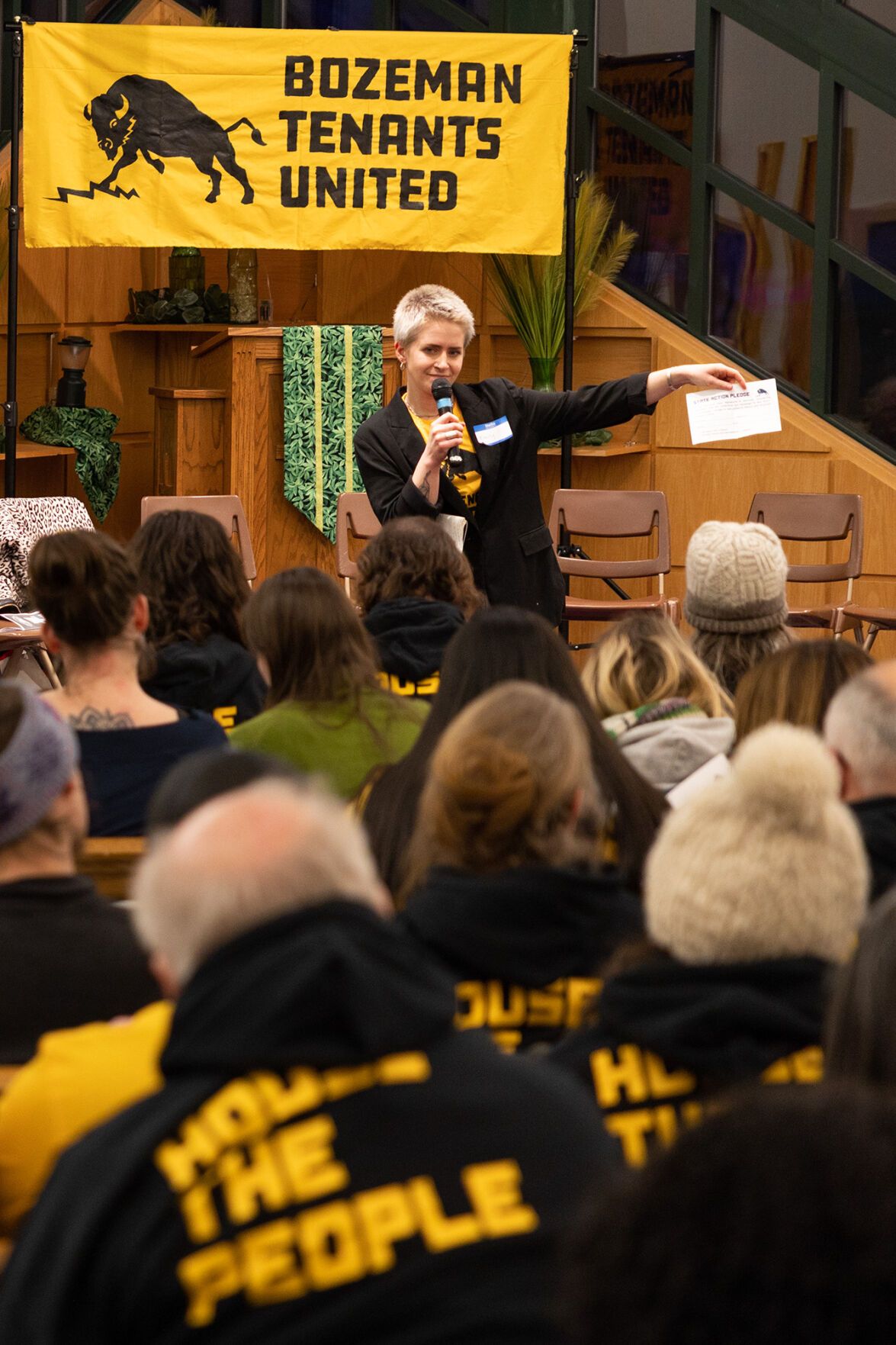
“That ain’t right.” This was the phrase that echoed around the UCC Pilgrim Church last weekend as Bozeman tenants gathered to share their experiences with housing in the city and advocate for new policies.
Members of Bozeman Tenants United, a volunteer-run organization advocating for affordable housing in the Bozeman community, gathered with over 250 supporters and four city commissioners to address the impact of Airbnbs and short-term rentals on long-term tenants in Bozeman.
The gathering, which was a joint town hall and a special city commission meeting, provided a unique opportunity for constituents to share their stories and address their representatives directly about affordable housing.
Bozeman Tenants United is urging city commissioners to ban Type 3 and Type 2 short-term rentals. Type 3 rentals are properties that are never occupied by their owner and serve the primary purpose of being a short-term rental. Type 2 rentals are properties such as guest houses or duplexes that are unoccupied by the owner. Type 2 and 3 bans would open up more long-term rentals and increase the availability of affordable housing in Bozeman, according to BTU.
The union is also urging the city to use its existing community housing fund to subsidize and incentivize homeowners to convert their short-term rental properties into long-term rentals.
“So many of us are made to feel very alone when we’re experiencing this housing crisis. But the thing we’re fighting against is actually systemic,” said Bozeman Tenants United spokesperson Emily Lashelle.
A majority of city commissioners attended the meeting, including Commissioner I-Ho Pomeroy, Commissioner Jennifer Madgic, Commissioner Christopher Coburn, and Deputy Mayor Terry Cunningham. Mayor Cyndy Andrus did not make the meeting.
Several Bozeman residents shared their stories during the first half of the meeting. One resident, Brianna Hope, a single mother of three, described her struggle to find a place to live. Hope had trouble getting an appointment to see rentals - seeing properties is typically required for applicants - and had to take time off work when she did get appointments. Additionally, she was asked to have perfect credit and make at least three times the amount of rent in monthly income. Even when working three jobs, Hope could not find a rental property. “When you have been homeless, people think you’re lazy or irresponsible. But that is just not the case,” she said.
Leota Kelsey also spoke on her experiences with eviction and homelessness while working and raising a child. “We are the people doing the essential jobs,” she said. “If we want to keep our economy and our city, we need people to work in it, and they need housing too.”
The personal accounts were followed by a question panel with city commissioners and BTU members. Commissioners were asked if they would support a Type 3 and Type 2 rental ban, as well as using the existing community housing fund to subsidize homeowners to convert short-term rentals to affordable long-term housing.
To hold city representatives accountable for their answers, BTU volunteers distributed red and green paddles, as well as a “waffle paddle” to all attendees. Audience members were encouraged to hold up their waffle paddles when they believed commissioners did not provide straightforward answers.
When commissioners failed to change their answers despite a sea of waffle paddles, there were some heated interactions.
Deputy Mayor Cunningham faced criticism when he advocated for state House Bill 430, which would provide a subsidy for homeowners to convert short-term rentals into long-term rentals using revenue from STR funds, as an alternative to the city’s community housing fund.
“Local housing fund is the fund that helped create the local warming center,” said Cunningham, who believes there are alternative uses for the fund that should be prioritized over a subsidy.
While all four city commissioners present at the meeting opposed using the community housing fund as a subsidy, Commissioner Coburn and Commissioner Madgic expressed support for a Type 3 ban, as they said it may open up more long-term rentals for Bozeman tenants.
None of the city commissioners have committed to supporting a Type 2 ban. “I have had friends in this town who have used [type 2 short-term rentals] just to make it,” said Commissioner Madgic.
While the commissioners cannot guarantee any type of short-term rental bans, they all committed to ask city staff to research the benefits. “We’re in the process of investigating all the options,” Madgic said.
Cunningham discussed using other growing cities’ affordable housing solutions as models. “One of the things we’re going to direct [city staff] to do as part of the research is to say what have peer communities done? Has it worked, and what should we be doing?”
Tia Goebel, who graduated from MSU in 2018 and lived in five different places during her four years as a student, felt that the tenant representation at the meeting was encouraging. “I felt proud to hold the identity of a tenant for the first time in my life,” Goebel said.
Goebel urged students to become active in local politics. “Even if you’re here for a year, two years, three years, four years, if you want to stay here longer, this is your community. The community needs student participation and student voices,” she said.
Lashelle noted that a short-term rental ban is only a first step towards affordable housing for all. “The fight will not be over. This is just the first campaign,” she said.
BTU provides a mutual aid network for students and other Bozeman residents looking for housing. Students can become a member through @bzn.tenants.united on Instagram. Membership fees are pay-as-you-can.


Comments ()