
DEQ and BLM seeking input on planned Montana and Wyoming pipeline project
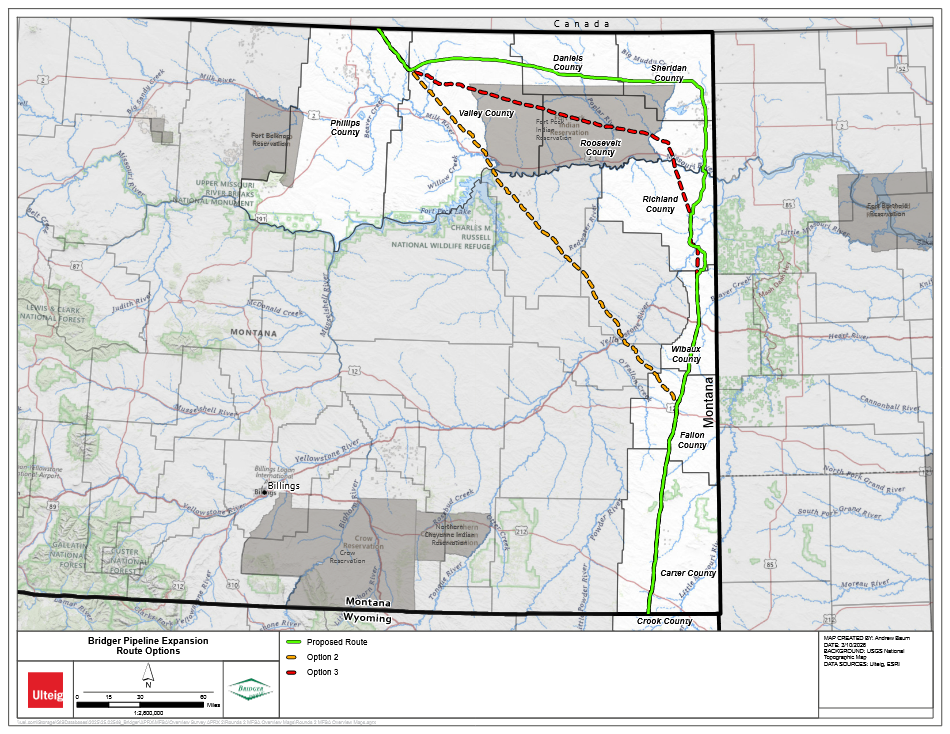
A project intended to bring oil from the Canadian border down through Montana to Wyoming is now seeking public input on its planned route for its 647-mile pipeline.
The route enters into Montana from a currently undisclosed location in Canada.
It crosses Saskatchewan border in Phillips County traveling through Daniels and Sheridan counties before taking a hard turn south several miles away from the North Dakotan border and exiting Montana through Carter County. The pipeline will then head to Guernsey in southeastern Wyoming where a future company can then build the infrastructure to take the oil on down to refining facilities like Cushing, Oklahoma and the U.S. Gulf Coast, according to Bill Salvin, spokesperson for Bridger Pipeline.
It’s neither the most direct nor likely most cost effective route for the 36-inch-diameter pipeline, especially when compared to two routes also identified on a map.
However, the company behind the project, Wyoming-based Bridger Pipeline, has pointed out that with 80% of the project on private land, 10% on state land and another 10% on federal land, it should help with the permitting process.
Other routes would have gone through tribal land on the Fort Peck Indian Reservation and would be adjacent to the Charles M. Russell National Wildlife Refuge, likely leading to further governmental reviews. The project’s current route plans to be developed alongside some of Bridger Pipeline’s existing infrastructure to help bolster the construction process.
Public hearings are set to be hosted by the Bureau of Land Management on April 14 in Glasgow, April 15 in Miles City and virtually on April 16. All will be held from 5-7 p.m. Details about the expansion can be found at deq.mt.gov/energy/assistance.
Keystone XL planned to cover some of the same territory as this pipeline does. However, the route would have taken a more direct route crossing and adjacent to Native American lands, leading to lawsuits and protests over the pipeline’s development. The Keystone pipeline was meant to transfer controversial oil sands crude from Canada into the United States. The product was considered by environmentalists and former President Joe Biden to be more harmful to the environment than should be allowed with refining, given the more arduous processing methods.
Bridger has not disclosed publicly whether it will transfer the same oil sands crude, also known as tar sands.
The currently proposed pipeline will cost Bridger nearly $2 billion in Montana alone and will be capable of providing 1.13 million barrels per day, though it is expected to only carry about 550,000 barrels daily based on market conditions. Based on 2024 numbers, that would be about a 12.5% increase on the amount of oil exported from Canada into the United States.
The peak capacity of Keystone was estimated to carry 830,000 barrels of oil per day.
Trump has expressed a willingness to see a revival of the Keystone since the start of his second term as he pushes further production of fossil fuels in the U.S. Though the company now holding Keystone assets, South Bow, has shown little public willingness to try the same pipeline again after losing billions in their last effort. Nonetheless, they have shown willingness in reviving portions of it. Reuters reported in late February that South Bow was in talks with Bridger on the American side about a partial Keystone resurrection plan, a source within the Canadian government told the media outlet. Roughly 93 miles of pipeline is currently sitting idle on the Canadian border after the Keystone project was canceled.
Bridger spokesperson Salvin declined to confirm the account to the Billings Gazette.
Bridger’s project would likely need an approved presidential permit to cross the U.S.-Canadian border. It’s something that can be revoked by future presidents and proved fatal in the development of Keystone before it after Biden revoked the permit over environmental concerns. Trump has already shown a willingness to grant presidential permits to pipeline projects in Montana. Last summer, he approved a permit for a company that had never built a pipeline before after an application had been dormant for years.
If all goes as planned in the permitting process, Bridger’s project will likely be completed before Trump’s term ends.
Salvin previously told the Montana State News Bureau that construction would begin in July 2027 given the attainment of all necessary permits. In its 195 page siting application, the company estimated that the project’s construction would take about 12 to 18 months.
The company’s DEQ application noted the 2015 Yellowstone River spill that happened under Bridger’s watch, giving the company a controversial history in Montana. Though the application seemed to downplay the spill, noting that the pipeline was built in the 1960s, was purchased by Bridger in 2004, and had no regulatory faults at the time of the spill. The document stated the company now has a better leak detection system formed since the incident.
“Throughout the response Bridger worked closely with Federal and State partners to minimize any impacts and Bridger was applauded by its partners at all levels on the swiftness, efficiency and effectiveness of the response,” the company wrote.
Bridger was ultimately fined $1 million by DEQ after 50,000 gallons of oil leaked into the Yellowstone River near Glendive, in addition to millions in related federal and state penalties.


Comments ()