
Display of pride flag becomes flashpoint in clash between students, admin over response to death threats
Update: On July 9, 2025, former MSU student Rex Wu pled guilty to one count of cyberstalking, which included sending threatening messages to MSU's Queer-Straight Alliance and to former student Alexandra Lin. He faces five years of imprisonment, a $250,000 fine, and three years of supervised release. His sentencing will take place on Nov. 6 at the Russell Smith Federal Courthouse in Missoula.
The display of pride flags on campus became a flashpoint last week in a clash between students and MSU administration over the university’s response to recent death threats directed at the Queer-Straight Alliance (QSA) and Young Americans for Liberty (YAL).
The debate originated with frustration among students about the lack of a public response by university officials to the QSA death threat and was meted out in a heated conversation on the floor of the student senate Thursday night, March 23. It ended with a statement from President Waded Cruzado to the MSU community Sunday afternoon, an action university officials originally opposed.
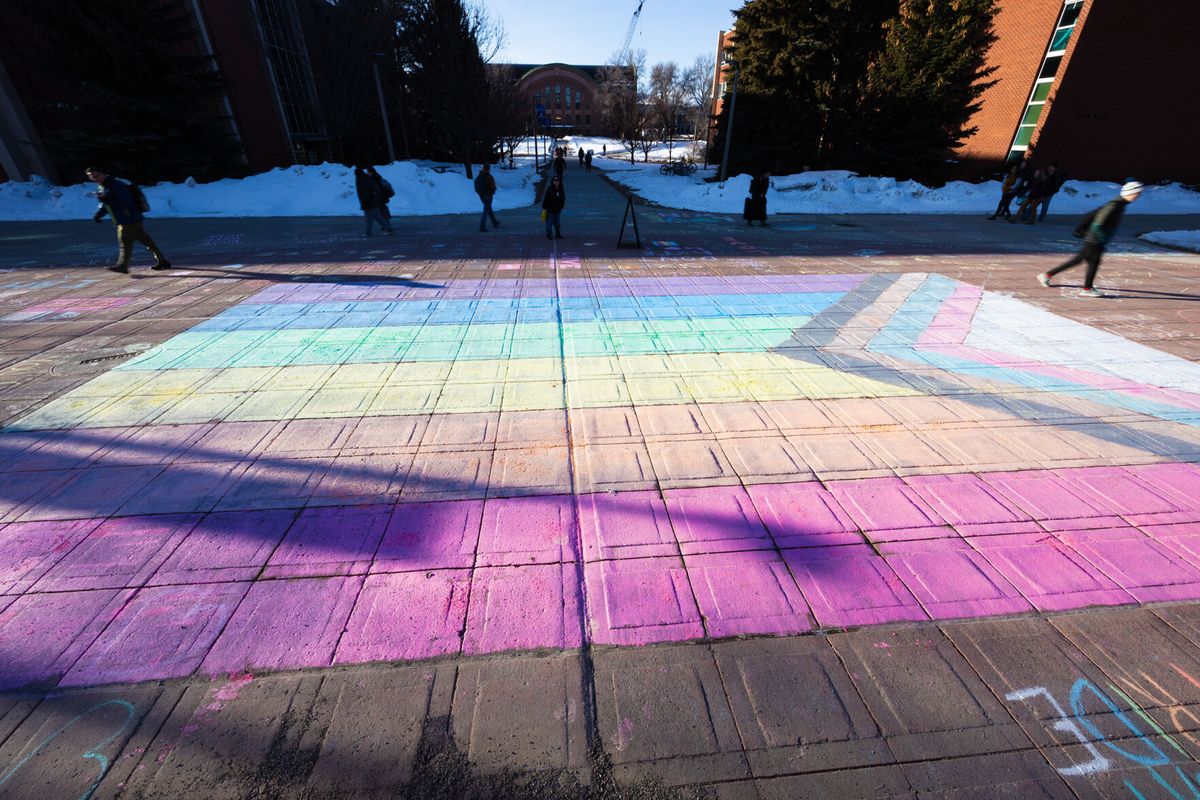
A massive pride flag drawn in chalk in front of Montana Hall Wednesday night was the first visible sign of growing friction between students and university administration. More than 50 students gathered on Centennial Mall that night after MSU denied a request sent by a student senator to deans of colleges across campus asking deans to hang pride flags in their respective buildings. Students who gathered to draw the chalk flag said they viewed the denial as a failure of the university to support the LGBTQIA+ community.
“It's a call to the administration. If the best thing that you can offer when a student is receiving death threats is a change of their name, that's not enough,” said an organizer of the chalking who requested to remain anonymous due to the death threats. “Students should not have to sacrifice their educational experience, their social experience — they shouldn't have to sacrifice their experience at all to feel protected.”
University officials said the denial of the request to hang pride flags was consistent with MSU’s long-standing Freedom of Expression Policy. The policy, established in 2011, regulates when, where, and how free speech can be practiced on campus — a type of permitted regulation of the First Amendment that was established through court cases so that government institutions can protect their regular operations.
“Even if [the requester] would have asked us to hang that rainbow flag at a different time disconnected to this, the answer would have been the same,” said Cruzado in an interview on Friday, March 24. “If there would have been other motivations behind this decision, maybe we could have foreseen the landmine that this ended up being. But two and two were not put together. This is the request. This is the answer. It is the standard answer.”
Frustration with being prevented from hanging pride flags and the lack of a public statement from the university about the QSA death threat boiled over in the weekly senate meeting of the Associated Students of Montana State University (ASMSU) on Thursday, March 23. For more than two hours, senators and students who attended the meeting pressed Tracy Ellig, MSU’s vice president of communications, and Kellie Peterson, MSU legal counsel — both of whom attended the meeting — about the university’s Freedom of Expression Policy and response to the threat.
ASMSU Associate Justice Garret Wright, who spoke during the senate meeting, said students should receive more communication from the university administration. “I don't want a Pure Gold email, I want to know what's going on on campus,” he said. “What are we facing? How is it going?”
Ellig said he was sorry this issue was causing concern among students. The university’s policy about freedom of expression, he said in the meeting, is consistent with universities across the country, and applied the same way to all requests about flags at MSU. “The reason we are here is because there are members of our community that feel threatened and unsafe, and I am sorry that we are having to educate you on the First Amendment in this environment,” he said.
The conflict has its beginnings in an anonymous email to the QSA on Thursday, Feb. 16, in which the sender threatened to kill attendees of a queer-friendly dance party that night at the Rialto Theater. This event was separate from the QSA; nonetheless, the QSA acted immediately to notify law enforcement and the organizers of the event, the ASMSU student government helped provide emergency housing for individuals at the event who felt unsafe, and MSU installed a CatCard swiper on the door of the Diversity and Inclusion Student Commons (DISC), among other action taken in response to the threat.
But, in the days and weeks following the threat, students were frustrated that the university hadn’t released a public statement.
“It is noticeable that there hasn’t been a statement from the university on this,” Tierney Hula, QSA’s drag chair, told the Exponent at the time. “I think it can be very clearly stated, without any controversy, that this is inappropriate.”
Ellig told the Exponent at the time that the university could inadvertently magnify the message of the death threat sender by releasing a statement. Instead, MSU makes its statement through resources on campus for students, including the DISC and the Office of Diversity and Inclusion, he said.
Even though it had not yet provided a public statement following the threats against the QSA, the university activated every office it had at its disposal to provide resources for students, Ellig said during the senate meeting. He continued by saying that those offices were still available to them and continue to reach out to students in whatever ways they can.
Upon receiving word about the threatening email, MSU reached out to federal law enforcement agencies — specifically the FBI — due to the nature of the threat, according to Cruzado. After an investigation was conducted, the University Police and Bozeman city police determined it was not a credible threat, she said during the March 24 interview.
The email was sent from a Switzerland-based domain called Proton Mail, which markets itself as being the “largest encrypted email service in the world” according to its website. Ellig said that the service markets itself as making users completely anonymous, and U.S. authorities are essentially unable to get that company to provide any information.
On the night the QSA received the anonymous death threat, members of the QSA requested that safety measures be taken, including taking down private information — such as membership lists — from ASMSU’s CatsConnect site, said ASMSU President Lucas Oelkers. The information was removed that night, he said.
A member of QSA also asked Oelkers if a CatCard swiper could be added to the door of the DISC to protect student safety. Oelkers then brought this up in an emergency meeting of President Cruzado’s Executive Council on the morning of Friday, Feb. 17, and it was done by the following Tuesday, he said.
The QSA was not the only organization to receive threats.
Students involved in Young Americans for Liberty (YAL), a conservative, libertarian student activist organization, also received a threat while operating a recruitment table outside the SUB on March 2 during the spring career fair.
According to a witness statement in the primary narrative of a police report filed by Officer Randal Schmautz on the date, an individual passing by the table saw their pro-second amendment signage and said, “F*ck you, you gun people. I’m going to shoot you all in the head,” to which a YAL member at the table, electrical engineering student Dylan Dean, replied, “Is that a threat, should I call the police?” and the man responded “Yes.”
According to the report, the incident escalated into a verbal confrontation between Dean and the man. Instead of citing both with disorderly conduct, Schmautz released both men with warnings.
This threat made to YAL was not discussed during the senate meeting but was mentioned in the statement ultimately released by the university on March 26.
Additionally, MSU student Alexandra Lin received personal threats, according to a student she appointed as her spokesperson. The first threat occurred on March 10, when Lin received a message to her student email from Proton Mail. This message referred to Lin with racist slurs and ended with, “this isn’t Missoula in real Montana we kill g**ks like you.”
The second threatening message occurred on March 19 via a Google form. Lin had been organizing an anti-hate teach-in on campus and used a Google form for registration for the event. One of the Google form submissions said “you better watch out we know where you live ch**k.”
Finally, on March 20, Lin received a call from a pizza delivery person to inform her that pizza had been delivered to her house. Both the pizza order and the Google form threat were attributed to Dylan Dean from YAL. Lin reported the threats to police.
Dean said these messages were falsely attributed to him. “These incidents are disgusting, and I have been working closely with MSU Administration and UPD to out the sick individual who impersonated me,” he said.
According to MSU Chief of Police Michael Stanley, the University Police Department is currently investigating a single incident of a reported threat outside of the QSA and YAL incidents. Stanley said he could not comment further because it is an ongoing investigation.
In the weeks since the QSA threat, students have rallied around the LGBTQIA+ community on campus in solidarity. This included a query by ASMSU Senator Taryn Van Steeland on the evening of Tuesday, March 21, to hang pride flags in various buildings on campus. She wanted to show support to LGBTQIA+ students through this gesture so that they could feel seen and not alone while on campus, she said.
Van Steeland emailed the dean of students and the deans of some colleges on campus on the evening of March 21, asking them to put up MSU-affiliated pride flags in the entrance windows of the busiest buildings on campus, according to her original email.
“The MSU bookstore already sells MSU-affiliated pride flags, and ASMSU would love to purchase and deliver these flags for you so that they may be hung up; all free of charge,” she wrote.
A meeting with the deans was called the same day by MSU Provost Robert Mokwa, according to Ellig. Both Ellig and Peterson were present along with college deans. The provost called the meeting because deans were seeking guidance on applicable policy in regard to Van Steeland’s request, Ellig said.
The applicable policy in question is MSU’s Freedom of Expression Policy. According to this policy, which was adopted by the university in 2011 and most recently reviewed in 2020, “printed materials, writing, or other tangible means of expression may not be attached to University property, including sidewalks, trees, walls, or other property.”
Especially important in the functioning of this policy are the concepts of time, place and manner. These are impartial boundaries imposed on expressive activity by the government to ensure that messages are being translated at the appropriate time, in the proper manner, and in the right place. These exist so that citizens can still express their right to free speech, but the government also has a way to conduct business — as it represents the entirety of the people, Ellig said.
“Over decades, the issue that has existed is that university campuses — as well as countless other governmental jurisdictions — have used time, place and manner to restrict expressive activities on the exterior and interior of government buildings, because in every case where they didn't, it resulted in a symbolic arms race with no end that ultimately ended up disrupting the business of either that university or government entity," Ellig said.
The symbolic arms race Ellig refers to means that if one expressive sign was hung, all expressive signs must be permitted for display, even those with hateful language. There would theoretically be no end to the varying expressive media that could go up if this were allowed to happen.
“I see time, place and manner like a traffic light so that we can coexist. It's almost been like an ‘all or nothing,’” Cruzado said. “We are either going to accept every banner or flag under the universe, no matter what it represents. Or we're going to say, ‘We all agree that none of us will.’ It's one or the other.”
The QSA threats and MSU’s flag request denial were not connected because the policy implementation was not related to the QSA threat, Ellig said. “The request [was] connected [to the QSA threat], our response was disconnected,” he said. “It had nothing to do with the timing or there was no ‘Oh, we need to de-emphasize this or hide this. We have a very clear policy. We have followed it for decades. We have to be consistent.”
Ellig said that during the meeting with the deans, there was a review of MSU’s Freedom of Expression Policy. “Pursuant to the existing policy, we asked deans to kindly decline requests they may receive to hang flags in university buildings,” he said.
“My understanding is the deans replied directly to the student who made the request via email by kindly declining the offer,” Ellig said. Van Steeland said she received some scattered responses on Friday that did not directly address what had happened, but some deans rescinded their previous "yes” — if they had responded already — and some did not.
Oelkers specified that these flags were not already in place at the time of the request. “It was a request to hang up. They weren't already hung up and then taken down,” he said.
ASMSU was informed of this policy implementation on the afternoon of Wednesday, March 22, at around 4:30 p.m., according to Oelkers. Some students interpreted this to be indicative of a lack of university support for the LGBTQIA+ community and responded by organizing the chalking event.
Last Thursday morning, anyone walking past Montana Hall may have noticed a pride flag drawn in chalk spanning most of Centennial Mall in front of the building, with dozens of colorful messages and drawings surrounding it.
Some of the messages offered support for marginalized communities on campus, and others called for MSU administration to take further action to defend them. For example, one message read “Protect me Waded: Latinas protect Latinas,” and another read “Bobcat Pride,” with the letters drawn in the rainbow colors associated with the LGBTQIA+ flag. Next to the large pride flag, a message read “We deserve to be heard and seen, love wins always,” and another read “You are on the right track, baby!”
A student who helped organize the chalking event — and asked to be anonymous due to the death threats — said that if a policy prevents MSU from protecting and supporting students, that policy should be changed. They also said students should not be the only ones sticking up for each other, and that the university administration should be looking out for the entire campus community.
A second anonymous student organizer said that this was an effort by students for students. “We can't be Bobcat nation or this great campus community that we market that we are if a portion of our students don't feel that way,” they said. “At the end of the day, it's your peers, it's the people that you are in class with.”
On Thursday, March 23, one night after students chalked their support for the LGBTQIA+ community on campus in front of Montana Hall, things came to a head in ASMSU’s weekly senate meeting. Oelkers, the ASMSU president, invited Ellig and Peterson to discuss the university policy regarding expressive activity and the death threat response with the senate. Ellig and Peterson answered questions and heard comments from the senate for what was ultimately more than two hours.
During the meeting, Ellig and Peterson explained the Freedom of Expression Policy and why university administration made the decision not to release a public statement. “I felt some revulsion at the idea of rewarding [the author of the email] by issuing a statement that all they needed to do was write a single email,” Ellig explained. “My counsel to the president was issuing a statement would not only reward them, but would encourage more. And the problem was: I could not see how we could come to a coherent ending if the bar is this email. And so, we didn't issue a statement.”
However, many senators believed that the university should put a statement out regarding these events or about campus resources for students affected by it.
Taryn Van Steeland, the senator who sent the flag request, said during the senate meeting that the university administration does not always understand what’s happening on campus, and this is a communication issue between MSU and its students.
“We make up this institution. Without us, there is no you,” she said. “We need you guys to act, and a statement from [Cruzado] is exactly what we're asking for.”
Van Steeland said that she understands that the pride flag display may have legal ramifications, but the university can make statements. “But if there is hesitancy on a way to make a statement, then let [ASMSU] speak with people who can make it happen. Because you came here to talk with us and give us answers. Your students are telling you what you can do.”
Senate Speaker Pro Tempore Melissa Ramirez said students are already showing up for other students, and now it’s the university’s turn to act — because those students showing up are also those who are now too scared to come to campus. “I’m Mexican, first-generation American, I spoke Spanish before I spoke English,” she said. “I haven’t talked to my dad in Spanish on campus in the last two months, because I fear people hearing my language. I know that my experience is similar to many of those who currently walk this campus and pay you tuition.”
During the senate meeting, Peterson explained that part of the reason MSU has time, place and manner restrictions was to keep expressive behavior from interfering with the university’s primary function, which is to provide education. “Every year, the preachers come through, and they are out on the Mall, and they say what they say,” she said. “They are allowed to do that in that space. A manner restriction: they are not allowed to use amplification, because that interferes with the business of providing the education that the university does.”
However, ASMSU senator Calvin Servheen said the death threats do interfere with students’ education.
“I heard you mentioned just now that the rationale behind making these time, place and manner restrictions is [to keep things from interfering with] the business of providing education,” he said. “But let me tell you something that interferes the heck out of providing [an] education: when people feel that their psychological and physical safety is threatened.”
Servheen said it’s the university’s responsibility to keep all of its students safe, not the responsibility of other students. He said that some could misconstrue a statement, but for many students on campus, it would reaffirm MSU’s values and “would contribute to helping the business of providing good education at this university,” he said.
At the meeting, Ellig also dispelled rumors about the pride flags, including an alleged secret meeting off-campus where MSU’s deans decided to spontaneously change the policy to deny the pride flag request. Ellig characterized this as “absolutely not true.” He said in an interview on Friday, March 24 that a mischaracterization of the policy implementation by university employees might have had a part to play in the confusion.
“The policy that we have — that we would apply to any request for any kind of flag for any student group — has been around for a long time,” he said.
Sociology student Marlayna Bennett, who spoke during the public comment portion of the senate meeting, said she felt like the student government was her only resource, and was scared that the threats might escalate. “I really feel, in my heart of hearts, that something is going to happen. I know it. It's going to happen,” she said. “And it might not be tomorrow and it might not be next week, but something is going to happen and [the university is] negligent about this,” she said.
During the meeting, Van Steeland said many students have reached out to her to ask for help because they are being harassed and called slurs daily as well as sleeping on friends’ couches.
“We’re trying to make more space so that all students can exist here. I talk with 18-year-olds who are just out of their homes. They're telling me they're going to transfer schools because it's worse living here than living in towns in Montana, with populations that are less than 1,000 people,” she said.
In the interview with the Exponent on Friday, March 24, Cruzado said this entire situation offers MSU the opportunity to grow and improve. “The person or persons who sent those hateful emails are still out there. Now, they have exposed a gap that existed that I did not know was there. I thought that all of our offices were working in unison at the same level of understanding,” she said.
She also said that addressing this situation with a lack of concrete information could induce unnecessary panic. “I'm very careful about how I use my language and my words. I'm very careful about my readers,” she said. “I cannot unsettle students by saying, ‘We received this horrible email, but I don't know where it came from, and I don't know what we're going to do.’”
Cruzado ultimately addressed the threats made to both the QSA and YAL in an email to students on Sunday, March 26.
In the communication, she recounted the chain of events that followed both the QSA and YAL threats, explaining the actions and assessments of law enforcement and writing that her heart goes out to individuals affected by those situations. She also highlighted resources students can reach out to, including CPS, the Women’s Center, the Dean of Students CARE Program, the DISC and the Office of Institutional Equity.
“We decry communications that contain threats because, whether they represent real or perceived harm, their inimical language erodes the community spirit that we treasure at Montana State University,” she wrote.
When asked by the Exponent what prompted this message, Cruzado explained that the facts about the credibility of the threats against the QSA and YAL have not changed, but she felt that misconceptions needed to be put to rest.
“What became increasingly clear for me this week, including this last Friday and Saturday, is that the amount of misinformation and rumors circulating around campus appeared to be growing and maybe getting out of control,” she said. “In that sense, in a preventive manner, the need to provide accurate information to dispel those rumors and to avoid further misinformation became evident.”
“I thought that a message of positive reinforcement might do a lot of good for a lot of folks," Cruzado said. "That message of encouragement and hope and community-building is the main objective of my communication today."
Marlayna Bennett, the student who commented at the ASMSU senate meeting, said Cruzado’s email only rubbed salt in the wound and did not accurately depict the danger to students because of ongoing threats and harassment.
“We are not asking for some bland, bureaucratic response; we are asking for Cruzado and the administration to accurately inform students while relentlessly and fearlessly standing by their BIPOC and LGBTQIA+ students that are being actively targeted on campus,” she said.
When asked by the Exponent, students from YAL said they felt grateful to be mentioned in the email but found it to be minimizing their experience. “I would have just liked it to be more clear about the severity of it,” said Rachel Stevenson, MSU chapter president and Montana and Wyoming State Chair of the organization. “It seemed very belittling, like YAL also ‘allegedly’ received a threat. That's not really what happened.”
The QSA did not respond to requests for comment about this story.
If you or someone you know is struggling, MSU has resources to help. These include MSU Counseling & Psychological Services, the Dean of Students CARE Program, the Women's Center, the Office of Institutional Equity and the Diversity and Inclusion Student Commons (DISC).
For anyone experiencing immediate distress or crisis, call or text 988 for 24/7 access to assistance.
The Exponent will continue to monitor this story as it develops. A story is forthcoming with more detail about the threats to Young Americans for Liberty.


Comments ()