
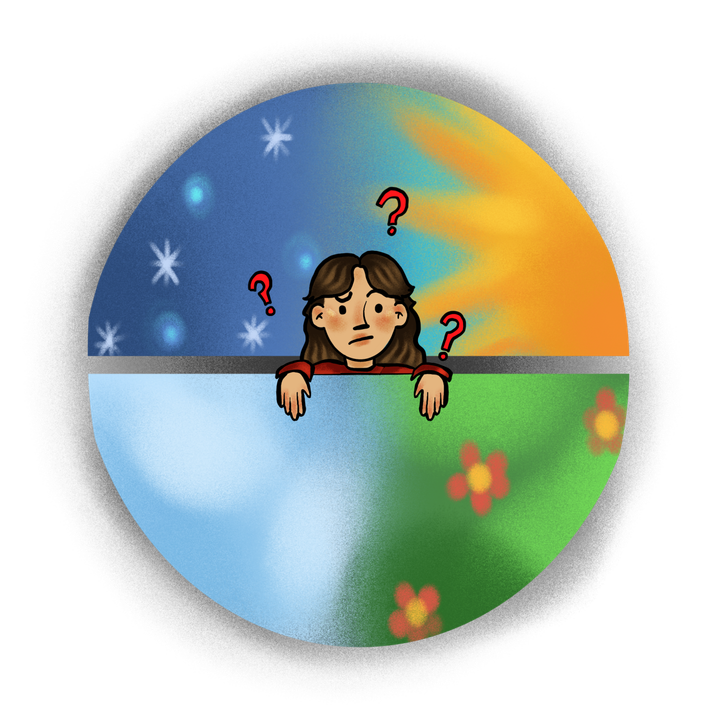
Do any of us truly understand the languages of love?

Tangled in the web that is modern-day love, communication is often hailed as the cornerstone of any successful relationship. Yet, as the digital age ushers in new modes of communication, the age-old struggle to decipher what love means has intensified, unveiling a poignant paradox in the realm of contemporary intimacy.
This begs the question — could this all be solved with better communication or are people simply failing to understand their partners on deeper levels of love? Could the answers lie within the five love languages?
The five love languages were coined by a Southern Baptist Pastor with a Ph.D. in adult behavior, Gary Chapman. In 1992, Chapman published his debut self-help and counseling book titled “The 5 Love Languages: The Secret to Love That Lasts.” But here’s the kicker — Chapman is not and never was a real licensed counselor.
Professor Kate Kujawa of the MSU Psychology Department commented, “[The love languages] were developed through that masculine perspective and through a very Christian perspective with a lot of that evolutionary psychology of [the idea that] men have instincts and needs that they can’t control. But I will be the one to tell you they can control themselves.”
Even though Chapman’s credentials are problematic — the concept of the five love languages have dominated social media recently. They’re practically mainstream at this point. It seems simple enough. If one can understand their partner's love language and cater to it a stronger relationship will be the result. Right?
Well, it isn’t quite that simple. The five love languages are often misunderstood and misused. “The love languages can be used very, very abusively,” Kujawa said.
So, how have the five love languages developed into such a cultural phenomenon? How can they be used in a thoughtful and respectful way with your partner? Are they even real?
It turns out the love languages can be a useful tool when navigating a relationship, but there is one key element to them to keep in mind: they are supposed to be used as a tool to foster important conversations, not to keep tally of which partner “owes” the other affection.
“As long as you're having communication around, what is the intention of this action, how is it being received, it's a really great aid to spur on communication and gain a deeper understanding of your partner, and a deeper understanding of yourself. But it's not supposed to be used as a tallying system where if one partner does something, the other must reciprocate,” Kujawa said.
Chapman claimed that by learning to recognize these preferences in oneself and in one’s loved ones more profound relationships can be built. He outlined five love languages in his 1992 book: words of affirmation, quality time, physical touch, acts of service and receiving gifts.
Words of Affirmation
Individuals who have the love language of words of affirmation tend to express love through the spoken word. That is, actually hearing someone give compliments, praise or appreciation. One might appreciate uplifting quotes, love notes from a partner, encouraging and appreciative texts and compliments. Kujawa describes it as being “affirming, but in a way that’s going out of your way to acknowledge that you notice the efforts that your partner is making.”
If one finds themselves in a relationship, romantic or not, with a partner inclined towards this love language, Kujawa provided some insight into how words can be really validating. “Words of affirmation can be really simple, like, hey, you're doing a great job, or, I see the work that you're doing, but it can also be a grand statement,” Kujawa said.
Quality Time
If someone's love language is quality time, they deeply appreciate love and affection being expressed by their partner's attention. Kujawa noted that quality time can take multiple different forms. “Some people like uninterrupted quality time. This is where you and your partner are doing something together. Or from a developmental perspective, like parallel play, we're spending time doing things together but maybe not doing the same things,” they said.
This could look like one person playing a video game while the other reads a book beside them. Both partners are physically close to the other and enjoying any situation in each other's company.
Quality time is also defined not by the amount of time one spends with a partner but by the perceived quality of it.
Physical Touch
People who identify their love language as physical touch feel the most loved and appreciated through different kinds of physical affection.
Kujawa spoke on the assumption of the majority of men’s primary love language being physical touch. They explained how society may be to blame for men only understanding how to express their love through touch and more specifically sex.
“There tends to be an orgasm-centric view of physical touch, but you don't need to be having sex. You don't need to be having orgasms. I think men, the way that they're taught about what actions are socially acceptable for men, is an influence on the flawed definition,” Kujawa said.“If men are not taught that they can cuddle, that they can have these really cute like cuddle bug moments, it’s hard to conceptualize how their physical touch needs are met without sex.”
In this context, giving physical affection is not limited to sexual intimacy but includes holding hands, hugs, kisses, cuddles, putting one’s arm around a partner in private, in public or other forms of physical affection.
“The amount of variability is huge, and sometimes having that physical skin-to-skin contact, even when it's non-sexual, is really what men are actually looking for, but they don't know about all of those options because they haven't been taught that there's more than one option,” Kujawa said.
Acts of Service
If someone's primary love language is acts of service, they may want their partners to show their love by helping them complete helpful deeds, such as chores and errands and even engaging in meaningful projects together.
“Act of service is anything that is doing work for another person without being altruistic by nature. There's not an expectation of having something in return,” Kujawa said.
The acts of service love language can also include a partner doing unexpected, nice things for their partner. “Doing an act of service can tie into gift-giving. If you [know that your] partner always forgets to eat between classes, you might stop by the vending machine because we have this moment where we cross paths during the day and I'm going to pack them an extra snack so that I can pass it off to them,” Kujawa said.
Completing these nice and helpful tasks for one’s partner instead of talking about doing them will communicate love in a deeper and more meaningful way.
Receiving Gifts
The final love language is receiving gifts. While a person may appreciate the physical gift, it is more about the thought and effort the gift-giver put into giving the gift. “The love languages are broad in general and there's this misconception that they have to be like these huge grandiose gestures,” Kujawa said.
Kujawa said that gift-giving can go hand-in-hand with acts of service and is often expressed by bringing one’s partner something to help them get through their day.
“If you have a love language where gift-giving or receiving is how you receive love, people tend to think that's a really shallow love language and like a gold digger and it's not really the case. You can have gifts that are not of monetary value,” Kujawa said.
Overall, this love language is represented by small acts — like bringing one’s partner a coffee during a break. A simple act like this shows the partner that someone was thinking about them throughout the day and makes the partner feel loved and appreciated.
Love languages are by no means the guidebook to a successful relationship — communication is. Love languages may act as a helpful tool to open lines of communication in a relationship. “We don't really know what someone's thinking unless we ask and this can sometimes be a good way for partners to let their thoughts, feelings or preferences be known in a safe way,” Kujawa said.
Throughout the process of uncovering the truth about Chapman’s five love languages, it was found that there is little empirical research to support the claims. However, they can still be a useful tool in navigating love in all of its twists and turns. Love languages and other theories of love can be widely encompassing and, therefore, must be approached tactfully, with the ultimate goal of being open to new channels of communication within one’s relationships.
If you would like to find out your primary love language, you can take this quiz on Chapman’s website: https://5lovelanguages.com/quizzes/love-language.


Comments ()