
Does Parking on Campus Actually Suck, or are We Just Lazy?
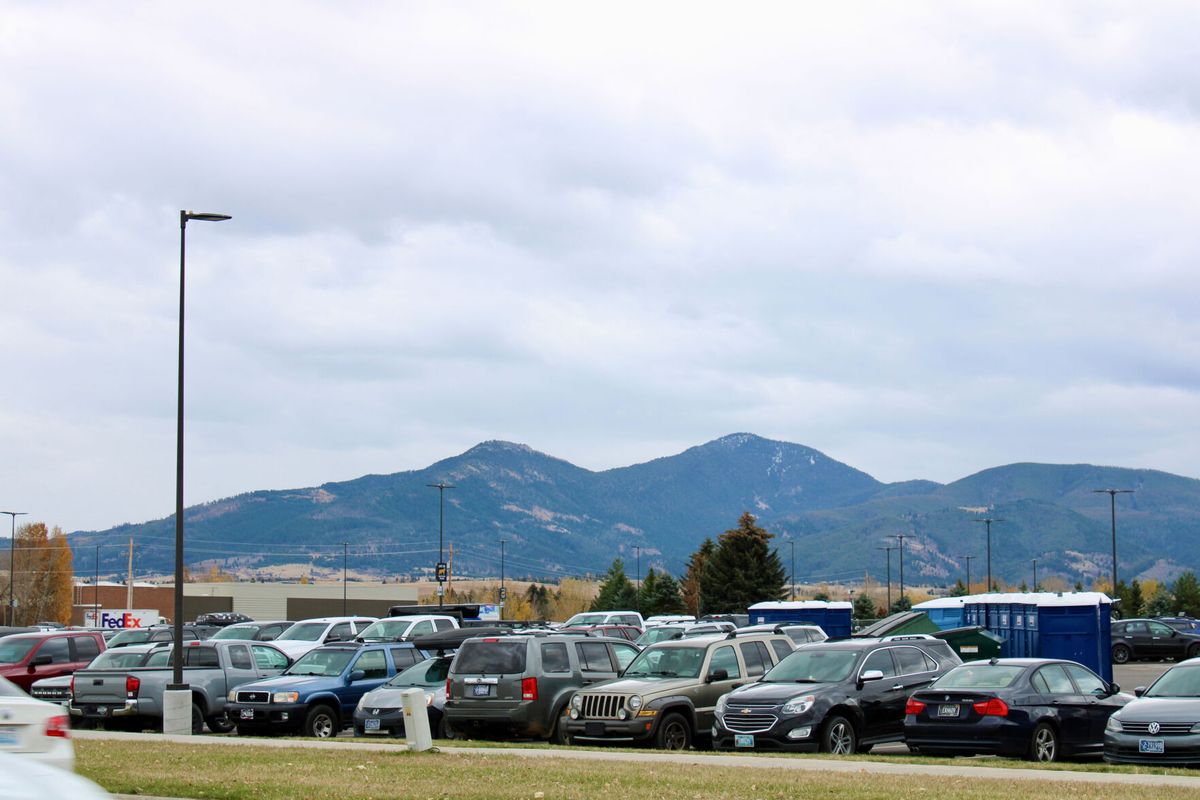
The very first thing you read on MSU’s Parking Permit Information site is: “Parking on campus is a privilege, not a right.”
That sentence has always ticked me off. Students on campus — including myself — believe that this supposed privilege is a massive pain in the neck. I can’t be the only one who is glued to my computer when the permits go on sale, anxious to spend hundreds of dollars on a parking pass before they all get snatched up — just to end up finding a good spot only once or twice a month.
I’ve heard complaints about parking from students all over campus. Curious about why it causes so much frustration, I set out to get some outside perspectives. Ultimately, what I found gave me a deeper understanding of how — and why — MSU’s parking system works the way it does.
For some students, especially commuters, there aren’t many other options to get to campus besides their cars. Bozeman is a car-dependent area, with 1.5 cars per household, according to the Gallatin Valley Sentinel. You would think that the students who pay tens of thousands of dollars to attend school could park where they please, but that is not the case.
“A lot of students, if they don’t get there at the ass-crack of dawn, they won’t get a good parking spot,” said marketing major Josey Blazer.
Psychology major Marie Hogan said that, during her freshman year, she had to build her schedule around finding a parking spot. “I would drive to campus — that took me about 20 minutes of traffic — and then it took me about another 20 to find a parking spot, and then another 20 to walk to my classes,” she said.
Students also complained about the cost of parking. Prices for annual commuter parking passes range from $285 for most Bobcat lots to $935 for Eagle Lot 16. On-campus students seem to get off easier, with $375 being the highest price for a Bison parking pass, but they also have to handle housing costs at just over $14,000 each academic year, according to MSU’s catalog.
“It’s crazy,” Blazer said. “We already pay a lot of money to be here.”
The estimated cost of attending MSU — including tuition, food, housing, educational supplies and miscellaneous expenses — is about $29,000 yearly for in-state students and $54,000 for out-of-state students, according to the MSU catalog. It seems that the last thing students want to do after paying these hefty fees is drop another few hundred dollars to park on campus.
“It’s frustrating when you pay so much money and it takes time to just find a place to park your car,” Hogan said.
Blazer also said she believes that MSU Parking and Transportation Services has not supplied enough parking spaces for the number of people enrolled here. “I would say it is not adequate for the amount of students we have,” she said.
Though students have many gripes about permit prices and spot availability, Interim Vice President of University Communications Mike Becker offered me a different perspective.
“Daily monitoring shows that there are available parking spots at all hours of the day. For example, the east stadium lot, Lot 25, consistently has many parking spaces available, even at the busiest times of day for campus,” he said. “Spots may not always be exactly where someone wants to park, but there is capacity.”
According to Becker, while Parking Services does sell more permits than spots available, staff members monitor the sales closely to ensure that there will be spaces available at all times of the day.
In addition, though it might seem unfair, Parking Services doesn’t charge these high prices just because it can. Ensuring transportation for all students and faculty costs money. According to Becker, Parking Services is a self-sufficient auxiliary office — that is, it does not receive state tax funding — and handles quite a lot.
“The office generates revenue to operate mainly by selling parking permits,” he said. “Those revenues are used to do everything from snow removal and operating the CatTracks shuttle to parking lot improvements and pavement maintenance.”
“It’s a hard problem to solve or make it cost less,” said Lenny Triem, Associated Students of MSU (ASMSU) president, who clarified that his opinion does not reflect ASMSU’s position as a governing body.
Citation and fee money are also put toward these operations, and help maintain safe transportation. “While we’d prefer not to issue citations and fines, we need to enforce parking rules to ensure parking is available for those who pay to have a parking permit,” Becker said.
MSU — and, therefore, Parking Services — is financially accountable to the Board of Regents (BOR), the governing body of the Montana University System. According to Triem, the BOR manages budgeting and sets annual contributions for each university in Montana.
“Permit costs and fines are set so that the office can meet its financial obligations and are approved by the [BOR] every two years,” Becker said. So while the permit prices are a strain, Parking Services has its own expenses to pay.
One thing that worries me about the future of parking on campus is the incoming VIM Hotel, a privately owned development that will provide work experience for culinary and hospitality students.
“One of the constraints that I know the campus runs up against is that when it’s building new buildings, sometimes it builds where parking lots used to be,” Triem said. According to Becker, Lot 11 closed permanently on Oct. 29 to allow for The VIM’s construction.
He said The VIM’s parking spaces will only be available to its customers following the hotel’s completion. When parking is such a hot-button issue, closing down a lot doesn’t seem like a great idea to me. Lot 11’s closure has made the parking situation appear worse, since The VIM’s parking spots won’t be available to permit holders.
Though some may feel that Parking Services does a lot to police but little to improve the parking situation on campus, Becker said this is not the case. Last year, Parking Services gave the stadium lots some serious upgrades, including fresh pavement and new lights for safety.
“The work ultimately added about 450 spots to the stadium lots,” Becker said.
Parking Services has also expanded inter-campus transportation by launching CatTracks last year to address the transportation needs of students, faculty and staff, according to a 2024 article from the MSU News Service.
“The routes connect some of the more distant portions of campus, such as the stadium parking lots and the MSU Innovation Campus to the central campus,” Becker said.
Students can use CatTracks to get where they need to go without worrying about finding a parking spot. This is especially useful for students like me who only have a stadium pass. Buses run their routes from 7 a.m. to 6 p.m., Monday through Friday.
According to Triem, disabled students also frequently use the shuttle.
“Say you have trouble walking, but you need to park in the stadium lot. You can use the campus shuttle to get into campus and you don’t have to walk,” he said.
Interviewing with Becker and Triem helped me realize that there is more to MSU’s parking situation than simply being charged exorbitant prices for subpar spots. Not to say the system is perfect — that’s why I’m writing this article — but I now believe that MSU is doing the best it can to accommodate the parking needs of students and faculty. The spots may not be ideal, but they’re always available. It’s just a matter of convenience.


Comments ()