
Early candidate filings signal heated primaries coming for the Montana Legislature
The long hallway leading to the Montana Secretary of State’s Office became the stage for campaign photo opportunities Tuesday as political candidates, many flanked by family members and supporters, arrived at the Capitol to register to run for the Legislature.
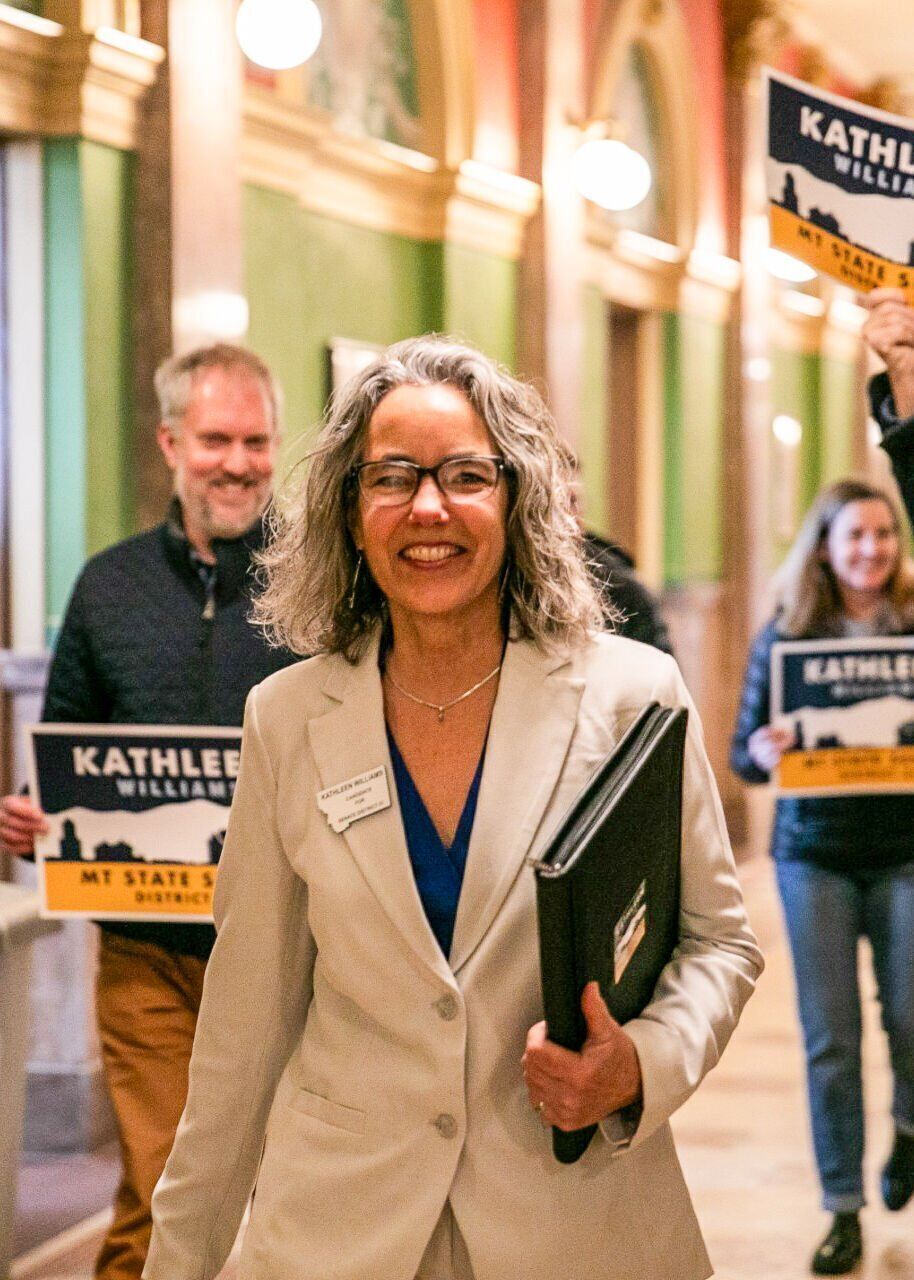
Nearly a dozen people joined Democratic candidate Kathleen Williams as she strutted down the hall holding campaign signs. They did that twice to capture video and photos. Republican Mary Horman, a longtime nurse, sported a set of scrubs and a stethoscope for photos at the Capitol after signing the paper to register her bid for the state house.
While Tuesday marked the opening day of candidate filing and was full of celebration, it also signaled the official start of what’s shaping up to be a heated election cycle for many of the candidates vying for the Montana Legislature and the race to replace the top two elected Democrats in the Capitol.
Across Montana’s 150 legislative seats, only a few of them are swing districts, meaning most of the competition in these races happens in the primary elections. Put another way, most districts will reliably choose a Democrat or Republican every election.
Candidates have until March 4 to file, so there’s still ample time for legislative races to change shape and for other challengers to throw their hats in the ring. But based on who has filed as of Wednesday afternoon, these are some of the contests to watch.
GOP primaries
During the 2025 legislative session, deep, longstanding divisions within the Republican party resulted in two factions that have persisted in the months since: The center-right and the hardliners. Now, voters are being asked to pick a side in the primaries.
The best example of one of those Republican primaries is Senate District 9 in northcentral Montana.
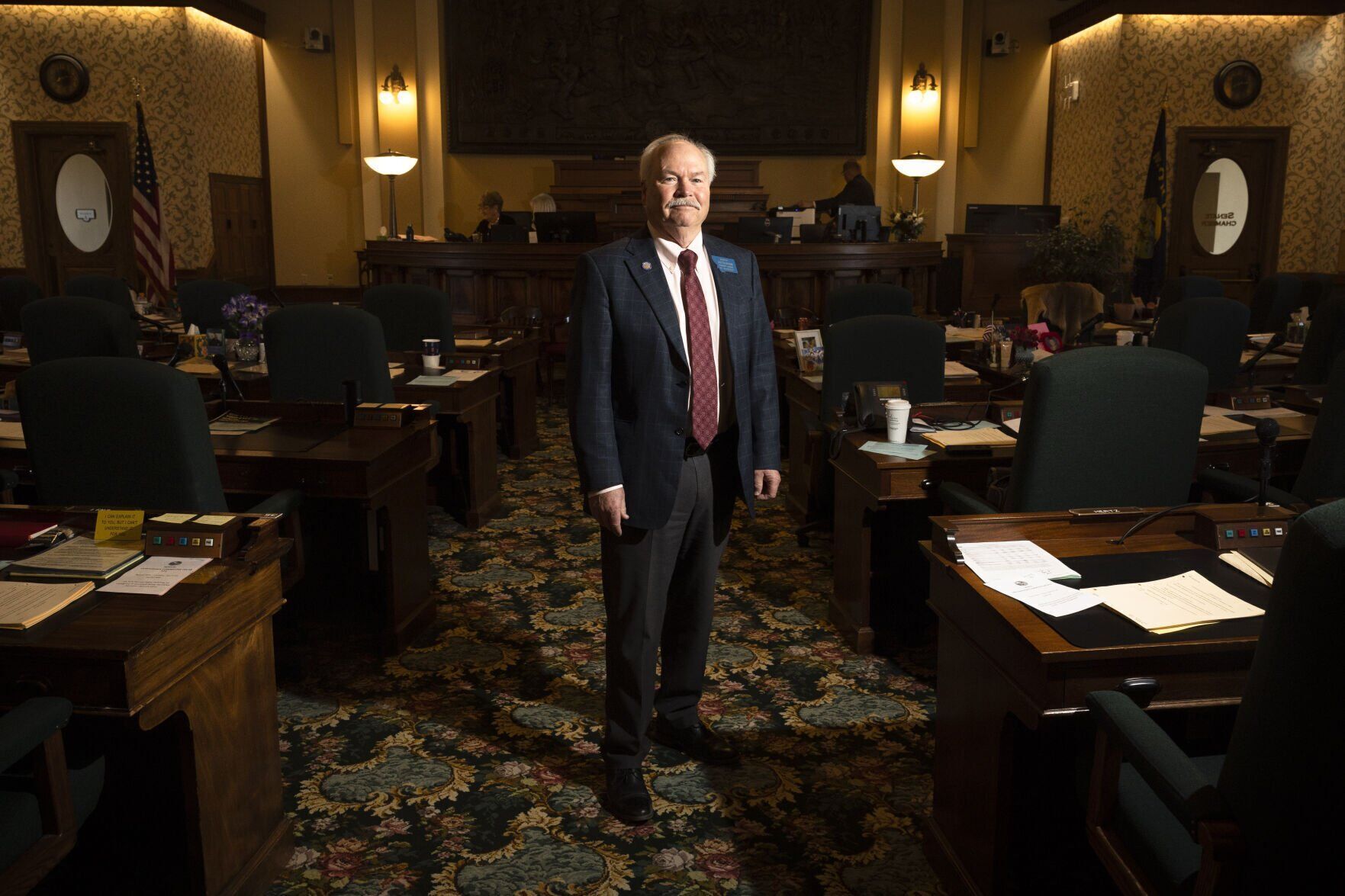
Conrad Rep. Llew Jones, a fixture of the Legislature known for crafting some of the state's landmark policies and chair of the appropriations committee, is being primaried from the right by Wolf Creek Rep. Zack Wirth.
Jones has served in the Legislature since 2005, including as the senator for SD 9.
The GOP hardliners are dead set on unseating Jones, as he served as the leader of the bipartisan coalition in the House and Senate and was able to get a number of policies into law that the farther right members opposed.
At the state Capitol on Tuesday, Wirth said that a Jones-sponsored piece of legislation that transformed the state’s finances was “the straw that broke the camel’s back.”
While filing officially opened Tuesday, some of these primaries like the one between Jones and Wirth have been raging for months.
More than 140 candidates file for political office as Montana's election season kicks off
It had been only weeks since the 2025 Legislature wrapped when voters in the district started receiving robocalls ridiculing Jones. The anonymous and automated messages, which don’t fall under electioneering or lobbying laws as campaign spending, followed a barrage of newspaper editorials, press releases and social media posts from conservative Republicans criticizing the state budget that lawmakers had just passed.
Those intraparty divides and the sharp-tongued rhetoric used to describe them are playing out in other districts, too.
Ravalli County Republican Reps. David Bedey and Kathy Love are going head-to-head for a hotly contested Senate seat. Bedey is a Jones ally and longtime legislator, while Love, a freshman, has the backing of the party’s conservative flank.
“My brand of conservatism recognizes that my allegiance must be to the constitution and not to any political party,” Bedey said in an interview.
Bedey called the campaign for Senate District 43 the nastiest he’s seen since joining the Legislature, and said the intensity has picked up steam far earlier than in his previous races.
Love did not respond to a request to comment for this story.
Just over the Sapphire Range is House District 76, where Republican Rep. John Fitzpatrick is being challenged from the right by Trisch Schreiber, a school choice advocate.
The two disagree fiercely on what’s best for the residents of their district, which is home to the state prison and next door to the state hospital. Fitzpatrick says he’s delivered for constituents by helping to pass a state pay plan and responsible state budget as well as supporting legislation to bolster rural public schools and hospitals.
Schreiber, on the other hand, says her opponent has strayed from rural values and no longer represents the Republican party.
Another race illustrative of the divisions is in Cascade County, an area of Montana that is never short on political drama.
Randy Pinocci, a Montana Public Service Commissioner, calls himself the “RINO hunter,” and he has filed to run for Senate District 12, where he’s up against Republican Rep. George Nikolakakos, a moderate.
Many of these more centrist Republicans or Republicans who defy the Trump agenda are often called “RINOS” which stands for “Republicans in name only.”
That seat is currently held by Sen. Wendy McKamey, one of the nine senators who allied with the Democrats on key votes last session. McKamey will not be seeking re-election following a stroke last year, but said she is throwing her full support behind Nikolakakos.
“I really did think I was going to be doing it this time, and I am not going to because of obvious reasons,” McKamey said. “It’s difficult to conquer.”
Filling top Democrats’ shoes
Democrats aren’t without their own intrigue this cycle as the minority party leaders from each chamber — Sen. Pat Flowers from Bozeman and Rep. Katie Sullivan from Missoula — are both terming out of office.
Former U.S. House candidate Kathleen Williams is currently the lone Democratic candidate running for Flowers’ seat. Flowers made waves at the state senate in 2025, helping lead a bipartisan coalition that forced the hardline Republicans in that chamber into a de facto minority.
To some, Flowers’ actions created tensions with Democrats, but to others he was an inspiring model of how Democrats can attempt to grab back more power in a chamber where they were nearly in the superminority. Either way, Williams is following a strong legacy.
“We need people with experience to hit the ground running Day One,” said Williams, who previously served in the Montana Legislature from 2011 to 2017.
There were previously two other Democrats who filed to run for that seat, but they have since closed their candidacy and re-registered in a different Bozeman-area Senate district.
Rep. Kelly Kortum, D-Bozeman, and Wes Siler, a Bozeman-based writer, are both now running for Senate District 32, along with another sitting legislator Rep. Becky Edwards, D-Bozeman. Sen. Denise Hayman, D-Bozeman, is not running for reelection to that district.
Kortum said that as one of the more senior house members, it is his time to move to the upper chamber, while Edwards said she’s the best candidate in that contest because she has personally lived the struggles of many people in that district, which is a residential area in West Bozeman.
Siler did not respond to requests for comment for this story.
Over in Missoula, House District 93 has at least three Democrats running for Sullivan’s seat.
Nick Kujawa, a builder and small business owner, and Sam Kulla, a member of the Montana Democratic Party Executive Board, both filed for office on Tuesday. Ben Davis, executive director of a youth mentorship nonprofit in Missoula, had not yet filed as of Wednesday afternoon, but voters in the district have already started to receive campaign mailers.
Kujawa said his experience as an entrepreneur would give him a leg up in understanding how policy crafted by legislators impacts real people, and Kulla said he wanted to bring the perspective of someone feeling the sting of rising health care costs and other economic pressures to Helena.
The primary election is June 2, and the general election is Nov. 3.


Comments ()