
Exponent analysis finds gender pay gap among MSU faculty
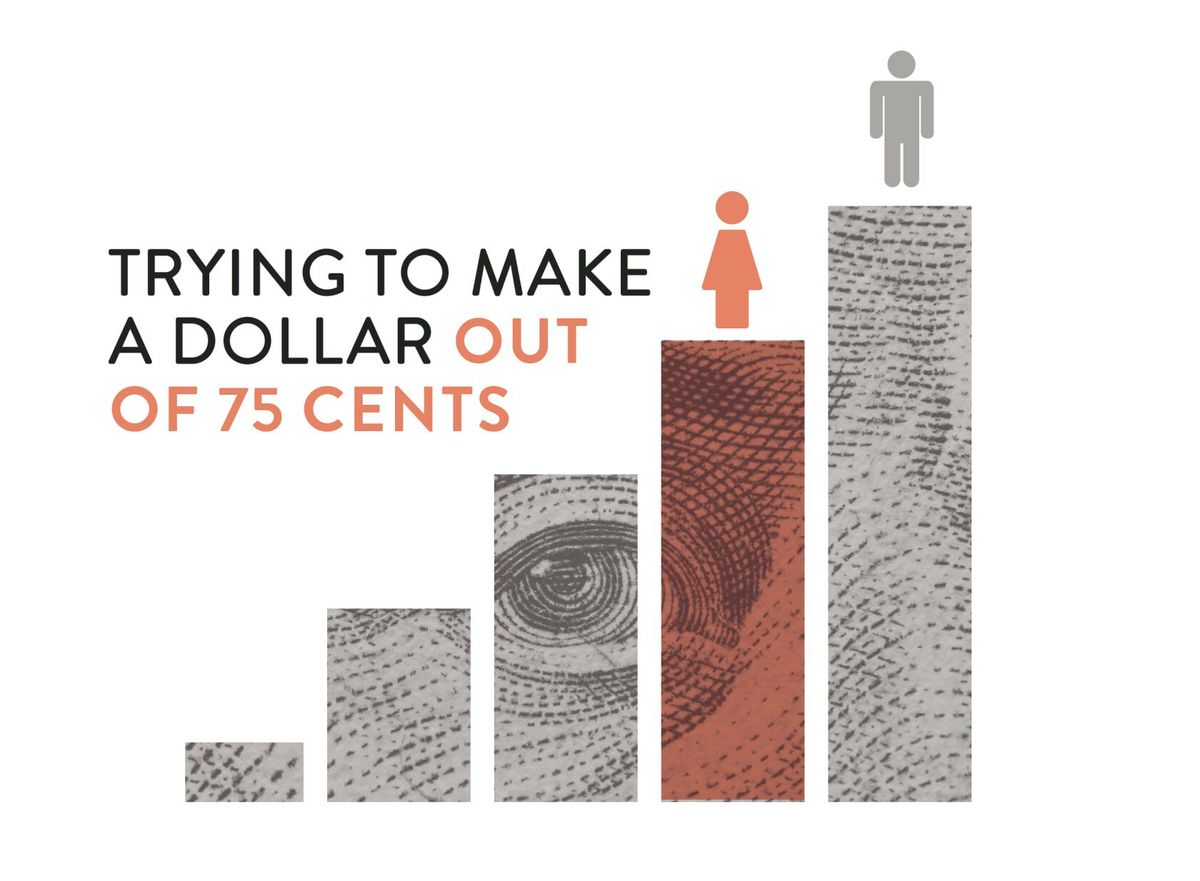
According to data from the MSU Office of Planning and Analysis (OPA), the median salary for female faculty at MSU, who make up 52.15% of all tenured, tenure-track and non-tenured faculty, is lower than their male counterparts.
Tenured and tenured-track (TT) women receive a median salary less than men in 29 out of 40 academic departments, and non-tenure track (NTT) women in 27 out of 55 departments make less than men, when there are both male and female faculty in a department. Though the data shows that female faculty make a median salary of $49,457 and men make a median of $65,890, MSU responded that the school’s complex salary structure means looking at data broadly produces an inaccurate impression. Although MSU believes that a finer analysis will produce equitable salary medians, a gender wage gap is part of a chronic issue in the U.S. surrounding the topic of equitable hiring, education and promotion practices.
Women have to work an extra 42 days a year to make the same as men, according to a Pew Research Center analysis of median hourly earnings from 2020. That equates to women making 84% of what their male counterparts make. It wasn’t until 2014 when Gap, Inc. became the first Fortune 500 company to announce equal pay for equal work in 2014 with the signing of the Equal Pay Pledge, put into effect by the Obama administration. The disparity is most stark in Wyoming, where in 2021 women made 63.4 cents on the dollar. In 2018, the City of Bozeman released a study of median earnings of both men and women, based on level of education, which showed a wage disparity ranging between 40 and 25 percent less than the earnings of men. Mayor Cyndy Andrus acknowledged the disparity in discussion with the Bozeman Daily Chronicle and highlighted Bozeman’s efforts to address the gender wage gap. This national pay gap reaches into the government, schools and corporate institutions, and can be largely explained by differences and unequal opportunities in education level, work experience and performance often stemming from lack of access to resources for women.
MSU has a hiring practice based on merit, market and equity (MME) which evaluates a faculty or candidate’s level of experience, research/publication credentials, discipline, rank, length of employment and performance, and takes into account comparable market salaries and equity concerns (including, but not limited to, race and gender). According to Jeannette Grey Gilbert, MSU’s chief human resources officer, accurately calculating and comparing median wages relies on extremely small levels of merit comparison which are difficult to calculate. Factors include areas such as the number of publications, date of hire and academic discipline. According to Grey Gilbert, these small differences skew data. “When you look at the data that’s comparable, I think you would see a different story. You wouldn’t see necessarily those discrepancies,” she said. Unfortunately, information on factors such as date of hire, number of publications, or performance is not public.
According to Grey Gilbert and MSU spokesman Mike Becker, the salary process at MSU is complicated. “I think it’s really important that you just, you can’t look at wages without taking those things into account,” said Grey Gilbert in an interview with the Exponent “Otherwise you’re, you’re really making an apples to oranges comparison.”
Becker and Grey Gilbert emphasized the ongoing efforts by MSU to ensure a fair and equitable workplace despite historical hiring trends. “Many of the processes that have gone into the current composition of our faculty are the result, in some cases, of decades of hiring practices,” Becker explained. “So it may be that you see colleges and departments that skew heavily toward one gender and you may also see that some of those professors have been there 10, 15, 20 years longer, back to times when less thought was given to inclusivity and equity in hiring processes.” Becker further explained that, beyond a focus on creating a diverse faculty, MSU is more concerned with hiring the “best people possible, regardless of other factors.”
According to MSU, the median wages calculated on the hiring track (tenured, TT, NTT) level, as well as on departmental levels, are not reflective of any wage gap. “There are very few things or questions that you can answer for everybody across the board with a broad stroke,” Grey Gilbert said after the Exponent noted that, even among equal ranked instructors within some departments, there remains a wage gap. The Exponent calculated median wages for this story because medians are resistant to outliers.
Each year, a salary analysis is conducted within the university. “In my world in HR, and we partner with the provost office on faculty salaries, we do that all the time annually,” Grey Gilbert said. MSU also compares salaries to Oklahoma State University’s Faculty Benchmarking Salary Service that is used by many universities, according to Grey Gilbert. Non-tenure track salaries are also bargained within the NTT Union’s Collective Bargaining Agreement, while tenured faculty are represented by the Faculty Senate.
The NTT Union did not respond to questions from the Exponent, and the Faculty Senate also said salaries are complicated when declining to respond to questions.
“Faculty salaries are a complex issue involving field, rank, longevity and merit among other things… Rest assured, Faculty Senate has always advocated for faculty salaries and the well-being of faculty at MSU to the campus leadership and the Board of Regents,” Faculty Senate President Braford Watson and Chair-Elect Michael Brody wrote in an email to the Exponent
The OPA provided the Exponent with the fall 2021 faculty salary spreadsheet, which includes the names, department, position, annual salary, contract length, full time equivalency (FTE) for part-time faculty and annualized salary. Exponent staff then assigned a male or female gender to each faculty member and calculated median rates.
Becker and Grey Gilbert raised concerns about the data used for the calculations.
“I would not characterize it as there’s a disparity across all faculty, because I don’t think that’s the case when you look at the data accurately, and I would encourage you guys to do that,” Grey Gilbert said.
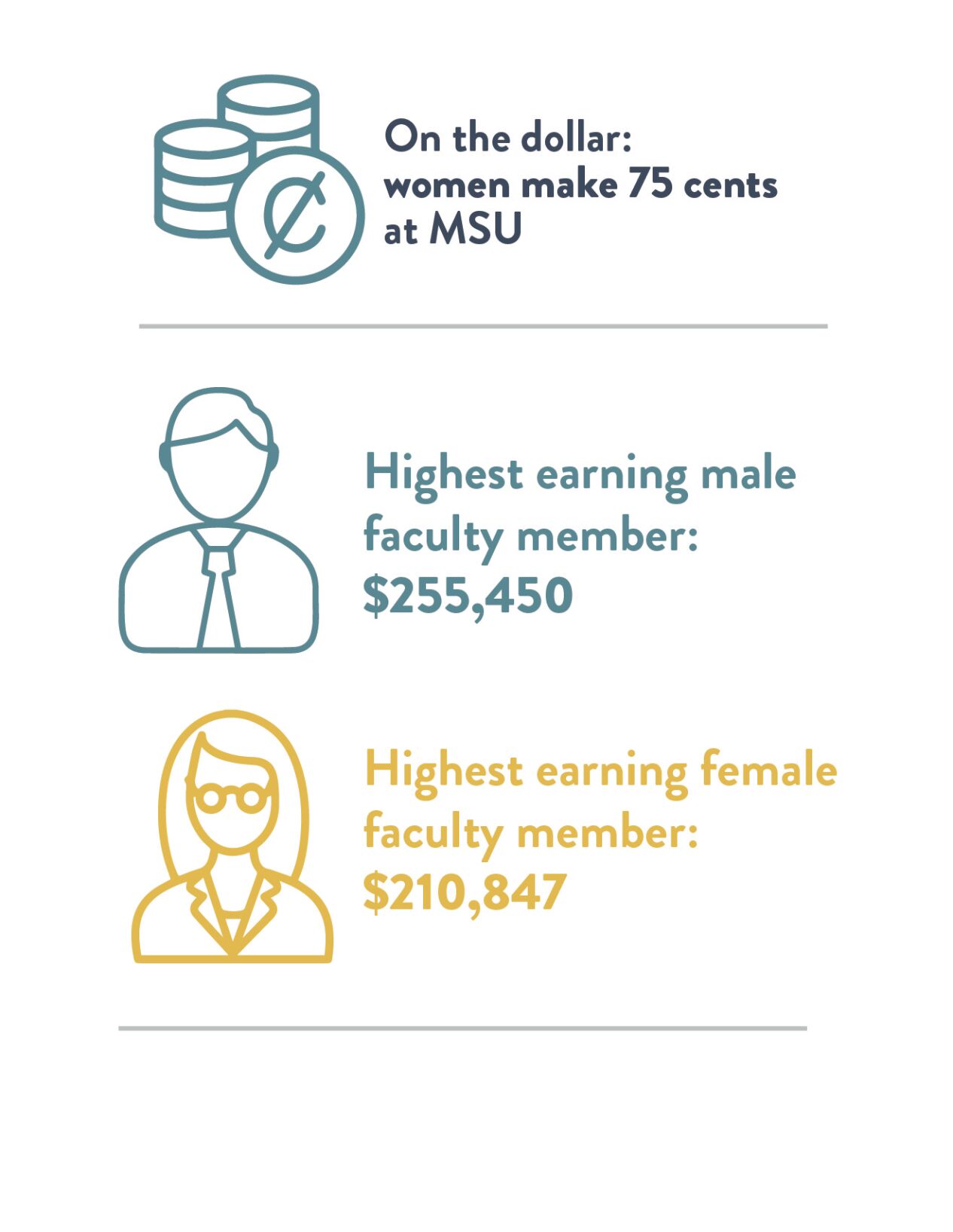
Based on information provided, the Exponent found that the median salary of all women, tenured, TT and NTT, is $49,457. Their male counterparts make a median salary of $65,890. This equates to women making 75 cents for every dollar a man makes.
The Exponent also calculated the median salary of each department (separated by hiring track), as well as the median salary for men and women within each department. Here, we found that in 49% of departments, NTT female faculty make less than men. Tenured and TT women make less than men in 72.5% of departments, according to the data.
In addition, there are 13 departments whose non-tenured faculty are all men, and five departments whose tenured and tenure-track faculty are all men.
Some findings which stand out include tenured/TT women in the civil engineering department, who make a median salary of $86,515 while their tenured/TT male civil engineering peers make a median of $103,312. Of the tenured and tenured-track women in this department, all six are associate professors. Of the men, four are associate professors and four are full professors (this calculation did not take into account the department head, who is a male making $140,571). Other fields where tenured/TT women make significantly less than men, on median, include electrical engineering, business, chemical and biochemical engineering, art, physics and architecture.
In some cases, women within the same department or the same ranking in a department regardless of tenure status, make more than their male peers on the median.
The single tenured woman in agriculture education makes $15,196 more than her three tenured/TT male counterparts. The four tenured/TT women in the chemistry department (not including the female department head) collectively make a median salary of $115,431, $14,736 more than the median of their 12 male peers. In the School of Film and Photography female professors make $92,564 on the median, compared to male professors’ $91,354 salary median. For associate professors in the film and photography school, however, women make a median salary $6,131 less than the singular associate male professor.
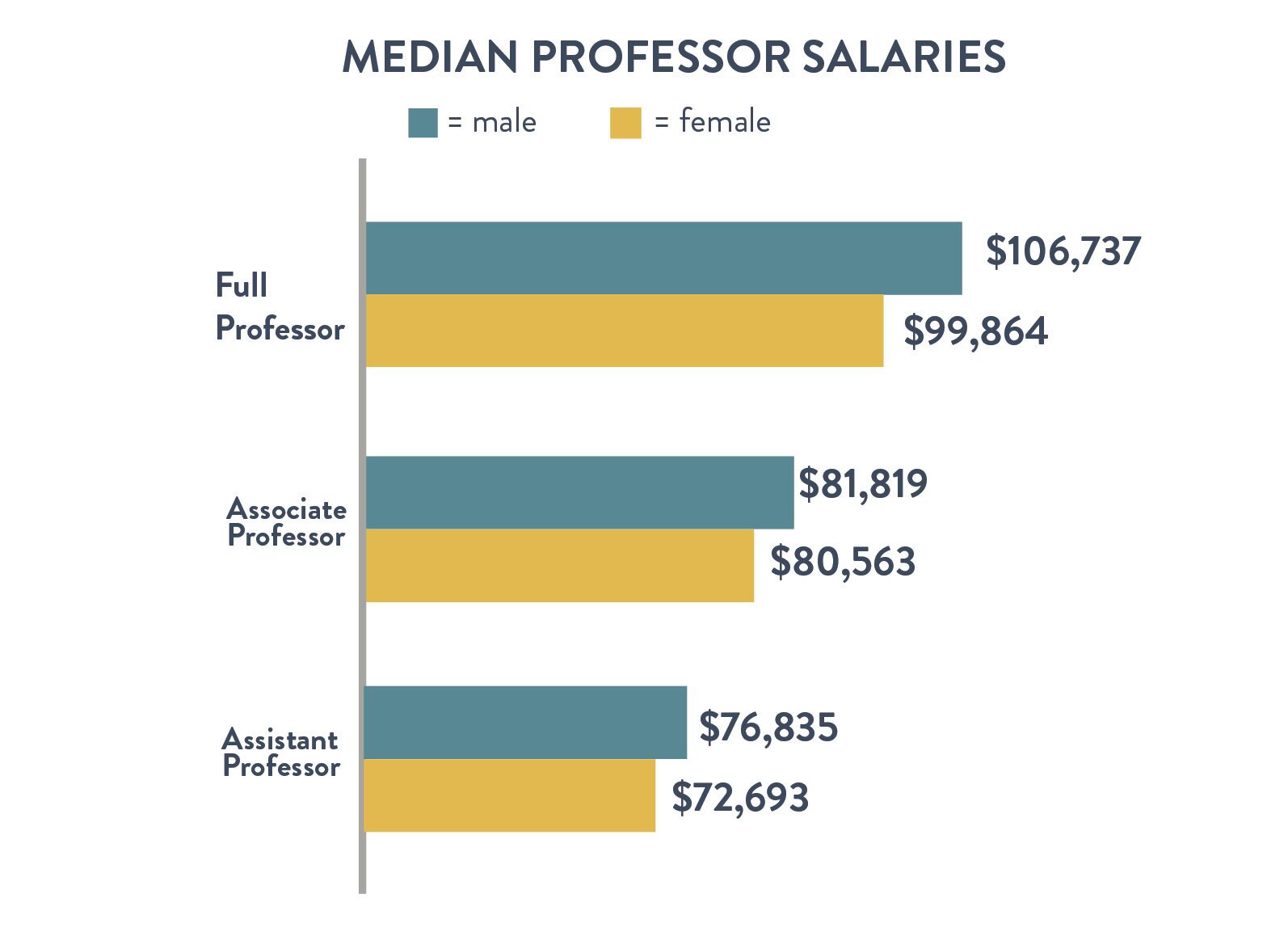
In plant sciences, the distinction of professor, associate and assistant ranking is also important to whether women make more or less than men. Although female professors in the department make a median salary $7,657 less than male professors, female associate professors out-earn men by $188, and female assistant professors make $1,723 more than their male counterparts.
As an example of the factors that Grey Gilbert specified as vital to calculating accurate medians, the highest paid tenured/TT woman in chemical engineering, who is not the department head or associate dean, makes $94,321. In comparison, the highest paid tenured/TT male in the department makes $145,254. However, the male is a full professor while the female is an associate professor, the highest rank for a woman in this department. The pathway of tenure-track faculty begins with newly hired assistant professors, who become associate professors and then full professors. This ranking can significantly impact salaries, Grey Gilbert explained. “Once you move up a rank, you get a salary increase. But there’s also a lot that can happen in between those promotions… that would fall under merit.” Academic publishing, for instance, adds to a faculty member’s merit quality while influencing the chance of promotion. Both those factors affect pay.
Another significant factor in the apparent faculty wage gap at MSU is the source of salary funding. Salaries of most faculty are completely funded by the institution. However, for professors who conduct significant research or are involved in other state or national institutions and organizations, salaries may be partially funded from grants not affiliated with MSU. In the spreadsheets provided by the OPA, a column specifies what percent of each faculty member’s salary comes from MSU. Any other funding, Grey Gilbert explained, may contribute to an apparent wage gap while remaining out of the institution’s control. “We have faculty…that are funded through state and federal programs. A lot of times those have a cap, right? And we don’t have the ability to pay them extra from state funds because they have to be paid from that grant. And similarly, some faculty…are able to be paid more based on research or grant money,” she said.
Another concern arises from the disparities in the data: is MSU failing to promote women? The answer is yes, and no – neither at the direct fault of the university. The glass ceiling, a term for the social barrier preventing women from being promoted to top jobs at a caliber equal to men, exists nationally. Historical trends such as women leaving the workforce to care for a child or family member and a lack of education in, or the inability or unwillingness to pursue, fields such as those in STEM–science, technology, engineering and math – due to social expectations create this invisible barrier.
Women make up over half of the MSU faculty, so it is clear that hiring practices, such as the involvement of the IChange Team from the Office of Diversity and Inclusion, which helps promote diverse hiring practices, works. MSU received an ADVANCE Grant from the National Science Foundation back in 2012, which partially helped increase women’s involvement in STEM fields. According to the OPA’s Faculty Diversity Dashboard, the percentage of female faculty (including non-teaching faculty) has grown from 40% in 2006 to 55% in the 2022 academic year. A more significant change is the proportion of female faculty to the position of professor, which has risen from 32 in 2006 to 71 in 2022, compared to 182 male professors in 2006 and 153 today.
When department and discipline, rank, merit and gender are all taken into account, it is clear that designating salaries for each of MSU’s 1,428 teaching-faculty members is a tedious and complicated process. MSU has evidently made great strides in just over the last decade in hiring a more diverse faculty and focusing on women and their pay. While it is clear, based on the salary data, that there is a long way to go, both on the national and university level, in the fight for women to always make 100 cents on the dollar of men’s earnings, representatives of MSU insist their efforts almost completely curtail any discrepancies in pay between genders.
Faculty salary data provided by the MSU Office of Planning and Analysis (OPA) can be found by visiting https://docs.google.com/spreadsheets/d/1LS-tDj-HuI1xRFkxhkMoTKHIBFgaxYlq/edit?usp=sharing&ouid=102503706135004975994&rtpof=true&sd=true.
A previous version of this article said that in 27 out of 55 departments, tenure-track women make less than men and in 29 out of 40 departments, non-tenure-track women make less than men. It has been corrected to note that the proportions are flipped. In 29 out of 40 departments, tenure-track men out earn women. In 27 out of 55 departments, non-tenure-track men out earn women.



Comments ()