
Amidst concerns, Campus Civil Rights opens with high hopes
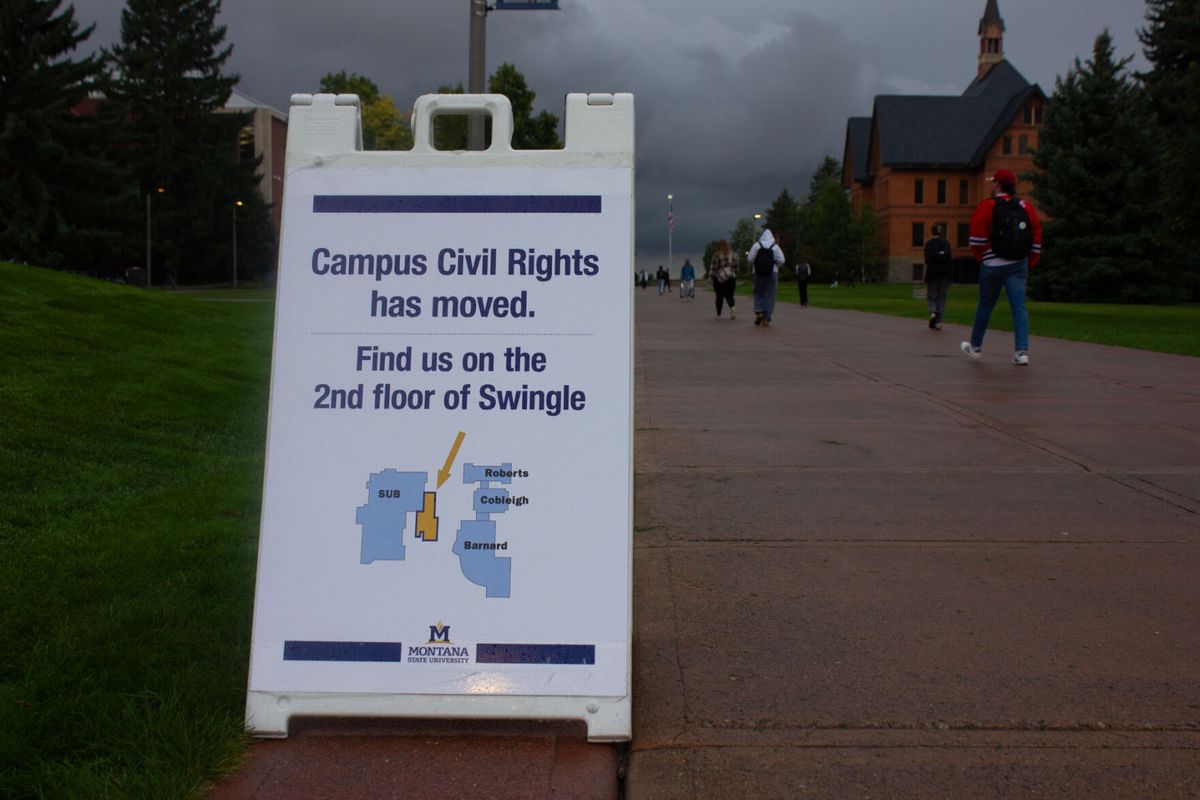
A new office has moved into the second floor of the Swingle Health Center. Almost every day since the beginning of the fall semester, a stark white letterboard sits outside, angled to catch the attention of passersby. In bright red letters, it reads: “CAMPUS CIVIL RIGHTS — COME TALK!”
On July 8, an email was sent out to MSU staff, faculty and students announcing the establishment of “a new campus unit” that consolidated the services of both the Office of Institutional Equity (OIE) and the VOICE Center under one roof. The new office, known as Campus Civil Rights (CCR), opened at the beginning of this semester and exists as a “one-stop shop” for students, faculty and staff seeking remedies and support, according to CCR Case Manager Jessica Feltner.
“[CCR] is here to help and support anybody that's dealing with discrimination, harassment, sexual harassment — including interpersonal violence,” Feltner explained. “What we're really here to do is get people to the support and the remedies that they need in order to get back to their role on campus.”
Origin of the CCR
The idea for CCR originated in response to student feedback from ASMSU, according to Feltner and Managing Director of the CCR Kyleen Breslin. The restructuring aimed to create one consolidated office for support and advocacy for students, faculty and staff.
Breslin said that during discussions in the summer of 2023 between administrators and ASMSU leadership, the idea of a centralized place on campus where students could seek advocacy for all types of protected class harm was brought forward by ASMSU leadership. During that time, The Exponent reported that due to feedback received during MSU’s 2023 “Week of Belonging,” the possibility of a new crisis response center was being discussed and researched.
“At the time, a lot of the services that [students] were identifying already existed on campus, but they were a little bit decentralized,” Breslin said. “We heard [students wanted] a broader scope and also felt like they had to go to a lot of different offices to get the resources that they needed.”
Breslin said that ultimately, CCR combines the resources of the VOICE Center and the OIE and expands their scope. Now, a student experiencing any form of protected class harm — discrimination and harassment based on a person’s identity — can receive the same services that were previously only available for students experiencing relationship violence. She explained that CCR further streamlines the services that were shared between the former offices to reduce transfer between those offices.
“Students won’t have to tell their story to multiple offices to receive all of the services available,” she said.
Feltner said that the office currently has five — soon to be six — professional staff members and about 20 peer advocates. A part of that group consists of former VOICE Center peer advocates, whom Feltner said were all given the option to join CCR.
“Obviously, we're not going to force anybody [to join] if they don't agree with whatever part of it — that's totally okay. But we have a good group of volunteers and student staff that wanted to join this effort,” she said.
Feltner said there are also around 20 prospective student volunteers who have displayed interest in joining CCR and now are going through training to be future peer advocates.
Concerns with the change and loss of the VOICE Center
However, this change — especially in regards to the dissolution of the VOICE Center — has not come without concern for some. MSU student and former VOICE Center advocate Ginny Lou Garabedian explained that she was disheartened by the office disappearing. “I'm less motivated to go and work for this office that I originally didn't sign up for,” she said. “It's just difficult to have a place that you loved, trusted and had a relationship with the people there and then to be like, oh, you're not doing that anymore,” she said.
Nathan Clark, vice president of MSU’s Students Against Sexual Assault (SASA) club, explained that he believes by dissolving the VOICE Center, the University has eliminated an essential resource for students and made it more challenging for students to seek support.
“To make it clear, I am not opposed to CCR, I am opposed to the dismantling of the VOICE Center. I do not believe that CCR will be able to take the place of the VOICE Center in the future,” he said. “The dismantling of the VOICE Center not only broke many people's hearts but also broke many people's trust that the University has their best interest in mind and that trust is not likely to be easily repaired. Not only that but, most students still seem to be unaware that the VOICE Center no longer exists. I've spoken with new and returning students alike who had no idea that this took place over the summer.”
President of SASA Danielle Johnson expressed that the club worked closely with the VOICE Center and that many members of SASA were also peer advocates. She said that the VOICE Center was familiar and a safe space for many students on campus.
“It was very well known as the VOICE Center hosted many informational events and there were stickers, posters and information on whiteboards in almost every building, dorm or classroom on campus, so even if students weren't currently in need of the resource, they knew it was there in case they needed it in the future,” she said.
Johnson said that because of the dissolution of the VOICE Center, she thinks fewer students will be reaching out for support as CCR is not well known on campus and, according to her, has fewer trained advocates and less defined confidentiality. “With MSU being in the red zone — the first six weeks of classes where 50% of all total assaults for the entire school year occur — it is really unfortunate that there isn't a fully functioning resource on campus for survivors,” she said.
Johnson said she believes that the creation of CCR was unnecessary, although she said it is amazing they have resources for students impacted by discrimination. “The VOICE Center had many amazing resources and there was nothing that needed to be changed about the resource, so it feels like MSU students were not listened to when they decided to create an umbrella resource of CCR,” she said.
“There were more in-depth trainings, more educational and healing events for survivors and a safer and more comforting space for survivors to share their experience,” she said. “Some survivors did not want to be referred to other resources, they simply just wanted to talk about their story, which is something I am worried CCR will not be able to focus on. I think the best and only option for survivors is to bring back the VOICE Center.”
Breslin, however, said she believes that the consolidation of The VOICE Center and the OIE into CCR will increase students’ confidence in seeking resources.
“Instead of having services split between offices, everything is being managed in one place by a case manager. Students won’t have to tell their story to multiple offices to receive all of the services available,” she said. “We have a fantastic team of professional staff, student-workers, resource advocates, many of whom served as VOICE Center advocates, helping to build the culture of CCR. With their input, I am confident that students will continue to view CCR as the place to get help navigating interpersonal violence and protected-class harm.”
The Exponent has conducted due research into conflicting information reported during the interview processes, reaching out to relevant parties and reviewing available documentation to ensure an accurate portrayal of events. Every effort was made to clarify incongruent narratives and address any misconceptions surrounding these complex events.
Confidentiality Concerns
While Ginny Lou Garabedian shared concerns about confidentiality in reporting threats to the campus community, Feltner, a case manager in the OIE for five years who worked closely with VOICE Center professional staff, maintained that VOICE Center policies around reporting have always been consistent. She said it was always required for the VOICE Center and OIE to report the de-identified information of crimes and incidents that fell under The Jeanne Clery Act of 1990, referred to as Clery crimes.
According to the Clery Center’s website, The Act requires colleges and universities to report campus crime data, support victims of violence and publicly outline the procedures put into place to improve campus safety. Clery crimes include, but are not limited to, aggravated assault, hate crimes, dating violence and stalking.
Feltner explained that if a Clery crime happens on campus grounds, offices must disclose de-identified information of the incident to the UPD. This report will eventually end up on MSU’s annual crime and security report, sent out each year in compliance with The Clery Act. The only truly confidential office on campus is Counseling & Psychological Services, she said.
“Prospective students, current students, families, all have a right to see what kind of activities [are] happening on a college campus and so it's part of our responsibility to the greater good to report this de-identified information,” Feltner said. “We don't report names, we don't report other characteristic details that would identify that person. But we do have to pass on the appropriate information just to make sure that it's being counted correctly.”
She explained that if a report of a Clery crime came into either the OIE or the VOICE Center, both offices were mandated to report that information. “I think that there's a misconception that the VOICE Center maybe was doing something very different,” Feltner said.
Breslin concurred. “[CCR] has the same Clery reporting obligations as the VOICE Center and the same FERPA-protected confidentiality,” she said.
Title IX Investigation Requirements
Garabedian claimed in her statement to The Exponent that the VOICE Center was not governed by Title IX and was instead “focused solely on supporting survivors rather than initiating investigations.” However, according to the Montana Board of Regents Policy 507; “All campuses of the Montana University System (MUS) shall follow Title IX policies and procedures adopted and approved by the Commissioner of Higher Education.”
Feltner confirmed that the entirety of MSU is governed by Title IX because MSU is Title IX compliant, and that policy applies to every office — including what was previously the VOICE Center.
Additionally, Garabedian alleged in a statement to The Exponent that due to changes made in 2020, Title IX offices could be required to report and investigate cases if more than two survivors identify the same perpetrator, even if the survivors do not wish to open an investigation. When asked if CCR would be required to open an investigation in the scenario described, Feltner explained that while a Title IX office always has the right to open an investigation, it doesn’t necessarily have to and each situation is evaluated individually to determine what course of action should be taken.
“We are here to make sure that our campus is safe. We're here to make sure that everybody's free of harassment and discrimination or the risk of sexual assault, etcetera. If we see a significant risk to campus, yes, we have the ability to address the situation. But that doesn't mean that if two people come in we automatically start an investigation,” she said.
Additionally, if CCR were to open an investigation for any reason, Feltner explained that complainants — people who come forward as impacted individuals — have full control over their situation and have the right to keep their information private within CCR. She said the process is participatory and that means people coming forward have the right to choose what works for them.
“If anyone is coming forward and they're seeking help, support, or they're just curious about what their options are — they still have the right to be in control. One of the things that we recognize is when we're dealing with events like interpersonal violence, it's that sometimes people lose the ability to make those choices,” Feltner said.
Breslin said that CCR’s process remains complainant-driven, meaning that the individual who experienced the harm will decide what happens next. “The only time that CCR must take action is when there is a threat of physical harm to an MSU community member,” she said.
Potential Loss of VOICE Center 24-7 Crisis Line
In regard to the VOICE Center’s 24-hour crisis line, Feltner confirmed that it is still active and is attended to by CCR staff during its operating hours. “After five o'clock, [callers] are being redirected to the Help Center so that they can still talk with somebody that has training around crisis response. [The services] have been adjusted a little bit to fit this broader range of things, so it doesn't look identical, but the heart of it is still there. The support and everything are still there,” she said.
Possible Lack Of Access To Contraceptives
Feltner mentioned that free Plan B, a resource the VOICE Center offered the campus community, is also still available to those who need it. “The Office of Health Advancement right now has all the Plan B, but we're working with them to get it back in our office at some point. Right now, if people walk into our office and they're looking for it, we're not going to leave them high and dry. We're going to walk them over there,” she said.
CCR open to questions, excited to move forward
Breslin said she encourages all who have questions about the new office to come ask them to avoid misconceptions spreading. “We have seen articles with inaccuracies or misconceptions about the change. These inaccuracies hurt community members who need resources. CCR is just getting started,” she said. “We invite anyone who has input on our services or the culture of the office to join our team.”
Feltner said that no matter what, CCR is ready to help anyone who needs it. “Our door is always open. If somebody walks in and they're confused on where to go, our job is to help them get the resources that they need, even if it's not something that we can help with.”
“The issue with misinformation is that it hurts the survivor. Survivors should be provided with accurate information, so they can make the choice [to] access the resources that they want and need,” she said.
CCR is open from 8 a.m. to 5 p.m. on weekdays. For more information about chances to get involved or access resources, head to its website at https://www.montana.edu/education/menu/resources/msu_ccr.html.
This story is still developing. On the date of publishing on Thursday, Sept. 19, Breslin will be presenting at the ASMSU Senate meeting in the Alumni Lounge in the SUB at 6 p.m. She will be going over the changes related to the OIE, VOICE Center and CCR. Questions will be reserved for speaking members of the Senate.


Comments ()