
Free Press Fest hosts discussions on the state of journalism
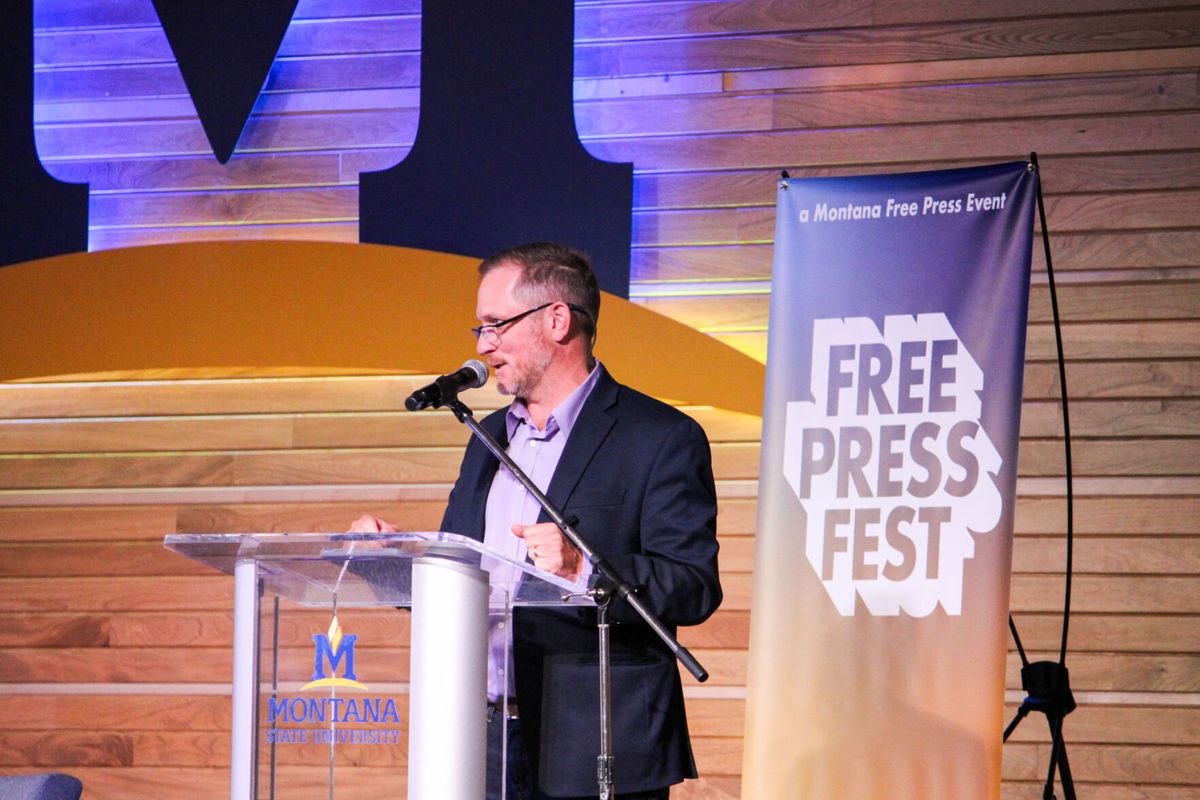
The second annual Montana Free Press Festival invited community members to campus for candid conversations about threats to journalism, democracy and public lands — and how local reporting offers a path forward.
MSU — the primary sponsor of the festival — hosted this year’s events, which were organized by the Montana Free Press (MTFP), a Helena-based nonprofit newsroom. The festival started Sept. 16 and featured three days of presentations and panels from prominent journalists and community figures.
“I can think of no better investment for those of us in this room — for our friends, for our neighbors, for our communities in Montana and beyond — than an investment in a free and fair press, and in a vibrant, flourishing public education system,” said MSU President Brock Tessman during the opening keynote on Sept. 16.
The opening keynote also featured award-winning journalist Tim Weiner and former Montana senator Jon Tester. The two discussed the precarious state of national security and the fight for credible information.
During the panel, Weiner addressed staffing changes in the CIA under the Trump administration. “These people are amateurs, and their amateurishness — their ideological blinders — increase the risks of a catastrophic, systemic intelligence failure,” Weiner said. “The only reason we know about most of this stuff is a cantankerous press.”
On Wednesday, breakout sessions featured a variety of panels. Conversations included land management in Montana, the role of local journalism in a shifting news landscape and hope for Gen Z in journalism.
“If you want people to be engaged with news, you need to reflect their lives back at them,” said UM journalism student and Youth Newsrooms panelist Claire Bernard. “I think local journalism is the core of what journalism is,” she said.
Wednesday’s presentations about public lands drew economics senior Frank Calandrella. He said it was cool to hear the panelists’ perspectives on the influx of wealth into the state and the landowners who are invisible to the public. “It’s not something that makes a lot of national headlines, so the local reporting — the local storytelling — is super important,” he said.
Pulitzer Prize-winning reporter Nate Schweber spoke on the “Managing the Millions: What Lies Ahead for Montana’s Public Lands?” panel. “The surviving conservation agencies — the Forest Service, the Park Service, the Bureau of Land Management — we see them now being defunded, defamed and demonized,” Schweber said. “Without those conservation agencies, the West goes back to being plundered and raided, and plundered and raided land is not long kept habitable.”
A keynote titled “Press Under Fire: Defending Journalism in an Age of Hostility” closed out Wednesday night. Speakers Mary Margaret White, Jodie Ginsberg and David Folkenflik shared advice from their experience as journalists.
During the festival’s concluding panel on Thursday, Barry Beach and his mentor Marsha Price discussed the power of the press in Beach’s own life. Beach spoke about his thirty-year incarceration for a crime he said he did not commit, and how journalism was critical in setting him free. “Had it not been for the press, I wouldn't have been able to carry out the battle,” Beach said.
Beach was 17 when his classmate Kimberly Nees was murdered. He was convicted of this crime four years later — despite none of the physical evidence matching him — and sentenced to 100 years without parole.
He spent nearly three decades behind bars before the investigative work of journalists publicized the case. In 2015, Beach was released from prison following the commutation of his sentence by former Montana Governor Steve Bullock.
“In order to bring justice into my life, it took the press and the media and the onslaught of deliberately using social media,” Beach said.
In an interview on Wednesday, Executive Director and founder of the MTFP John Adams said that the organization is driven by a desire to educate and inform people, not to garner profit.
“We’re not trying to capitalize on people’s fear, which is what so much of the mainstream news is now,” he said. “Our role, if we’re doing our jobs right, is that people can find the common ground.”
Some attendees observed a lack of young people at the festival. “I mean, it's kind of funny. I sit in the back of the crowd, and I'm like, there's a lot of white hair here,” Calandrella said.
Bernard said she thinks more young people need to engage with the news. “I think when people aren't willing to read something for more than 10 seconds, we're really straying from the core purpose of journalism,” she said.
“I think in general, part of the reason why people — young people — don't want to read the news is because they don't see themselves in the news. You have to make young people feel represented,” Bernard said.
To learn more about MTFP, go to https://montanafreepress.org/.

Comments ()