
French and architecture students to continue service learning in Morocco
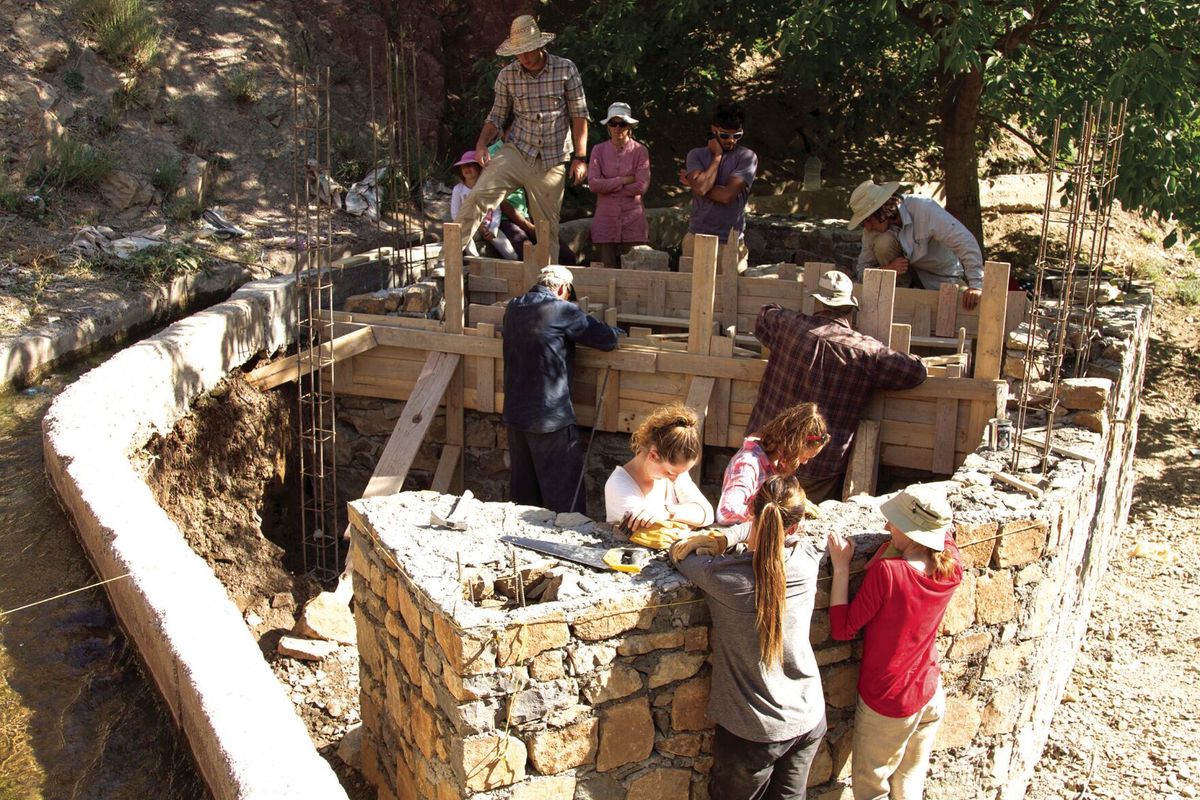
In late May, French professor Pascale Hickman and School of Architecture professor Christopher Livingston may embark with their students to the mountainous Zaouiat Ahansal region of Morocco for the first time in five years.
Hickman first began traveling to the region before the university laid out their priorities to expand international programs and since then the Office of International Programs (OIP) has increased its involvement in sending students abroad. “They’re there to support faculty, and to help organize these trips in such a way that they are safe and legal,” she said.
“Since COVID-19, I haven't been successful in getting my trip approved and sometimes it's because of factors that are outside of our control, like the pandemic, or where Morocco is classified on the State Department’s [safety classification of] different countries depending on what's going on there politically,” Hickman said.
Hickman also described roadblocks in the past with the dress code of students. Morocco is a majority Muslim country, and Livingston explained how students are expected to observe other cultural practices such as not drinking alcohol.
On Oct. 13, Hickman met with the Office of International Programs in hopes to smooth out the final hurdles going forward with the program. Currently, the trip to Morocco “[is] not confirmed but it is very highly likely. We have made it over the hurdles, but it still has to go past a few desks,” she said.
On these trips, Hickman and her French students have taught whatever the villagers asked for. “Sometimes they wanted computer literacy, sometimes they wanted English, they wanted Spanish or they wanted French. Mostly it's been French and that's what we started with. But because we believe in a bottom-up service learning paradigm, we simply ask the villagers what it is that they would like us to bring and we bring that,” she said.
Livingston has also taken students to work on the restoration and construction of buildings in the villages of Aggoudim and Amzerai. In 2015, they constructed a wash station in Aggoudim.
The region first became of interest to the School of Architecture after MSU alumna Cloe Erickson visited it on her honeymoon, according to the accounts of both Livingston and Hickman, as well as an article published by the MSU News Service in 2010.
At the time, Erickson’s husband Kris was a climber for the brand North Face and was featured in a short documentary video from 2006 which followed one of their first projects in the area — repairing a school roof and building trails for herders in the village of Taghia, one of the five villages inside the Zaouiat Ahansal region.
“Spending a couple of days working on the trails that they use makes a big difference and I think it really changes the attitude of the locals and makes them feel like people care about this place more than just to come climbing,” Erickson said in the article.
According to Livingston, former architecture professor Bill Rea brought students to Zaouiat Ahansal between 2009 and 2012 to work with Erickson on the restoration of igherms — rammed earth structures — used to “house the pilgrims of Zawiya Ahansal, the followers of the local religious sect who come to visit the founding saint’s grave,” according to the Atlas Cultural Foundation, a non-profit charitable organization which was founded by Erickson in 2009.
Other purposes of this structure were to house members of the saint’s family and to protect the village from other tribes as well as the currency of villagers. They were used because they are “well protected by guards — the saint’s family slaves,” according to the Atlas Cultural Foundation.
Hickman explained how the Morocco trip with French students was passed down to her from her own mentors in the department. Entomology professor Florence Dunkel first took a graduate student to Mali in 1997 and the first four undergraduates in 2000, which began the Mali Externship Program on campus. French professor Ada Giusti then began taking students to Mali alongside Dunkel, but when a civil war broke out before her trip in 2012, Giusti was redirected to Zaouiat Ahansal, while Dunkel continued her relationship with the village in Mali.
On her work in Mali, Dunkel said: “It was a time when we could test this process of engaging with a community in a decolonized way, a thoughtful way, a way that generates real relationships and can lead to people [in the village] solving problems that they want to do something about.”
Since then – though the entomological program is no longer running – the School of Architecture and French faculty have run separate programs to the region. The architecture program is five weeks long and the French student-teaching program is two weeks long.
“This is all interesting because these are all wonderful professors who are passing the torch, mentors who are passing on what they know to other professors,” Hickman said.
She described her hesitance the first time she made the trip. “Language is one of those things which can be seen as an instrument of oppression [when doing service work in an area that has a history of colonization],” she said. She said that she wondered what her role was there, how she and her students could help. She questioned if the sheik, who is the leader of one of the villages and whose home they were staying in, believed that they were a “force of good.”
Hickman described the experience of the elders pulling her aside on this first trip and explaining the ways that the village children would benefit from the help of Hickman and her students. “One of the things that really stuck with me was when one of the elders pulled me aside at the cafe and he said, you know, it's easy to make friends, it's hard to keep them. And he said, we really want and hope that we can keep this friendship,” she said.
Hickman also made a promise to the sheik’s son that she would come back every year as long as she was able to. “These promises that I have made, and these relationships that I've forged, and this encouragement that I've received from the village elders, makes it all very, very important to me,” she said.
“It’s my happy place.” Livingston said when asked about Zaouiat Ahansal. He described the process of helping the community through architecture and how he and his students have to adapt to the resources locally available to them.
He discussed an instance where students were cleaning shovels and expressed that they wished they had a brush to scrape them clean. A craftsman came over and grabbed the branch of a juniper bush, scrubbing his own tools and walking away. “We have the tendency to move towards the most complex solutions to solve anything, instead of looking for real simple ways of solving things,” he said.
“What we do as architects is we suggest different ways of working, and we propose something that they can build, and that they can turn into their own. So that we essentially aren't there. It's really community empowerment, at least from the architecture,” Livingston said.
Speaking on the projects Livingston and his students have designed over the years, he said: “The ones that we built, they're interesting because of the students that work on them. Some of them are a little bit more organic, and some of them are a little bit more straightforward, but they're all fairly simple crude drawings that are done by hand, on-site.”
Livingston also described a project completed by him and the students in 2019 — a public toilet facility — that he hasn’t been able to revisit since its construction. “This is why I was interested when [Hickman] contacted me because it was like, well, maybe I can actually go and see that project again,” he said. “It was a really interesting project because it was something that [the villagers] said they would never do. And then they went ahead and did it, but they combined it with a place where people could wash themselves before they prayed.”
MSU’s ties to Mali stretch back over two decades, and ties with Morocco nearly as long. Service learning work that professors have done across departments has fostered long-lasting relationships that still continue, and benefit both faculty and students here at MSU and these communities abroad.
“The thing that I miss the most is being around all the people that are in the village. And what I like best about the program is that you can teach students to have a more accepting global attitude, being an architectural student working in a village that they’re really immersed in,” Livingston said.


Comments ()