
'From the belly of the beast': Bozeman residents protest Iran war
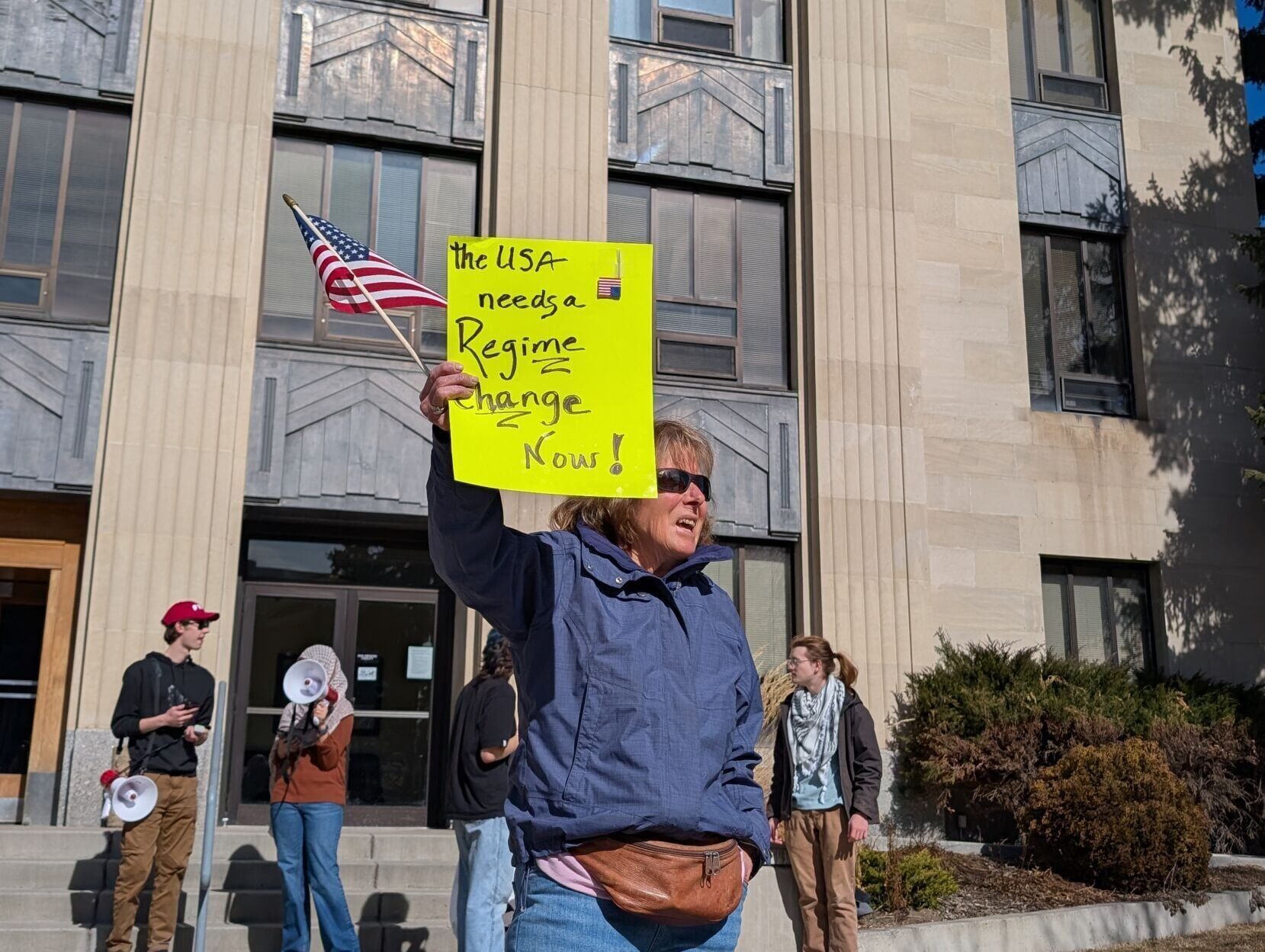
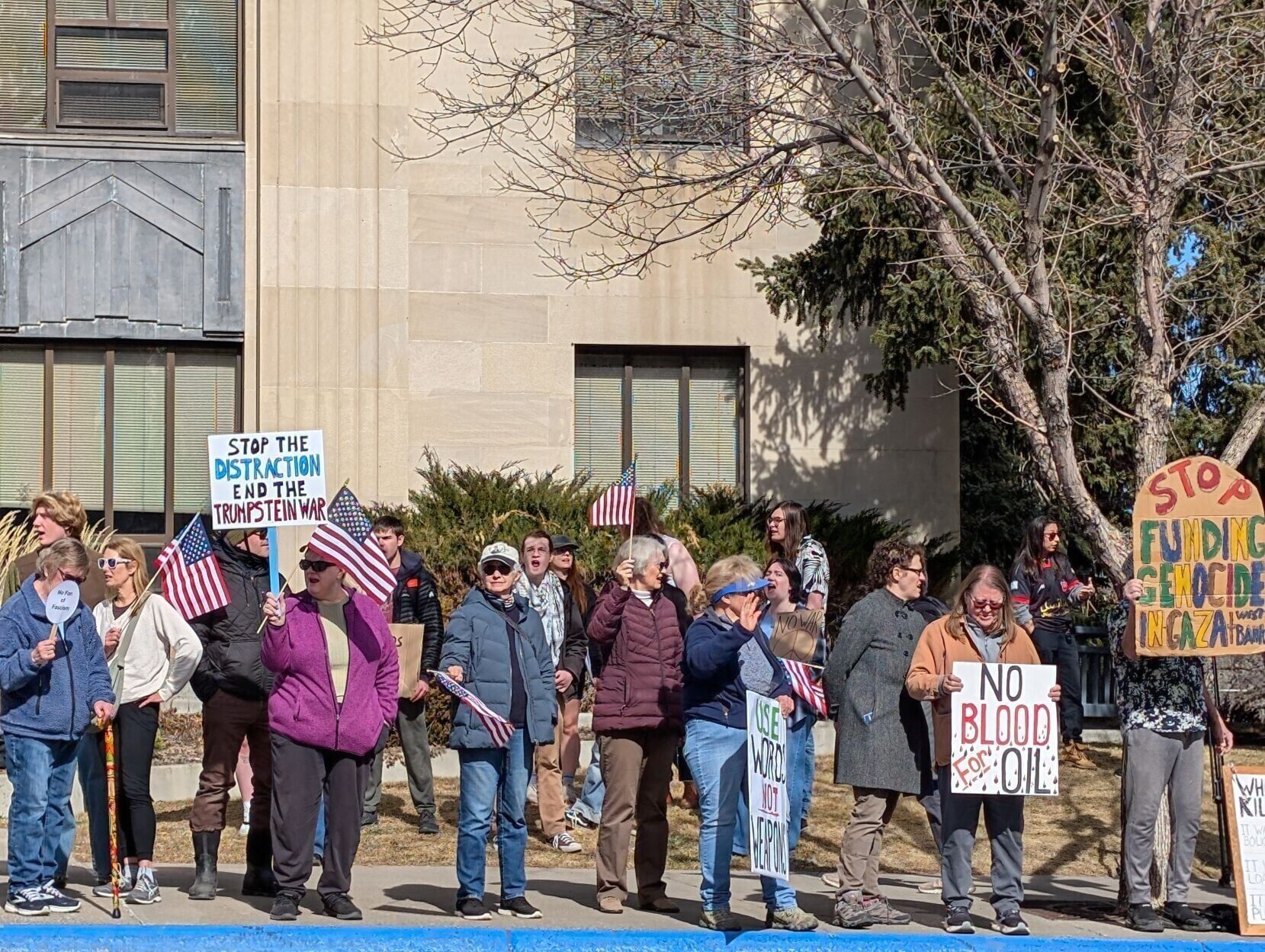
As rounds of strikes and retaliatory fire continue pummeling the Middle East, more than 50 protesters in Bozeman gathered outside the Gallatin County Courthouse to oppose the U.S.-Israeli strikes on Iran that set off the regional conflict.
Organized by Montana State University groups Students Against Genocide and Students for a Democratic Society (SDS), the Sunday rally drew chants against U.S. foreign intervention and perceived warmongering. Organizer and SDS vice president Homa Masood said Montana’s conservative stronghold makes the message all the more powerful.
“It shows that even in red states, people are also standing up,” Masood said. “I think it’s important that from the belly of the beast, we’re standing up and saying that we don’t want this from our government.”
Speaking at the rally, SDS president Julian Staggs urged the crowd to hold President Donald Trump responsible for starting a “reckless war.”
He also encouraged attendees to support the broader campaign by SDS and Students Against Genocide pushing the university to sever its ties to weapons manufacturing.
“Affiliated with Montana State University are a variety of companies that sell technology to Israel, which it uses against the people of Palestine and now against the people of Iran,” Staggs said. “We stand against that. We don’t want war industry here in Montana.”
Trump announced the joint operation in the early hours of Saturday morning. Strikes hit more than 14 cities across Iran, killing Supreme Leader Ali Khamenei and 40 other senior Iranian officials, according to the Guardian. More than 100 children were also killed when bombs struck a girls school in Minab. Iran and Hezbollah have since retaliated with strikes on Israel and Gulf states, and the exchange of fire continues.
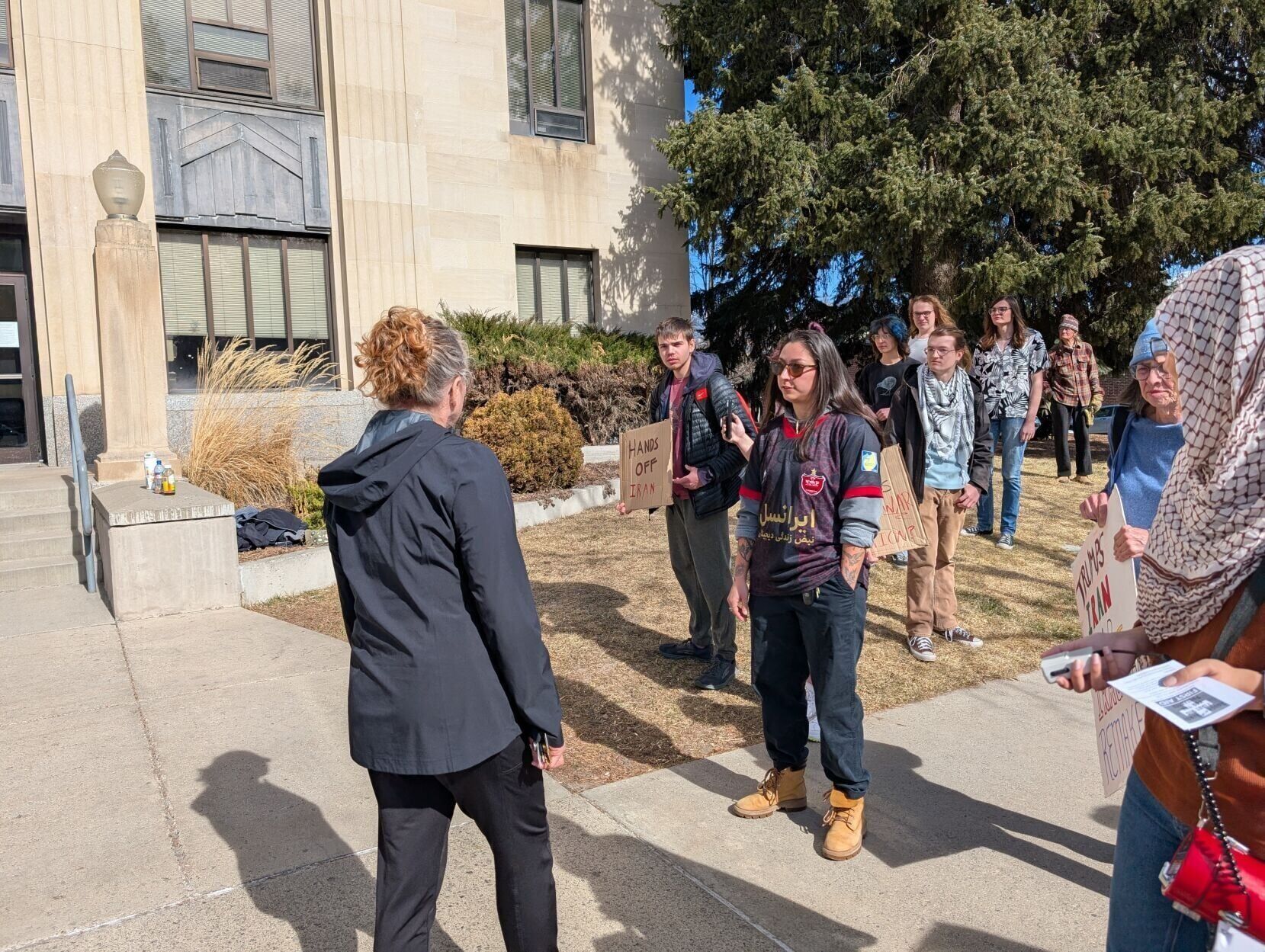
As tensions rise overseas, the protest outside the courthouse did not encounter organized counter-protests. However, a woman passing on foot stopped to challenge the group, suggesting the strikes benefit Iranian civilians by removing a dictator, pointing to the Islamic Republic’s record of systematic human rights abuses as evidence that the regime itself is the primary threat to the Iranian people.
For Emma Shahabi, an Iranian-American in the crowd, it was a familiar argument. She thanked the woman for her concern but said the future of Iran should be decided by Iranians themselves, not through an externally imposed decapitation of its government.
“They deserve a free and secular Iran,” Shahabi said. “And that means freedom from the current oppressive regime, and also freedom from Western interference from the U.S. and Israel.”
When she heard news of the strikes, Shahabi called her grandmother looking for word of extended family still living in Iran. The country has been under an internet blackout since the strikes, cutting off communication, but Shahabi said her grandmother has not lost hope.
“Iranians are a very brave people, very proud to be Iranian,” Shahabi said. “What she shared with me is that she has a lot of faith in the (Iranian) people to be resilient, and just hopes that we can do our part here to get the US to stay away.”
The estimated death toll in Iran has surpassed 1,000, according to Al Jazeera. Israeli officials have confirmed 11 casualties and dozens more injured, and six American soldiers have been killed by Iranian retaliatory strikes, with Trump warning there will “likely be more” casualties.
As escalation continues overseas, Bozeman resident John Heilman said the domestic pushback feels like a repeat of history. He recalled marching in the protests against the Vietnam War in the 1960s, a conflict he viewed as a senseless drain on lives and resources that could have been spent elsewhere.
“My thought was maybe Vietnam would teach us, because Vietnam was clearly a waste,” Heilman said. “Yet we just keep on doing this over and over and over again.”
Back then, Heilman was one of thousands of young people in the streets. Now, decades later, he couldn’t help but notice that the faces around him at the rally had aged along with his own. Daisy Baertschi, SDS treasurer and one of the rally’s organizers, said there’s more apathy on campus today compared to the widespread student activism of decades past.
“You couldn’t escape the Vietnam War,” Baertschi said. “If you were young, you were going to get drafted, so the youth rose up. But now we can just ignore it.”
Baertschi said they understand why many young people disengage. The internet makes distraction easy, they said, and many young people are burned out from the volume of major news events over the past year.
“We were just processing the corporate takeover of Venezuela,” Baertschi said. “We have no idea exactly how that’s going to shake out, and already we’re bombing another country.”

Comments ()