
Get into the swing of things with Big Sky Timber Sports
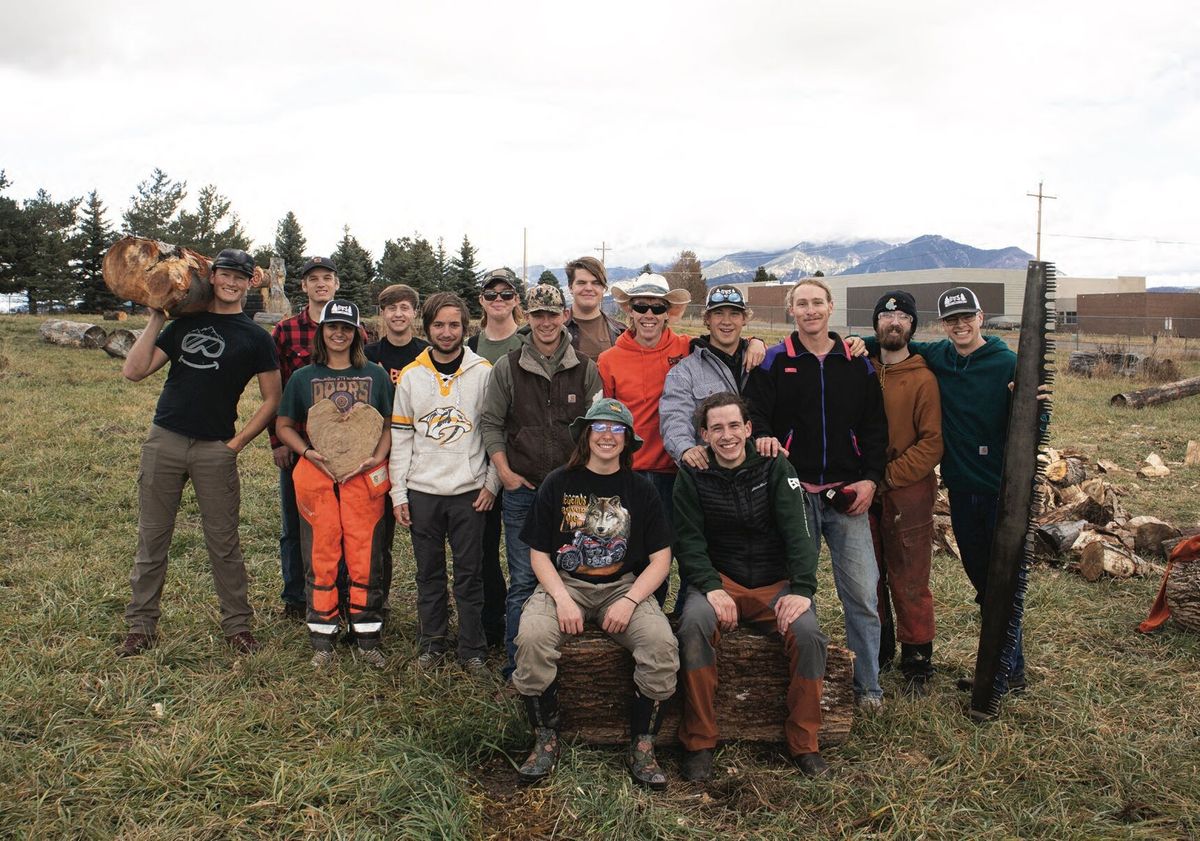
Walking up to the Big Sky Timber Sports (BSTS) practice field behind Bobcat Stadium, the lawn may first appear as a scrap yard as you pass piles of wood, rusty machinery and scattered wood chips. Looking inward, axes swing and nail the center of distant targets as log poles soar through the air. Among the split logs and wood debris, 20 MSU students get together three days a week to keep the competitive traditions of lumberjacking alive. Grab an axe or a saw — and perhaps a red-checkered flannel, too — and join us as we get into the swing of things with BSTS.
Lumberjacking emerged industrially on the North American continent in the 18th century when the French and British colonists began logging fallen trees for timber, according to The Canadian Encyclopedia. However, logging trees for domestic use began thousands of years ago. Senior Jake Torstenson, from the birth town of The National Lumberjacking Championship in Hayward, Wisconsin, explained how competitive lumberjacking came to be.
“Basically, what would happen at logging camps around the U.S. is loggers would get done with clearing their plots of land, and they had to prove who was the best at what they did, and that’s where all these competitions were bred from. So, for example, the log running event came from loggers who used to bring the wood down the rivers to sawmills. We compete in all these events to try and keep them alive within the community,” Torstenson said.
MSU alum Gavin Lommatsch did just that when he formed BSTS in 2011.
BSTS keeps busy; from traveling to competitions to out-sourcing wood, the team does it all. The team competes in two to three yearly competitions, consisting of Choptoberfest in Fort Collins, Colorado, the Idaho Classic in Moscow, Idaho and the Conclave in San Luis Obispo, California, for the 2023 season.
Each competition gives participants a chance to show off various skills. At the team's largest event this year — the annual Idaho Classic — 130 participants from the American Western Forestry Conference (AWFC) will compete for the titles Belle and Bull of the woods on Nov. 10-11. These are the female and male competitors who score the most amount of individual points.
Scoring in timber sports is no different than popular sports such as track and field in regards to the use of points systems. In competitions, cumulative points are awarded to teams and points per event are awarded to individual competitors. Most events are separated by gender, but sometimes, in events such as the pulpwood toss — where competitors throw a set of four pieces of pulpwood between two pairs of stakes — or Jack and Jill — a cross-cut sawing event — men and women compete together. Typically, ten points are awarded to the first-place finisher, six to second, and so forth, according to Torstenson.
With competitions usually lasting one to three days, there are a lot of events to complete. For this reason, the American Western Forestry Conference (AWFC) created what’s known as open and closed events to allow participants to show off their strengths in competitions while still minimizing material overuse and time concerns, according to Torstenson.
“A hosting team can only acquire so much wood, so you don’t want everyone doing one event,” Torsentseon said. Therefore, in an event as big as the Idaho Classic, participants can only enter three closed events and as many open as they wish.
For example, in caber toss — an event where participants launch a sizeable tapered pole, that varies in weight per competition, called a caber forward to see who can throw it the furthest — and axe throwing — in which participants throw an axe at a target in hopes of hitting the center bullseye — people bring their equipment, which helps prevent the hosts from burning through materials.
However, selecting only a few events isn’t easy, with up to sixteen events to choose from. The number of events and how many one can select depends on the host and event size. Aside from physical assessments of strength and form, timber sports members can also test their forestry knowledge.
In the event known as dendrology, participants are tasked with identifying trees and plants based on the leaves and seeds presented. Along the same lines, in the cruise event, participants must study a plot of land and try to determine the size of the tree — identifying the diameter, height and central unity — within a specific area.
“There are a lot of skills that can be taught [in timber sports.] It’s a chance for people to learn actual skills that they can use later on in their life,” Torstenson said.
If there is one thing the club stresses, it’s safety. The president of the club Rex Lindley shared that timber sports isn’t as scary as you might think. According to Torstenson, the club has had no severe injuries since its inception in 2011.
One way the conference mitigates injuries is by enforcing practice protocols. The AWFC requires a minimum of seven practices per event for a competition. Torstenson explained that, ultimately, the team wants each person to be able to control and understand what they are doing.
Participants must also wear personal protective equipment such as glasses, earplugs and chaps for chainsaw events. For chopping events, metal greaves — which are steel caps worn over boots in events where down-swings — a motion where the blade glides off the wood and hits your shins — are possible, according to the AWFC.
Lastly, the team caps enrollment at 30 members for safety and monitoring reasons. In addition, there needs to be two safety officers present at every practice.
With 20 members, BSTS is one of the smallest clubs in the AWFC. However, in the last two years, the team has grown exponentially. During Lindley’s first year on the team in 2021, the club had only three members. Lindley said this is most likely due to their expanded outreach on campus and social media, with events like Catapalooza boosting their reach.
The AWFC encompasses 15 schools, ranging from Arizona, Colorado, Idaho, Montana, Oregon, Washington and California. According to Torstenson, some teams are better than others given the size of their forestry programs or geographical knowledge of logging. MSU is one of the few schools in the AWFC without a forestry program, Torstenson explained. Students within other schools' forestry programs can gain a knowledgeable edge over the competition, something that BSTS has to learn through experience and not in the classroom.
Despite this, BSTS has managed to have their best season yet. “The team environment is so good this year,” Lindley said. In their last competition, Choptoberfest, the team won more titles and events than ever, with 14 awards in total.
The conference may be competitive, but it’s far from uncompassionate. “Everyone wants to help out everyone. In our last competition, [BSTS’ opponents] Oregon State University gave us a brand new axe head and saw so that we could remain competitive. It’s amazing. The entire community just wants to keep the sport alive. They don’t care about winning, they just want everyone to be involved,” Torstenson said.
Their compassion extends beyond the conference: the team consistently finds ways to give back to the community. At the beginning of the season, the team helped out a farmer in Four Corners who needed cottonwoods cleared from their property. The wood the team removed was then used for practice purposes.
“It’s a community involvement that helps us engage with people. It helps us get materials while still giving back,” Torstenson said. And the cycle of giving doesn’t stop there. The scraps from practice were then bundled up as firewood and donated or sold back to the community according to Torstenson.
The team welcomes everyone, even those who have never held an axe before. “This team gives everyone the opportunity to get involved. The key value of our club is the ability to teach. We teach members how to handle, maintain, sharpen and change equipment,” Torstenson said. Take Lindley, for example, who joined the club without prior experience and is now at the forefront of the program.
In focusing on inclusivity, the team hopes to close the team’s gender gap. Currently, the team has fifteen male and five female members. “We want more [of a] female presence on this team,” Torstenson said. “A lot of people believe that in this sport, you have to be big and strong. A small person can do amazing at these competitions. Size shouldn’t discourage female members,” Torstenson said.
Instead of focusing on physicality, Torstenson believes the key to success is good form. “It’s more about form and understanding the events than being as strong as possible. I’ve been in competitions where you have someone who looks like an NFL player and someone who looks like a string bean. The smaller kid can beat him because he is more accurate with an axe,” Torstenson said.
BSTS is filled to the brim with competitive encouragement and a passion for preserving old traditions. BSTS invites you to support the timber sports team as they continue to climb the scoreboards this season.


Comments ()