
Gov. Gianforte vetoes subsidy for Montana child care workers

Following failed votes at the legislative session and a series of decisions Friday by Gov. Greg Gianforte, Montana families struggling to access child care are unlikely to see relief in the near future.
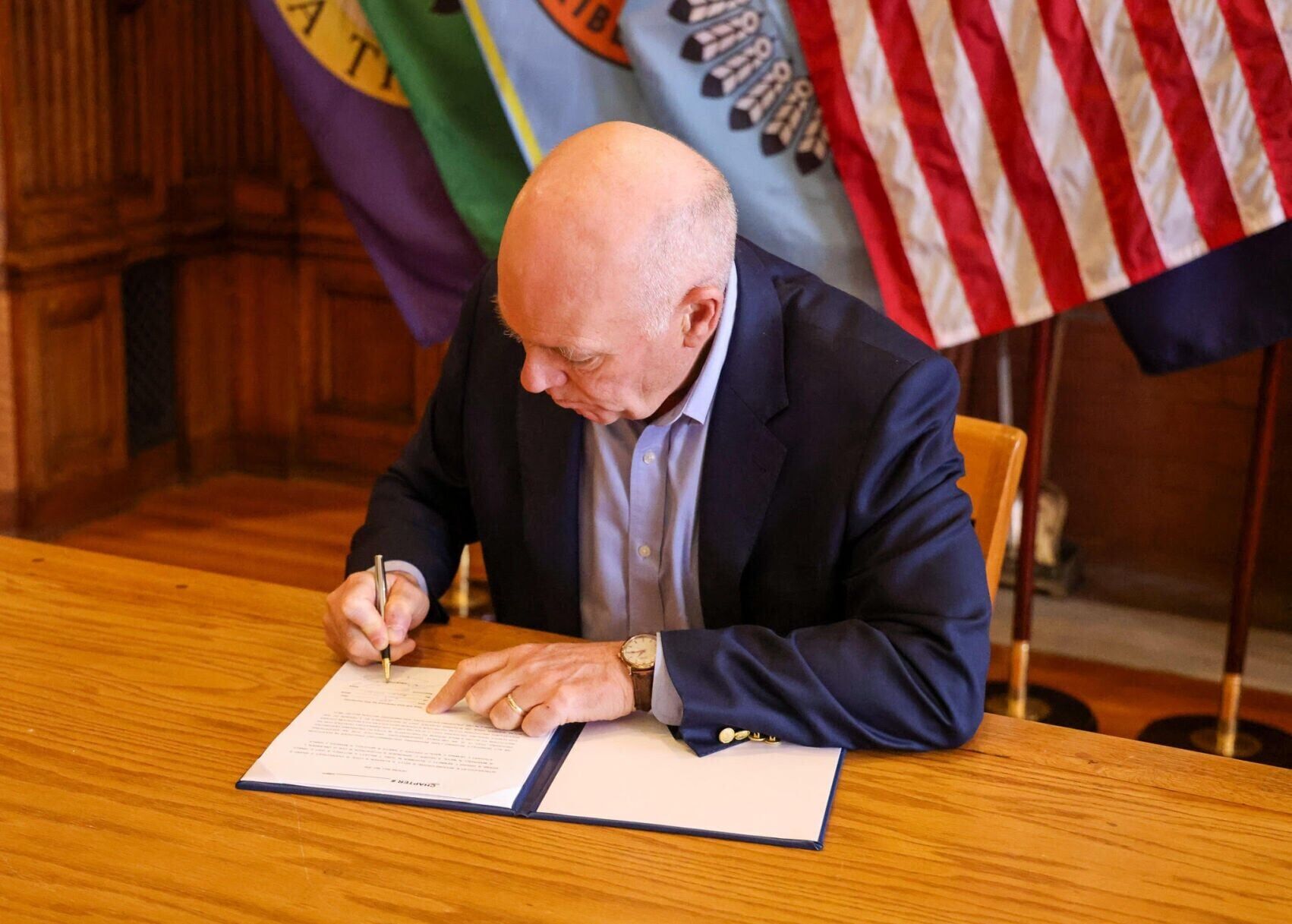
Gianforte, a second-term Republican, vetoed House Bill 456 on Friday, a measure that would have extended an existing child care subsidy program to parents who work in the industry. It was also the last bill left standing that had been architected by Democrats in an effort to provide relief to the beleaguered sector; two other child care reform bills failed to make it to Gianforte’s desk.
Sporting a $5.5 million per-year price tag, HB 456 would have used a combination of state and federal money to subsidize tuition for child care workers with a household income less than double the state median. That’s about $100,000 for a family of three.
The average child care worker in Montana earns $11,700 per year at a center or $9,100 in a home-based facility. That’s too much to be eligible for the existing Best Beginnings subsidy (the cutoff is 185% of the federal poverty level, or $49,302 for a three-person home) but not enough to afford full price child care.
In an industry where frequent staff turnover is the norm, many providers sweeten the pot by waiving or subsidizing tuition for prospective employees with day care-aged kids of their own. The move might get them workers, but it whittles already-shoestring margins even further as limited spots are used on non-paying parents.
Bill boosting funding for child care workers' kids headed to Gianforte's desk
HB 456 was heralded by day care owners all over the state as a ‘game changer’ in their efforts to stay open without raising prices even higher for families and a “lifeline” for their small businesses that would have a positive economic ripple effect across entire communities.
Nearly 100 child care providers, nonprofits, unions, various cities' chambers of commerce, and others sent Gianforte a letter urging him to sign the proposal into law following the close of the legislative session, saying it is an “effective, smart, and focused solution for child care recruitment and retention.”
It wasn’t enough to convince Gianforte, who wrote in his veto letter that the proposal would provide “a benefit to one worker to the exclusion of the others.”
Supporters’ enthusiasm for HB 456 was matched by their disappointment at news of the veto.
“Hundreds of workers, child care providers, parents, and business leaders made their voices heard and shared how important HB 456 would be for recruiting and retaining child care workers,” said Grace Decker, coordinator for Montana Advocates for Children in a statement. “Montana faces a child care crisis, and we will continue to push for needed investments to support expanded access to child care.”
Butting up against the Friday deadline, Gianforte did sign into law House Bill 924, a megabill that creates a trust fund unique from anything that exists in Montana, including a pot of money for child care.
“With House Bill 924 enacted, we have tools at our disposal to address Montana’s child care shortage and innovate the industry, including offering grants to launch or grow child care services, improve affordability and increase access,” Gianforte wrote in his veto letter of HB 456.
While the bill is worth $900 million overall, only $10 million is allocated toward child care at the outset, and only three-fourths of that can be spent immediately. Ultimately, the account’s true purpose is to accrue interest to fund future initiatives like recruitment and retention of childcare workers, efforts to make childcare more affordable and technical assistance grants for child care businesses.
The bill also creates a board that will decide how the earned money will be used to bolster the industry, so it’s not yet clear when or how the money will be doled out.
Rep. Jonathan Karlen, a Missoula Democrat who sponsored the Best Beginnings bill and was also a major backer of HB 924, said he imagined the two as working together to tackle the child care crisis from different angles.
“I almost feel like (HB 456) was a measure to stop the bleeding and to keep child care providers open,” he told the Montana State News Bureau. “What I was hoping the trust would be was more of a tool to pilot innovative methods on top of [HB] 456.”
In the next fiscal year, the HB 924 child care trust is projected to accrue roughly $2.3 million in interest, to $2.8 million the following year, and that number is projected to steadily increase each year. It is set to increase in perpetuity, although expenditures can not exceed $10 million per year.
HB 924 had an arduous journey to the governor’s desk. The proposal stoked tensions and deepened pre existing divisions between some Democratic legislators and between a more moderate moderate group of Republicans and the rightmost flank of the party.
'Once-in-a-generation' bill worth $900 million intensifies divisions at MT Legislature
The bill’s proponents explained that Montana has been in good financial shape in recent years, seeing surpluses in the state coffers largely because of increased income tax collections and pandemic-era federal allocations. They want to see that money invested into Montana’s future. But those who were against the bill, of which there was a significant number who loudly voiced their opposition, believed the state was squirreling away its surpluses instead of putting the extra cash directly in the pockets of Montanans.
Both HB 924 and HB 456 made it across the finish line in large part due to the support of the Nine, a group of Republican senators who sided with Democrats to pass a slew of shared priorities even in the GOP-majority chamber.
Bolstering child care was a top priority for the Democrats – who are nearly in the super minority in the Senate – going into the legislative session, and they were able to get the Nine to join them in voting for HB 456 to get the bill to the governor’s desk.
Sen. Josh Kassmier, a Republican from Fort Benton and the ringleader of the Nine, acknowledged the governor’s equal part to play in the lawmaking process, and that sometimes means striking down measures passed by the Legislature.
“They both cost money,” Kassmier told the Montana State News Bureau. “He had to make a choice with what he felt was the most responsible way to invest in child care as he sees it.”
Karlen was careful not to dismiss the importance of the HB 924 child care trust, calling it “a major step forward” and one that puts the state in a better position to solve the problem than at the start of the session. But he did lament the lack of support for bold action on the issue.
“The state has a big problem in a lack of child care and it seems like the governor is not willing to meet the problem at the scale that it needs to be met,” Karlen said.
With more than 60% of Montana communities lacking enough day care spots to meet local demand, soaring costs and a dwindling roster of qualified staff who can work for low wages, advocates and lawmakers alike say the child care conundrum remains unresolved.
“That’s why we get to come back every two years,” Kassmier said. “Maybe we find different legislation in the interim and maybe find some good ideas … there’s always going to be continued work on making sure we invest in child care.”





Comments ()