
Iranian-American man's anti-war banner vandalized at Missoula home
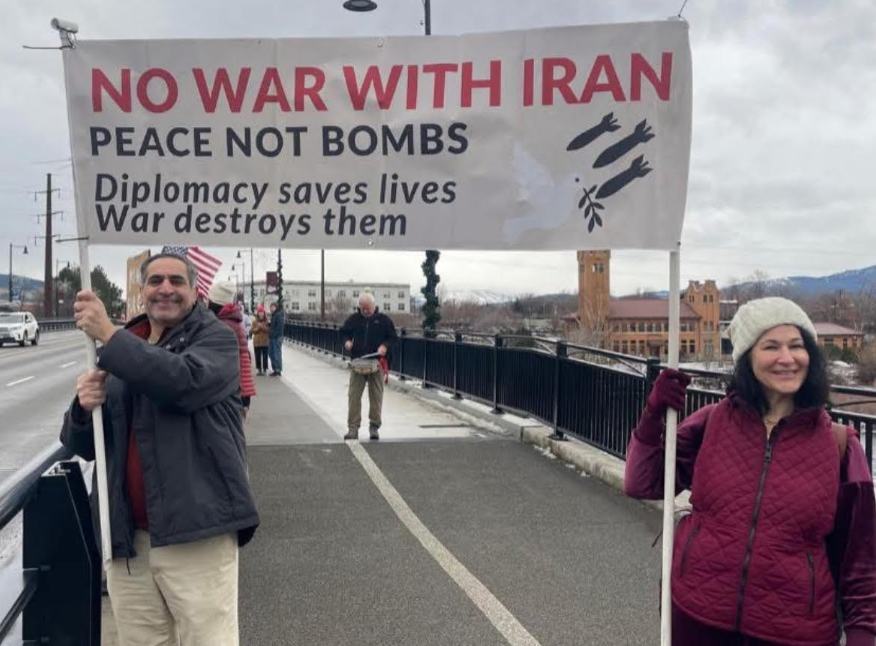
An Iranian-American man and his wife recently caught people on video vandalizing their property, including an anti-war banner, several times at their home in Missoula's University neighborhood. Someone also yelled profanity at him while he was raking his yard, an incident also caught on video.
Mehrdad Mostafavi, who grew up in Iran but has lived in the U.S. since 2005, resides on a fairly busy street in Missoula with his wife Jenny Nielsen.
Shortly after the start of the war with Iran, they hung a large banner in their yard that read "No War With Iran, Peace Not Bombs, Diplomacy Saves Lives, War Destroys Them."
Then, sometime around the end of the first week of March, someone threw a latex balloon full of paint at the banner. The couple washed off the paint and then re-hung the banner in their front yard.
After that, someone was caught on one of their video cameras stopping their car on the busy street, in the middle of the day, to get out and kick over a sign in their yard. The sign was advertising off-street parking at their house for sporting events and concerts.
Next, the anti-war banner was knocked over again, even though cinder blocks had been used to hold up the posts. Nielsen said she's never seen the wind move cinderblocks across the yard.
Finally, someone was caught on camera driving by and yelling the word "bitch" at Mostafavi as he was raking leaves in the yard.
"I was hurt because our message is about peace and respect for all people in the world," Mostafavi said. "For Iranian people, for Israeli people, for American, people, for everybody in the world."
Nielsen said she's disappointed in the behavior of whoever was behind the acts.
"Haters gonna hate," she said, chuckling. "I know that doesn't sound very eloquent. But it is hard when it happens at your home."
They took down the banner finally on Wednesday.
Still, the couple takes comfort from the support they've received.
"Multiple neighbors and friends in Missoula came to our home for support after the incidents," Mostafavi said. "A few of them even proposed staying at our house to support. I am so grateful for these friends and neighbors in Missoula. I believe the majority of people are for peace and friendship rather than war. I am so grateful for supportive friends and neighbors in Missoula."
But Mostafavi also said the incidents have only increased the stress he was already feeling from the war, because he has family in Iran that he's worried about.
"I have lost contact with my sister and her family," he said in an email. "The last message we exchanged was the night before the war began. Since then, silence. I woke up on Saturday to see messages sent while I was asleep: the U.S. had begun dropping bombs on Tehran. Every passing day without contact deepens the fear in my heart."
He can only watch from afar.
"I scroll through social media and the news, images coming out of Iran — heartbreaking, almost unbearable to watch — but I still compulsively watch," he wrote. "Growing up, these were images of home. Places I grew up, streets I walked down not so long ago. Every photograph feels like another piece of my heart breaking. Reports come in that the broadcast station next to my mother's house has been blown up. The number of innocent lives stolen away grows every hour as the bombs keep dropping on both girls' and boys' schools, hospitals, along with UNESCO heritage sites that belong to all of our human history. International law seems to be tossed away."
It's an added fear on top of the stress of being an immigrant to the United States.
"Today, I live in Missoula as an Iranian-American," he continued. "War creates fear not only where bombs fall, but far beyond the battlefield. Far from those battlefields, fear still finds me. Over the last several months, I have begun to feel anxious walking down the street, worried ICE will kidnap me. I have seen them shoot white Americans. When I go out, I am always carrying my passport card with me, wondering if that will be enough. I ask myself what would happen if I were suddenly detained and sent somewhere unknown. Would I survive?"
Mostafavi participated in the 1979 Iranian revolution, but he was saddened when religious extremists soon took over and established authoritarian rule.
He said that foreign influence, largely tied to oil profits, has been one of the biggest hinderance's to people's ambitions for democracy in Iran.
"Each passing day without news deepens the fear that something terrible may have happened to my family," he said. "I also fear something even worse — that the conflict could escalate further. Why war? Why risk the deaths of millions of innocent people? When has war and chaos produced democracy when imposed by a foreign government?"
Mostafavi's family has experienced repression, both prior to 1979 and after. Still, he believes that war rarely leads to democracy.
"The Iranian people do not need another war," he wrote. "We in the United States do not need another war. We need health care and day care for working families. Give the Iranian people the peace, dignity, and freedom to determine their own future. Under the current regime, I was imprisoned for trying to leave the country. You would be surprised how fast you can lose a democracy and any sense of normalcy."
Mostafavi believes that the current regime in Iran is "bad," but he said that's no reason to destroy historical sites and harm civilians.
Comments ()