
Lyman Creek water rights dispute continues between landowners and city of Bozeman
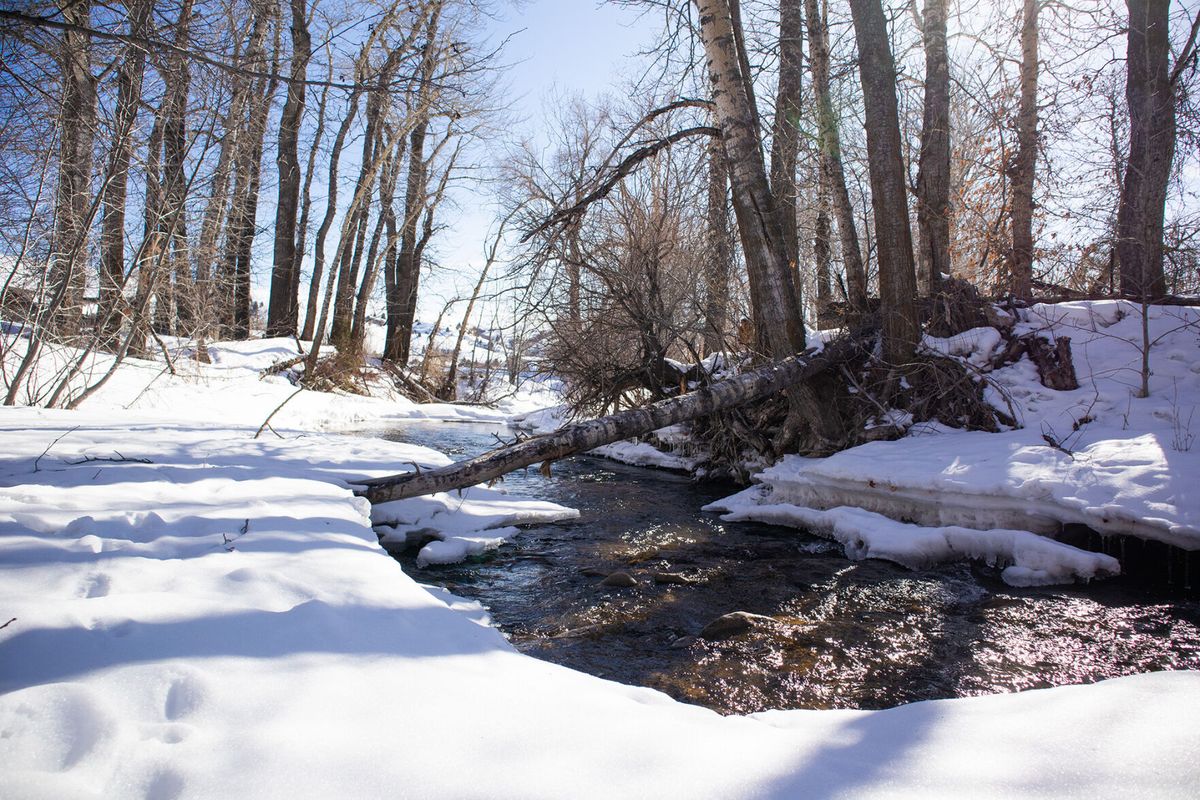
Concern over water use and wildlife habitat has sparked an ongoing disagreement between the city of Bozeman and a local landowning couple. The location of concern is Lyman Creek — a tributary to Bridger Creek and one of Bozeman’s oldest water sources.
The couple that currently lives on the property in which the creek flows, Siri and Lance Gilliland, say that a potential increase in water by the city to use more water within its rights could pose detrimental impacts to trout species that use the creek for spawning and the ecosystem that surrounds them. According to a spokesperson from the city, Bozeman has no plans to increase its water use beyond what it has a right to.
The Gillilands bought the property in 2014, which came with water rights junior to the city of Bozeman — since the city claimed rights to the water before the property was designated. Lyman Creek flows for approximately 1.75 miles long before joining Bridger Creek. The Gillilands’ property resides on approximately 1 mile of the creek which contains a maximum flow rate of 426 gallons that they use for irrigation, which is what their water right includes.
The couple wanted to understand what they needed to do to protect and continue using their water rights appropriately and legally when they first moved onto the property, Lance Gilliland said. In talking to a water consultant to assess their responsibilities, they found that Bozeman was looking to expand its usage, considering measures like upgrading diversion pipelines to pull more water from the creek. “We were concerned about their continual expansion,” Lance Gilliland said.
The Gillilands claim that the City plans to use more than its historic allowed use of water, diverting it illegally, and expanding the place of use.
The City’s statements of claim are for 5.95 cubic feet per second, said Takami Clark, Bozeman’s communications and engagement manager. The existing system has the physical capacity to divert and convey 5.95 cubic feet per second (CFS), Clark said. The City has no plans to augment its existing infrastructure to increase the amount of water it can divert from the stream, but is asking the water court to correct its claim to 5.95 CFS so that it can draw the full amount from the creek “The City is not asking to use more water, it is asking to correct its existing water rights,” Clark said.
The Gillilands alleged that Bozeman abandoned its legal rights in whole or in part, Clark said. “In defending against those allegations, the City asked the water court to correct the City’s water rights based on the district court decree issued in 1896.”
Lyman Creek has been a source of Bozeman’s water since 1899, and provides approximately 20% of the city’s water, Clark said. “The city’s water rights are the measure of the amount of water it can legally use from the source. For planning purposes, we account for the reliable amount of water the source is predicted to produce during a 1 in 50-year drought,” she said. “The frequency of such drought events may increase because of climate change.”
Lyman Creek is considered a small spring creek, in which only about 1 CFS of water flows through at any given time, said fisheries biologist and lawyer for Trout Unlimited, Patrick Byorth. Despite its small size, the creek’s biological importance is often overlooked, because it provides prime nursery habitat for rainbow and brown trout, he said.
“Sacrificing tributaries will lead to a collapse of our watersheds,” Byorth said. Biologically, high-quality, cold, clean water that is stable during all months is perfect for trout spawning, he said. As a wild trout fishery, tributary streams like Lyman are critical to keeping the population healthy.
The Gillilands said that “even if [the city] took every drop of water, it’s not going to solve what they’re hoping to solve, which is a city that just keeps expanding and expanding,” Siri Gilliland said. “Once you dry it up and make it a seasonal creek, those fish go somewhere else — it affects everything downstream.”
In 1991, the Montana Department of Natural Resources and Conservation (DNRC) authorized the city’s change application to use spring collectors to divert surface water from Lyman Creek, which was done to comply with the federal Safe Drinking Water Act, Clark said. Now, 30 years after the deadline for challenging that decision, the Gillilands claim that a change application should have been filed for a change in source from ground to surface water.
However, “the task of the Water Court is to determine the city’s rights as they existed prior to July 1, 1973; as a rule, the Water Court does not concern itself with changes made after that date,” Clark said.
According to Clark, To entertain the Gillilands’ claim would be an exception to water court rule. Although each of the Western states has its own version of water rights, Montana, Colorado and Idaho are the only three states with water courts, according to the Montana Courts website.
The Montana Water Court, created by the 1979 state legislature, is responsible for expediting and facilitating over 219,000 state law-based water rights, according to the court’s website. The Water Court has exclusive jurisdiction over water rights claims.
When a change in water rights takes place, a change application must be completed through the Montana Department of Natural Resources. The party seeking to change their right has to establish where they would change their points of diversion and prove that those points would effectively yield water, Byorth said.
In 2008, when the city added another underground spring, they didn’t complete a change application, Lance Gilliland said, which he said is illegal under Montana Water Law.
The Gillilands made this claim unsuccessfully in their 2018 district court case, Clark said. “The city does not believe a change application was required,” she said.
The legal problem is twofold, Byorth said. “Under Montana Water law, if you have an old water right for 100 cubic feet per second, but you’ve only used seven cubic feet of that, you don’t get to keep expanding because you never used that water.”
Essentially, Bozeman only used to divert about 3.5-4.5 cubic feet per second including surface and groundwater, but “they’ve now decided that they’re going to take all 5.95,” he said.
However, the City of Bozeman has no plans to increase how much water it diverts from Lyman Creek, Clark said. In completing the Integrated Water Resource Plan (IWRP) in 2013, which prioritized optimizing any unused portion of Bozeman’s Lyman Creek water rights to meet growing demand, “Trout Unlimited participated actively as a member of the Technical Advisory Committee (TAC) in that public process and specifically endorsed the city’s plan to optimize the use of Lyman Creek water,” she said.
Clark also said there was an extensive opportunity for public involvement from 2012-2017 during the preparation of the city’s water facility plan, as well as its integrated water resource plan that called for optimization of the city’s Lyman Creek water rights. Recently, public input has been quiet, but residents may reach out to the commissioners at any time with questions or may attend public meetings for comment, she said.
The Gillilands initially tried to come to a settlement with the City of Bozeman under the Montana Water Use Act in early 2016 to express their concerns about wildlife. “We have water rights and that gives us a reason to have a view and be able to challenge what they’re doing, but we wanted to protect the habitat,” Lance Gilliland said.
After the first meetings with the city, on advice from counsel, the Gillilands then sued the City of Bozeman in district court under the Montana Water Use Act in 2018. The district court ruled that, under the Montana Water Use Act, private parties do not have a right to sue under Montana Water Law, Gilliland said. “It didn’t rule on the merits that we raised, it ruled that technically we couldn’t raise the issue.”
When the couple went to the Montana Supreme Court, a similar ruling resulted. “At no time has the City intentionally relinquished its legal ability to utilize the full amount of water under its historic water rights,” Clark said.
The Gilliands have started a public media campaign, “Save Lyman Creek,” to keep up public awareness about the issue, they said. The campaign consists of a website and social media accounts under the same name.
“The fundamental point we have is to hold [the city] to their historic use, and not allow them to expand because we don’t think it’s legal for them to expand, and we don’t think it’s in the best interest of the community for them to expand,” Lance Gilliland said.
The city of Bozeman intends to continue to use Lyman Creek as a water source, striving to protect it from collateral attacks to ensure it has adequate supply to serve its current and future population, Clark said.


Comments ()