
Montana oil politics heat up as war in Iran continues
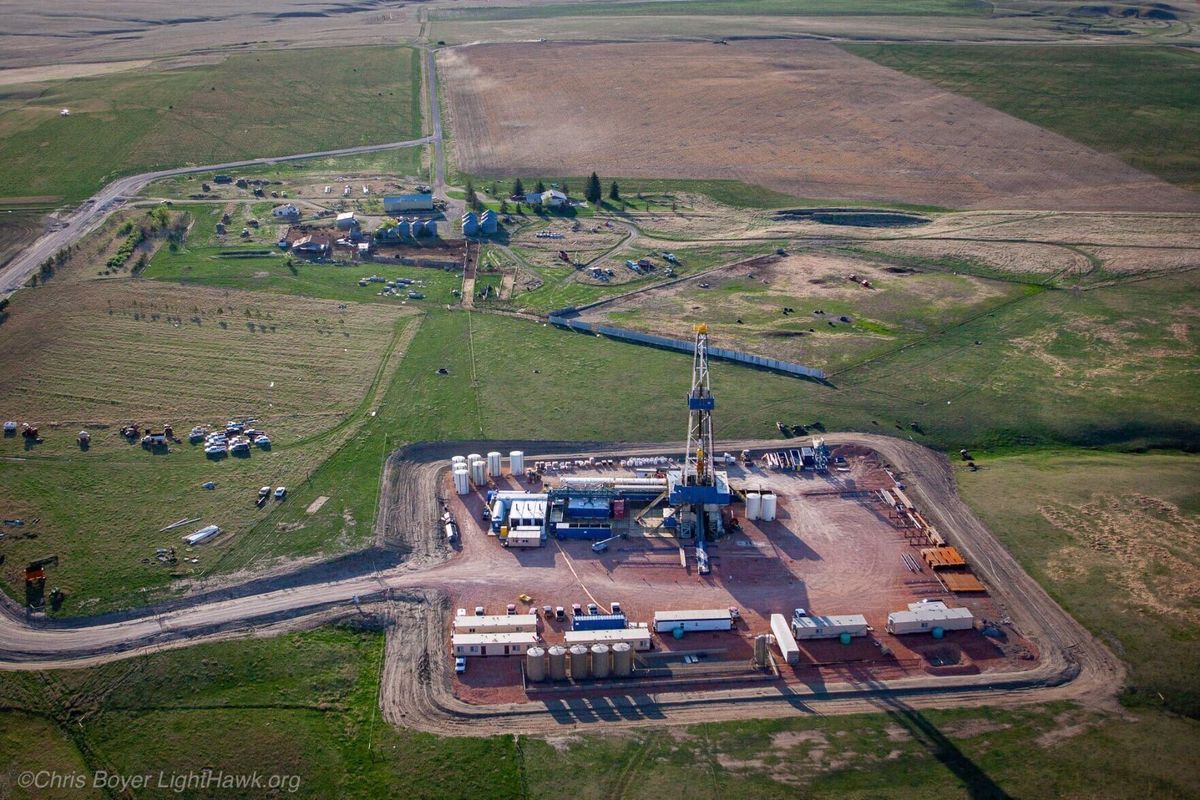
Landmen poring over property records in county courthouses along the Montana-North Dakota border aren’t usually chatty about what they’re up to, but they do create a paper trail that starts at the photocopy machine of the county clerk.
A Richland County commissioner tells Montana Free Press that photocopies of property records, clerks tell him, have been generating about $1,000 a day for the county clerk and recorder, which charges 50 cents a page. He said the copier has been humming like that for a few months, a brisk business for a far eastern Montana county with 11,000 residents.
County property records are the first stop for landmen to learn who owns a property’s surface rights, and whether the minerals beneath belong to someone else — key details when offering oil leases. State drilling permit records suggest that Montana will issue as many oil and gas permits for the quarter ending in March as it did in all of 2025.
It’s been years since Richland County’s property records vault has been this busy, County Commissioner Loren Young said.
“If you go to the Montana Board of Oil and Gas, there’s literally probably hundreds of permits that are trying to be obtained. There were so many at the last Board of Oil and Gas hearing that they couldn’t even get through hardly any of them,” Young told MTFP on Feb. 26. “The landmen have been here. It’s kind of slowing down now. I think they’ve found every acre they can find to lease, or present to their companies. I don’t go in the vault very much and talk to those people, because it’s kind of like a doctor-client privilege thing where they can’t talk about who their client is.”
Young was describing the northeastern Montana oil landscape as it existed two days before oil prices began a weeks-long 40% climb as the United States and Israel began bombing Iran in what the Trump administration has dubbed Operation Epic Fury. The war-related increase is stirring speculation about what comes next for Montana’s already heated share of the Bakken shale formation — and concern about fuel prices.
The benchmark West Texas Intermediate price settled at $65.21 a barrel on Feb. 26. Thursday’s price settled at $94.64, raising the possibility of a rough 2026 election cycle for candidates running under President Donald Trump’s MAGA banner.
What was U.S. Sen. Tim Sheehy’s slogan in his 2024 election victory over incumbent Democratic Sen. Jon Tester? “Secure border. Safe streets. Cheap gas. Cops are good, criminals are bad. Boys are boys, girls are girls.”
Montana’s congressional delegation has publicly said very little about the rising cost of oil, gasoline and diesel. The AAA gas price monitor had regular gasoline selling for $3.49 a gallon in Montana on Wednesday, March 18, up from $2.74 a month ago. Diesel was $4.40 on Wednesday, up from $3.27 four weeks earlier.
Montana’s all-Republican delegation backed the bombing of Iran when it started Feb 28. They didn’t respond to MTFP’s questions about oil prices Thursday.
U.S. Sen. Daines on March 3 told Newsmax the bombing was “forceful, focused and limited.” Sheehy called the military action “righteous.” Western District Rep. Ryan Zinke said March 11 he expected the military action to wrap up in four to six weeks, as Trump suggested. Eastern District Rep. Troy Downing told Newsmax, “the reality of it is that history is going to be on our side.”
Whether rising oil prices, brought about largely by shipping challenges in the battle-plagued Strait of Hormuz, become a liability in elections this year will depend on how long fuel prices pinch consumers, said Jeremy Johnson, political science and foreign relations chair at Carroll College in Helena.
“Regular voters are more attuned to prices at the gas pump, food prices, and airfares. We may already have crossed a tipping point, as opinion polls suggest independent voters are moving away from Trump on cost-of-living issues,” Johnson said.
The benchmark for oil prices affecting elections is the energy crisis of the 1970s, but there are more recent tipping points as well. Russia’s invasion of Ukraine pushed oil prices above $100 a barrel. Trump campaigned on the high price of gas under Joe Biden. The president referred to the latest increase in fuel prices as “a little glitch” on March 9.
In Montana, energy politics in Trump’s first year favored expansion for oil, gas and coal. In January 2025, Trump declared a national energy emergency and accelerated approval of drilling and mining projects.
The federal government expedited the approval of a 74-mile natural gas pipeline from Helena to Three Forks for NorthWestern Energy, while also accelerating approval of coal mining permits for the Bull Mountain and Rosebud mines in southeast Montana.
The next big pipeline on Montana’s horizon, a 645-mile expansion of Bridger Pipeline, has informed the state that it, too, will seek Trump’s energy emergency status so the project can be permitted quickly. In Montana’s 2024 U.S. Senate Election, the owners of Bridger Pipeline were contributors to More Jobs, Less Government, a PAC that spent more than $22 million both promoting Sheehy and opposing Tester.
The pipeline would deliver Canadian crude to U.S. refineries, similar to the ill-fated Keystone XL Pipeline, which never passed permitting muster. After Keystone fizzled, Montana’s Republican politicians took to posing beside the stacks of light-green Keystone pipe that had been positioned along its route during the first Trump administration.
President Joe Biden rescinded the Keystone permit in early 2021. Bridger has indicated that some of the Keystone pipe will be used for the current project.
“The project reflects a significant, meaningful investment in the US energy economy, while creating high-paying jobs during construction and operation and benefiting all landowners, public and private. Executive order 14156, declaring a national energy emergency, directs federal agencies to expedite completion,” states Bridger’s Jan. 28 general project overview filing with Montana’s Department of Environmental Quality.
It’s too early to tell whether current oil prices will stick around, said Sonny Capece, of the Montana Petroleum Association. Prices would have to remain high for months to encourage a surge in oil production in the Bakken, he said.
“It’s the difference between hitting a scratch-off and hitting a Powerball,” Capece said, describing short-term price spikes versus sustainable increases capable of driving oil exploration. “You know, the way oil’s been for a couple years now, a lot of companies have been hemorrhaging their money. I think there’s a lot of guys who are saying, hey, let’s just get our bottom line back to quote-unquote normal. I don’t anticipate this lasting. I would say, six months we’re back to pre-Iran.”
Capece explained that the Richland County property records offices were buzzing with landmen even before the war because oil companies have fully filled out their North Dakota drilling sections with arrays of horizontal channels for extracting oil, and planned to do the same in Montana. Stronger oil prices over the long term could spark even more interest.


Comments ()