
Montana Sec of State quietly pays for controversial mailers using federal elections grant
After months of unanswered questions on the funding source for a controversial mailer campaign from the Montana Secretary of State, the office quietly paid that invoice earlier this month using federal grant money.
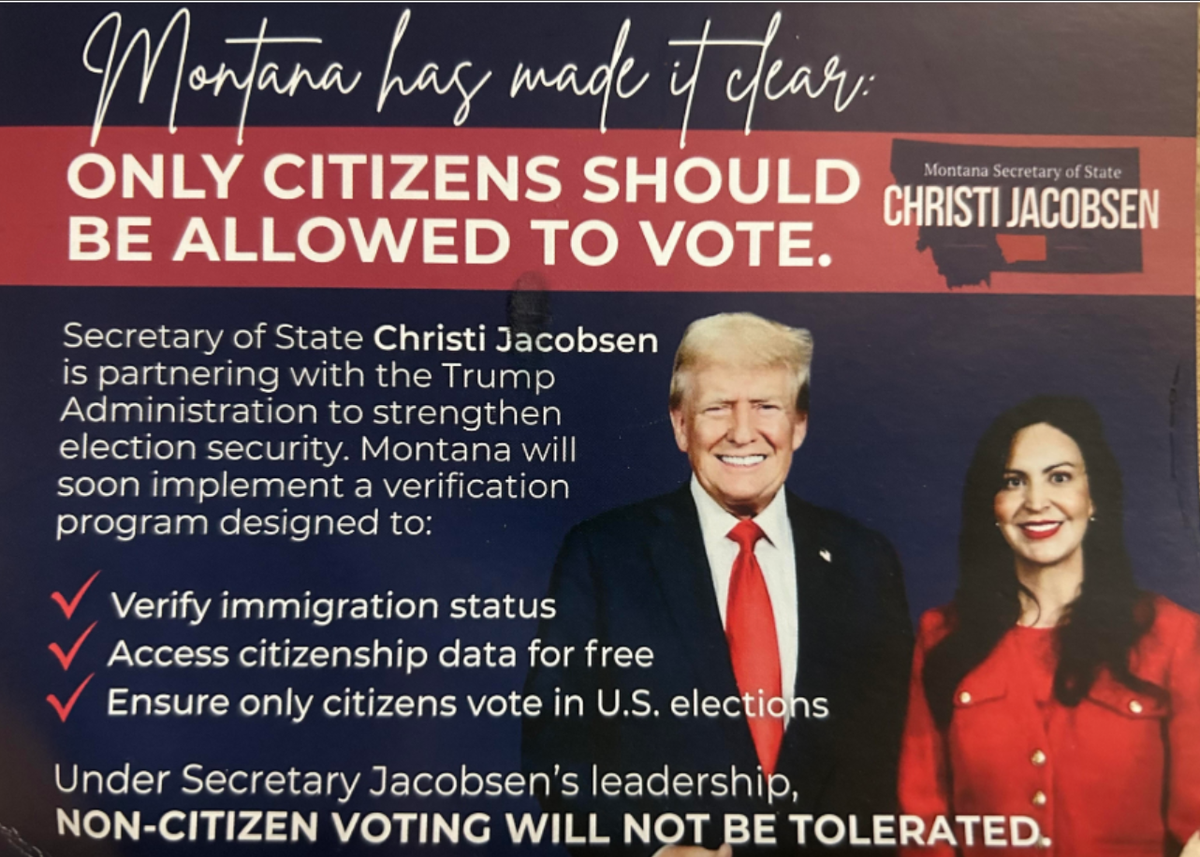
The postcards, which feature Montana Republican Secretary of State Christi Jacobsen and President Donald Trump side by side, started hitting mailboxes around the new year. The nearly half a million mailers inform Montanans that Jacobsen’s office is implementing a new tool by partnering with the federal government to ensure that noncitizens do not vote. Existing law already prohibits noncitizens from voting in Montana.
In the time since these postcards were sent out, Jacobsen filed to run for the western congressional district.
There has been bipartisan angst over the mailers themselves and the lack of information around them since the start. First, Jacobsen’s office was evasive on the cost of the mailers, but that figure – $196,829 – was ultimately revealed through a records request fulfilled by a different state agency. The Secretary of State also continually left questions about the funding source unanswered.
In late January, Rep. Jerry Schillinger, a Circle Republican who chairs the Legislative Audit Committee, asked Jacobsen a list of questions in a letter, including how her office planned to pay for the project. Her response letter did not answer that question.
Those inquiries about the funding source remained unanswered until the Secretary’s office ultimately paid the bill earlier this month using federal grant money from the Help America Vote Act (HAVA) of 2002. HAVA funding is doled out to states almost every year and is meant to help states improve the administration, technology and security of federal elections.
Jacobsen did not publicly state that she used HAVA money to fund the project, but a state agency's payment of an invoice posts to an internal government accounting system, and those records were obtained by the Montana State News Bureau.
As of a Feb. 28 report from the Legislative Fiscal Division, the Secretary of State had $2.7 million in HAVA grant money on hand. Of what the Secretary of State currently has spending power over, the office has spent $6.7 million since fiscal year 2018, according to that same report.
The Secretary of State is firm in its belief that the mailers constituted voter education — which is permitted under the law — and were not electioneering. In the response letter to Schillinger, the Secretary of State's office also said that in order to use the new tool, it was required by the federal government to inform registered voters in writing that the technology would be deployed.
But now that the funding source was revealed, the use of this grant to pay for the postcards has raised some eyebrows.
“Its definitely outside the norms, I would definitely say that,” said Michael McNulty, the policy director at Issue One, a nonpartisan organization that tracks elections issues. “Whether or not it’s determined to be legal, it’s still quite concerning.”
The law says that states can use the grant money in part for “educating voters concerning voting procedures, voting rights, and voting technology.”
McNulty said that the postcards fall into a “gray area,” because some of the language leans more towards voter education, while some of the other language comes off as “campaign style messaging.”
“Under Secretary Jacobsen’s leadership, non-citizen voting will not be tolerated,” is the line in the postcard that McNulty referenced as “campaign style.”
Secretary of State spokesperson Richie Melby pointed out that Montana's Commissioner of Political Practices recently dismissed a complaint alleging that the postcards violate campaign and ethics rules. Commissioner Chris Gallus said that the mailers may be viewed as partisan, but that it still does not constitute a violation of the laws that he has jurisdiction over.
Jacobsen's office also explained its reasoning in an unsigned memo on Secretary of State letterhead.
“The required mailing informs all affected registered voters that their registration information may be checked, explains the purpose of the verification program, and promotes public confidence in the administration and security of federal elections,” the Feb. 27 memo read. “Accordingly, the expenditure of HAVA funds for this outreach mailing is an allowable cost under HAVA because it is reasonably necessary to improve the administration of elections for Federal office through enhanced voter registration list maintenance, voter education, and election security.”
The HAVA grant money is doled out by the U.S. Elections Assistance Commission. Don Palmer, one of the commissioners, advised Elections Director Austin James on the use of HAVA money in a late January email obtained by the Montana State News Bureau.
Palmer told James that informing Montanans of new technologies “seems to be core HAVA requirements,” but warned that “electioneering” should be avoided.
“The chief election official as the trusted source to explain new procedures is appropriate to explain or highlight what are the new procedures and rights of voters,” Palmer wrote in his email. “However, one key caveat is to avoid any electioneering but to get more details on that loaded term I would look to past opinions.”
Neither Palmer nor a commission spokesperson responded to repeated requests for comment.
McNulty said that he is not aware of any other HAVA disputes similar to this one, except one from the early 2000s in Iowa.
In 2005, the Iowa Secretary of State used $118,000 of the federal grant money for a “celebrate voting” campaign. The campaign was in honor of the 40th anniversary of the Voting Rights Act and was meant to educate young people on the struggle for Black people and women to gain the right to vote. HAVA funds were spent on an essay competition, a traveling exhibit, speakers, entertainers, space rental among other items.
A 2009 report from the inspector general of the U.S. Elections Assistance Commission found that the funds “were used for promotional activities that were unrelated to voter education as prescribed by HAVA.”
As of publication time, the Montana Legislature’s audit division is still looking into this use of HAVA funds, and plans to provide more information later this week, an office spokesperson stated.
Schillinger said that he plans to invite Jacobsen to the Legislative Audit meeting next month to answer further questions.
Jacobsen’s office recently announced that the tool that is being touted in the mailers found evidence of 23 individuals who “appear in non-citizen status” and voted in Montana’s elections. However, Jacobsen's office has also repeatedly declined to furnish any additional information on those findings when asked by the Montana State News Bureau.




Comments ()