
Montana's 0% statewide sales tax may be attracting big data centers
Montana's lack of a statewide sales tax could definitely be a factor in why there's interest from big data center companies looking to build facilities and buy power here.
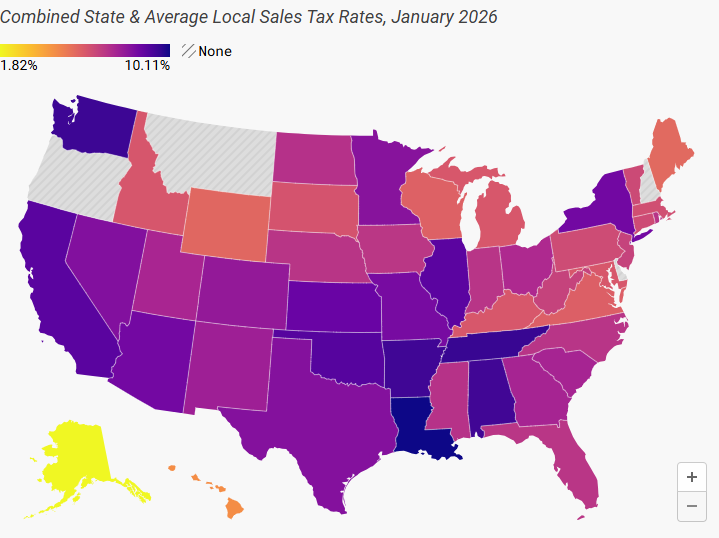
The CEO of NorthWestern Energy, Brian Bird, recently gave an update to investors in which he revealed there are 11 unnamed data center companies in NorthWestern's queue to get approved to buy power and set up in Montana or South Dakota. But Bird mentioned that many of those companies are waiting to see if South Dakota's Legislature will change its statewide sales tax rate of 4.2% before they invest.
"We're waiting on sales tax reform in (South Dakota)," he said. "Which is something that is very very important to data centers before they move forward in South Dakota. If we do see some sales tax movement in South Dakota I do expect to see that queue count to go up in 2026."
Montana's statewide sales tax is at 0%, although some tourism-dependent communities have a local-option sales tax.
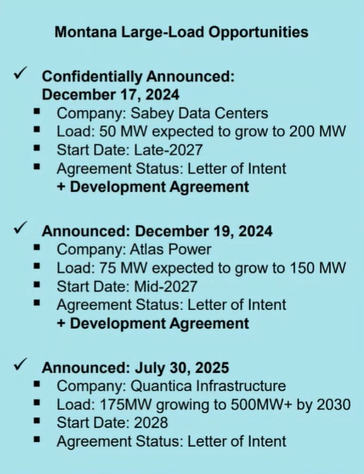
Besides the aforementioned 11, three other data center companies are in more advanced stages of discussions with NorthWestern Energy, having already signed Letters of Intent to buy enormous amounts of power. Those three companies, Sabey, Atlas and Quantica, have plans to purchase between 850 and 1,400 megawatts of electricity by the year 2030. That's more than all the power being supplied to all homes in Montana right now.
Jeffrey Michael, the director of the Bureau of Business and Economic Research at the University of Montana, recently went on a statewide tour to talk about the potential impact of a sales tax in Montana.
"A sales tax has a potential to be a data center deterrent," he said. "There's an awful lot of computer equipment that goes inside a data center. And all that equipment, in many states, would normally be subject to a sales tax."
Michael said that a lot of states have created a sales tax exemption for data centers.
"I haven't checked all of them, but Virginia and Louisiana are two that have attracted a lot of data center investment and both of them have passed exemptions for computer and tech equipment, provided they create a minimum number of jobs," Michael said. "The Virginia one expires next year. I don't know if they'll renew that. There's been some pushback on data centers. The political environment changes, and sometimes states become less willing to provide an exemption."
The nonprofit Tax Foundation recently published a guide on how different states tax data centers in different ways.
Jared Walczak, a senior fellow at the organization, authored the report.
"For data centers, sales taxation of machinery and equipment is particularly significant due to the sheer scale of capital investment and the frequency with which servers and network equipment must be replaced to keep up with technological developments," he wrote. "Data centers associated with so-called 'hyperscalers' (the major cloud computing providers) begin at about $1 billion in initial investment and easily exceed $5 billion for large new AI-centered projects. Even investments not involving the industry’s largest players can easily reach $1 billion per project now."
He goes on to note that California is the only state with both a significant data center concentration and a sales tax that is broadly-applied on data centers.
"And California is likely to be one of the few states that could get away with this," he said.
Montana also offers data centers a lower tax rate than it does for most commercial and industrial properties.
Qualified data centers are classified as Class 17 property with a taxable valuation rate of 0.9% of market value in Montana. That was lower than the residential rate for properties valued up to $400,000 until 2025, when the rate for those residential properties was lowered to .76%.
In 2025, commercial and industrial land valued at up to $400,000 is taxed at a 1.4% rate and properties over that value are taxed at a 1.89% rate.
Environmental nonprofits and other groups in Montana have expressed concern about data center growth here, saying they could increase electricity prices for everyone, harm the environment and not provide much benefit to the state.
Proponents of data center growth in Montana come from the business community, saying it would bring jobs and tax revenue.
In November of last year, Gov. Greg Gianforte announced that he'd signed a memorandum of understanding with a huge multinational Japanese company to “advance potential investment in data center and power infrastructure projects in Montana.”
Gianforte signed the document in Tokyo with Mitsubishi Heavy Industries during a strategic trade mission to Japan in October.
According to a press release from Gianforte’s office, the agreement “formalizes collaboration between the State of Montana and Mitsubishi Heavy Industries to evaluate opportunities for investment in data center development and energy infrastructure, particularly in southern Montana.”
The memorandum establishes a framework for continued talks and cooperation as both parties “explore project feasibility” and potential next steps.
“Montana offers affordable, reliable energy, a skilled workforce, and a welcoming environment for innovation,” Gianforte said in a statement. “This agreement with Mitsubishi Heavy Industries marks another step forward in expanding Montana’s high-tech and energy sectors and creating more good-paying jobs for Montanans.”



Comments ()