
Montana's foreign ambassadors weigh in on international issues
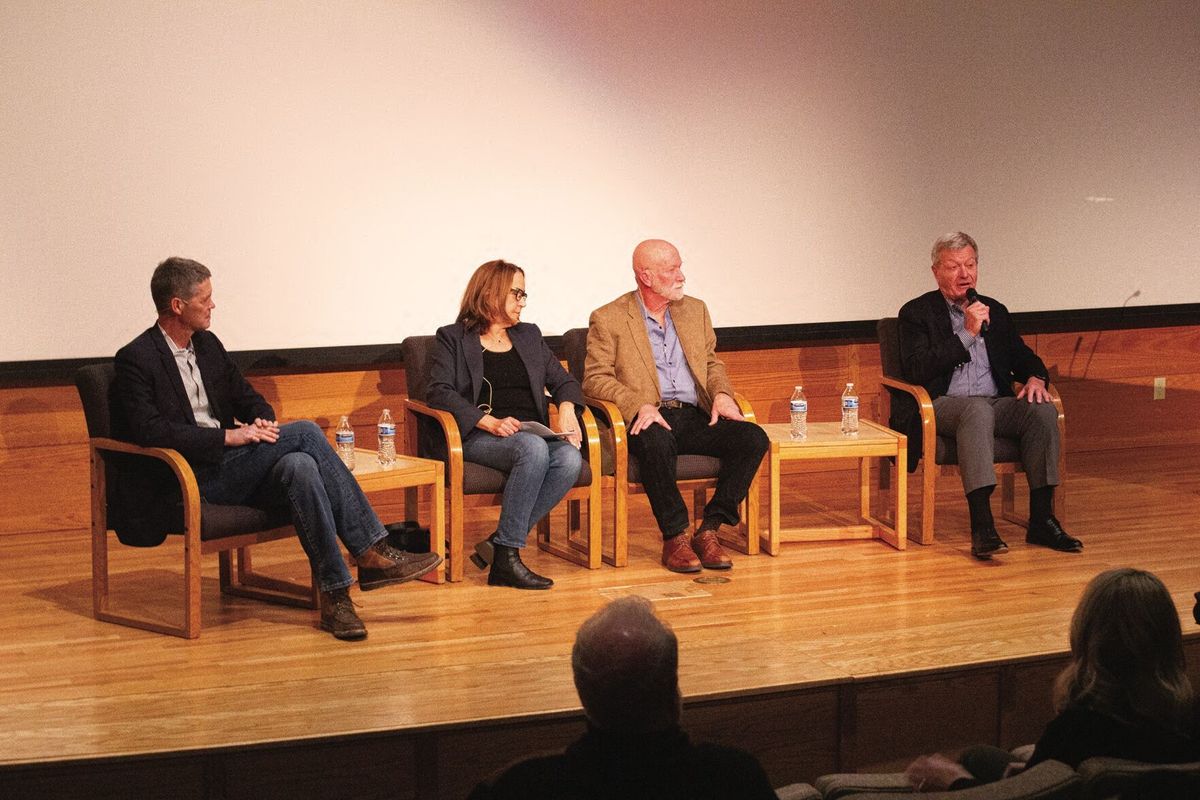
On Nov. 30, the Montana World Affairs Council (MWAC) hosted a public event in the Museum of the Rockies’ Hager Auditorium. The event featured four Montana foreign ambassadors, each of whom focused their comments on different world issues.
Former Montana foreign ambassadors Max Baucus, Robert Loftis, Brooke Anderson and Michael Punke spoke on the current state of international affairs and how such things pertain to their home state of Montana. With different areas of expertise and vastly different experiences in the field of global affairs, all four ambassadors provided insights into why Montanans should get involved in global politics.
Executive Director of MWAC Chris Hyslop introduced the night’s speakers, providing brief biographies and discussion topics for each.
The first to speak was Montana’s longest-serving U.S. senator and former foreign ambassador to China, Max Baucus. His topic, as introduced by Hyslop, was U.S.-China relations.
Baucus began by acknowledging China's rising power in relation to the U.S. He also highlighted the importance of both maintaining national security and remaining respectful toward one another.
“I think that President Xi and President Biden are doing what they can, but the domestic politics in both countries prevents any rational public discourse on how to work together,” Baucus said concerning China and America’s current political states.
Further, Baucus said, “There’s not going to be a war in Taiwan in the near future,” addressing the ongoing background contentions between China and the U.S. and how there are other things America should be focusing on right now.
To best reckon with and avoid further contentions between the U.S. and China, Baucus suggested the following: we must speak no ill of one another as nations, each nation must live up to its agreements, people should travel to other countries to truly understand them and we, as members of society must think critically.
The suggestions of travel and critical thinking could be achieved by students applying to the Baucus Institute, Baucus said. This is an institute he had founded for the purpose of sending college students to China and Washington D.C. to strengthen international relations and educate a younger generation in that field.
Robert Loftis, former ambassador to Lesotho in Southern Africa, said, “I’m not saying that we’re living in the most dangerous times we ever have — because we’re not — but we are living in a little bit more dangerous times and I attribute that to the appeal of two things around the world: virulent nationalism and authoritarianism.”
He also brought up President Biden publicly calling Xi a dictator, an incident which Ambassador Baucus referred to as a big mistake. Both Baucus and Loftis agreed that speaking ill of other world leaders from a position of power endangers international relations.
Following Loftis was former United Nations foreign ambassador Brooke Anderson. She spoke on the importance of civil and apolitical rights.
“When you invest in diplomacy, you are investing in a safer, more prosperous U.S.,” Anderson said. The U.S. spends less than one percent of our federal budget on diplomacy and global development, according to Anderson.
She also invoked former Secretary of Defense, Robert Gates who is a vocal proponent for investing more of the federal budget in diplomacy and development. In doing so, she urged that we as a nation follow suit in advocating for and investing in diplomacy.
Former ambassador of the World Trade Organization in Geneva, Switzerland, and author of The Revenant, Micheal Punke touched on global economics. He would do so in a different century, though in a way that pertains to the current state of affairs he said.
“There were more Montanans killed per capita in WWI than from any other state,” Punke said. He also highlighted Montana’s role in global economics through a historical lens. This point he related to globalization and the economic impact of the war and Montana’s participation therein.
Punke continued on this point, going further back in time saying that Lewis and Clarke’s mission was rooted in global economics as their purpose was to find water routes to the Pacific so the U.S. could beat out the U.K. in the fur trade.
This success in the fur trade would be achieved by opening a more direct trade route to China to advance the U.S.’s global influence on the path to the country becoming a major world and economic power during Jefferson’s presidency according to Punke.
Butte’s Berkeley Pit’s origin and close relation to the Panama Canal and its technology were also points used by ambassador Punke to strengthen his point. The technology used to dig the Panama Canal was the same used in the creation of the Berkeley Pit.
The Berkeley Pit provided a more economically efficient way to obtain exportable copper, establishing Montana’s role in global economics, and allowing the U.S. to remain competitive in that market at the time, according to Punke.
Punke also touched on the Anaconda Mining Company’s expansion into Chuquicamata and the fall of the company’s stock once the Chilean power industry was nationalized.
“These things we think are new phenomena often aren’t,” he said.
Information on similar events can be found at https://www.montanaworldaffairs.org/ .


Comments ()