
MSU honors Native American Heritage Month with horse painting event
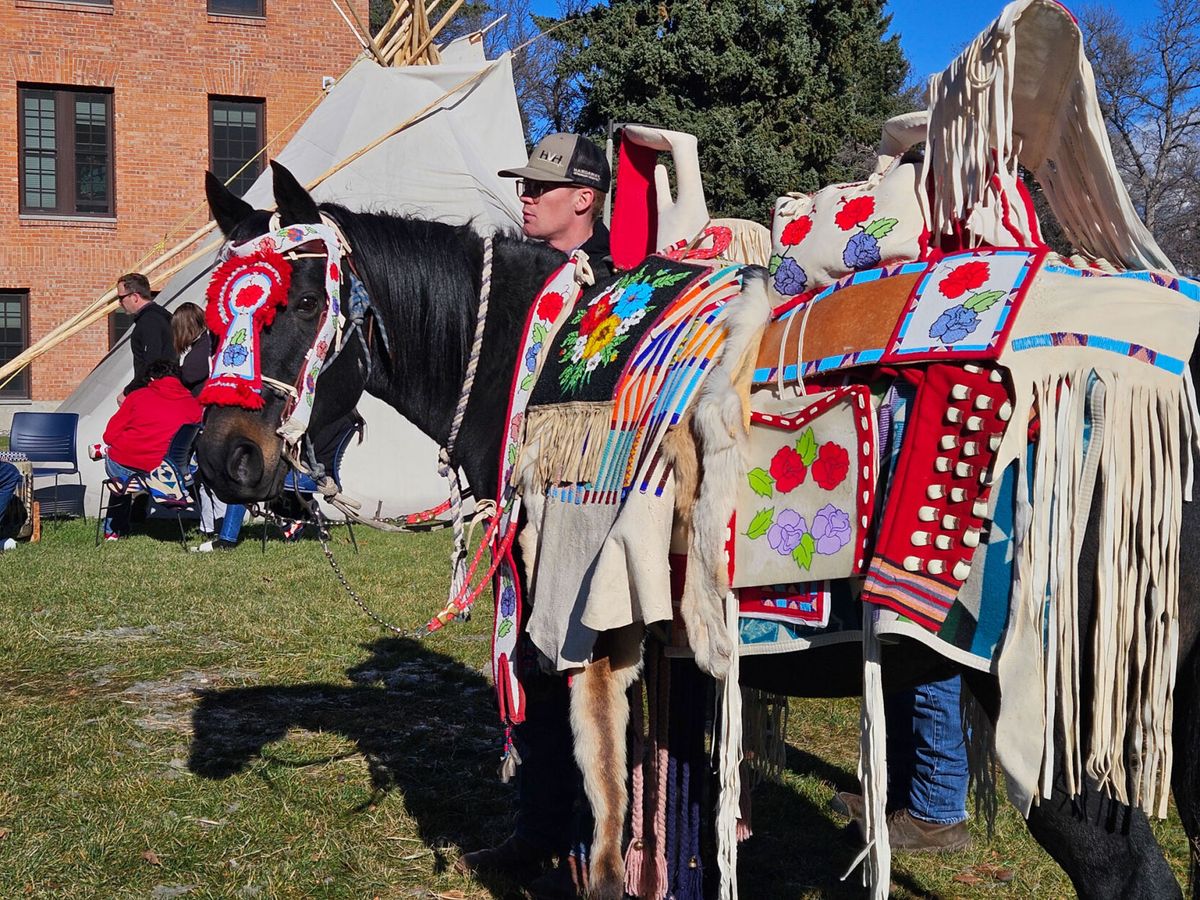
On a bright Wednesday morning in front of the SUB, a regal brown stallion stood adorned with intricate beadwork, fur skins, an elk tooth dress, blankets and vibrant horse regalia. The cut glass beads — colored red, white, yellow and blue — glittered under the sun as the sounds of drumming and singing filled the air.
The Arapaho Eagle Drummers — who opened the event with a flag song — are associated with the Arapaho Suicide Prevention Program. They performed for the second-annual Horse Painting event hosted by MSU on Nov. 6 to honor Native American Heritage Month. This year, the event was held in conjunction with MSU’s first-ever “Celebrate Agriculture” week. Angelina Toineeta, a second-year agriculture student and a member of the Apsáalooke Tribe — commonly known as the Crow people — was the one who initially suggested the collaboration.
“When this event was coming to be, it was a vision to see people come together to learn and share knowledge,” Toineeta said, referring to a conversation where she suggested the event to Nick Ross, a program manager for the American Indian Hall (AIH). “It didn’t take long to connect with those in the College of Agriculture to devise this project which was made a reality that following month.”
Toineeta explained that the overlap between MSU’s “Celebrate Ag” week and Native American Heritage Month gave her the opportunity to connect many students’ passion for agriculture with their heritage, something she had already thought about extensively “I joined every agricultural-based club I could join while also getting connected with the people in the [AIH],” she said.
Ross kicked off the event by welcoming Dean of Students Matthew Caires to the stage. Caires gave thanks to the Morrill Land-Grant Colleges Act, a piece of U.S. legislation passed in 1862 that provided federal land to states. According to Caires, the point of this Act was to fund the establishment of colleges that would focus on agriculture, mechanical arts and other practical disciplines.
“The horse painting event is a wonderful way to engage in these cultures, to celebrate the bonds between agriculture and our Indigenous communities,” he said during his introductory speech.
Toineeta introduced herself next, detailing her experience as an agriculture student and member of the Apsáalooke tribe. “For Native tribes, many share a deep-rooted horse culture that is central for one's own identity, history and traditions,” she said. “For the Apsáalooke, horses symbolize freedom, status and mobility. Our survival and our resilience comes from the horse.”
She then offered gifts to Dean of Agriculture Sreekala Bajwa and Director of the AIH Walter Fleming, who were in attendance, as well as MSU President Waded Cruzado. “In Native culture, it is important that we honor those that share their knowledge, so we give them gifts to say thanks,” she said. Toineeta then presented handmade ribbon skirts to Cruzado and Bajwa, and a vest — made by Toineeta’s mentor — to Fleming.
There were three presentations during the event, the first one led by Allison Sage, who comes from the Wind River Reservation in Wyoming. He is the founder of the Arapaho Suicide Prevention Program (ASPP) along with his son Elk Sage. Since 2013, the ASPP uses a unique form of therapy with its patients — horse riding.
According to the CDC, Wyoming ranks third in the U.S. for suicide mortality. “We want our people to live, we want our children to live,” Allison said. The point of the program is to allow young Indigenous members to feel genuine connections to one another, to find safe adults and to connect to their culture, allowing them to feel more comfortable reaching out during difficult times, Allison said.
“Some of our findings is that just being around horses is a major de-stressor,” Elk said.
Throughout the speech, Elk performed a ceremony called Smudging with burning cedar. This ritual, in which one bathes oneself in the smoke, acts as a “protection cover,” according to Sage. Smudging has deep spiritual roots and is often performed as a part of rituals, like horse painting.
The Arapaho Eagle Drummers played another song while the next speakers, Sheldon Carlson and Helen Augare-Carlson, a Piikani — otherwise known as Blackfeet — married couple, prepared for the horse painting.
Helen is the Title III director in the Institutional Development Department and the division chair for Piikani Studies at Blackfeet Community College, while her husband Sheldon works as a contractor and bison caretaker. They both serve as bundle carriers — people who are responsible for holding and displaying sacred bundles, which are collections of sacred items used in Blackfoot ceremonies — and as bison rematriation cultural advisors. Helen led the ceremonial horse painting by first painting her husband’s face. “Just like the buffalo and the way their society runs, we mimic them — we’re a matriarchal society,” she explained.
Sheldon then prepared the horses for painting by Smudging and getting them familiar with him. He then went on to use his hands — covered with the paint — to draw patterns and designs on their bodies.
The last presentation was led by Lydia Falls Down, who provided the regalia, beadwork and skins featured on one of the horses. “The art of making beadwork was handed down to me by my grandmother,” she said, emphasizing that it was a form of bonding between them. “The outfit I’m wearing — she made it when I was 15, making it 40 years old.”
The dress features 1,000 elk teeth, using the bottom two incisors, meaning that it took 500 elk to make it. Falls Down then explained that the Apsáalooke made a concerted effort to use every part of an animal after hunting it.
She told the event’s attendees that she started beading at 18 years old, eventually selling an art piece to the Field Museum in Natural History in Chicago for their “Apsáalooke Women and Warriors” collection. The horse regalia — also known as parade — regalia made of cottonwood, cut beads and hide, took her over seven years to complete. According to Falls Down, horse regalia was especially important to the Apsáalooke tribe as nomadic people. “The Crows were known for their horsemanship, and as we would travel to our neighboring villages we’d dress up in our best,” Falls Down said.
During her part of the presentation, Bajwa explained that through this event, the attendees were celebrating not only the agricultural heritage of Montana, but also Native American Heritage Month. “What a splendid way to bring those two heritages together through horse painting. This wouldn’t [have happened] without the Native American Studies program and all the elders from the three Native American communities today who are here to educate us,” she said.
“It was exciting to see how members of tribes, like the Blackfeet, Arapaho, Aaniih, etc., honor the horses in their own ways and how that connection is still strong to the horse,” Toineeta told the Exponent after the event.


Comments ()