
MSU Library and DISC advocate for health equity
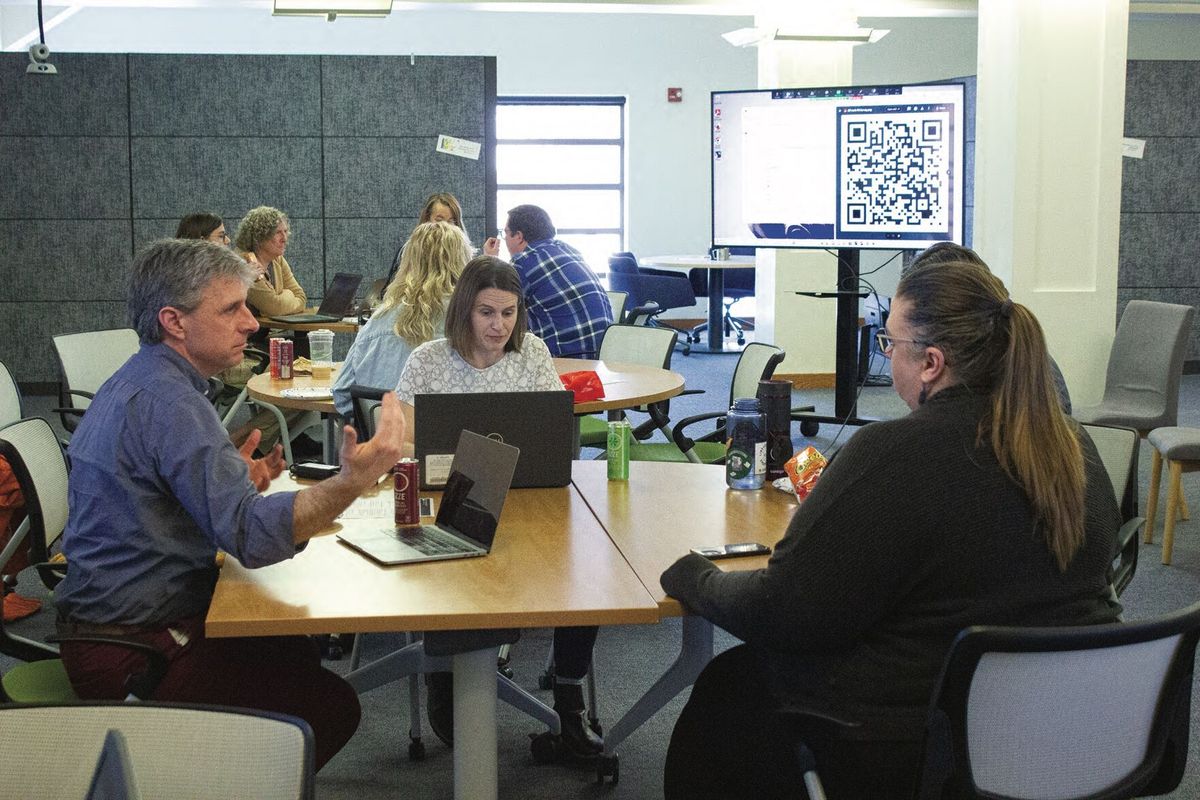
The MSU Library held a health equity Wiki edit-a-thon in the Renne Library. The event was held in conjunction with the Diversity and Inclusion Student Commons (DISC), the MSU Research Alliance and the USDA National Agricultural Library (NAL) to spread awareness of health equity issues in Montana communities.
The “Health Equity: Barriers Under-served Communities Face Advocating for Healthcare, Wiki Edit-a-thon” was created by the MSU Library in collaboration with the DISC. An edit-a-thon is a space for people to learn to edit Wikipedia articles in a group setting. During the event they chose to edit articles that focused on health equity. Health equity is defined by the Center for Disease Control as “the state in which everyone has a fair and just opportunity to attain their highest level of health.”
“Last summer, Melissa Pomeroy contacted me about the Wikipedia edit-a-thon event the library was going to organize,” DISC Managing Director Barbara do Amaral said. Curator of Archives and Special Collections Melissa Pomeroy said the specific focus of the event was determined in a meeting between the DISC and library representatives.
“I suggested a topic related to health and wellness that explores the experiences of marginalized communities with healthcare providers,” do Amaral said.
The Library and DISC teams worked through the summer and fall semesters to organize the event in association with the USDA, according to do Amaral. The official contributing parties were the MSU Library, The Research Alliance, DISC and USDA NAL.
“The USDA partnership brought another critical aspect to the conversation — food security,” do Amaral said. Access to proper nutrition is one of the many barriers health equity aims to combat.
While the library has had edit-a-thons in the past, this was the first one held in conjunction with the DISC, according to Pomeroy.
Introduced by Kristin Nelson, senior law librarian for the NAL, the first portion of the event consisted of student and professional panels and presentations that were recorded via Zoom. Online viewers were able to ask questions and provide input during the event. The presentations will be available on the NAL YouTube channel, according to USDA Senior Wikepedian and Outreach Specialist Jamie Flood.
The students on the panel were chosen for their experience and involvement in the campus community. “I have known them for a couple of years. They were able to speak about the subject with first-hand knowledge, share their personal stories, and expose us to dimensions of experience we would not have considered otherwise,” do Amaral said.
The student panel consisted of pre-med student Miller Rijfkogel and Barla Beaudoin, a cellular biology and neuroscience student.
“Most of my time at MSU I've been doing things that focus around diversity, equity and inclusion,” Beaudoin said, speaking on her experience in various campus organizations and as a Latina woman in the healthcare field.
Beaudoin also cited a particular experience that strengthened her dedication to promoting equity within the healthcare field. According to Beaudoin, a Spanish-speaking patient who had allegedly fallen off a roof working construction was brought into the hospital when she was working the front desk. No one else could understand what they were saying, but Beaudoin knew enough Spanish to get them the help they needed.
“He was having internal bleeding — really serious stuff. And I just can't imagine other patients who have gone through that same thing, and not have had an interpreter and have not been able to get that surgery that they needed, because there's no interpreter to convey the needs of a patient. So really it does come down to life or death,” she said.
Rijfkogel, who is also the co-founder of the MSU Disabled Student Association, highlighted the issue of inequity based on disability. “Campus, while also inaccessible to psychological disorders, is very inaccessible to physical injuries and disabilities as well,” they said.
They also spoke on the inequity present in medical schools, and how difficult it can be for potential students with disabilities to be accepted. “There are laws against discrimination when it comes to disability, but medical schools are clever and they find a way around it,” Rijfkogel said. “You might have to travel, and you have to pay for that all yourself. Then if you get accepted, you also have to pay a deposit. For me, it was like a thousand dollars for school to save your seat. So that's just one of the biggest barriers that I've seen.”
Following the student panel were the professional presentations. The first presentation was given by BridgerCare Operations Director Ellie Webster.
According to Webster, BridgerCare is doing its best to fill in the gaps Rijfkogel and Beaudoin mentioned. A reproductive health clinic, BridgerCare has multilingual providers, high patient satisfaction rates and employees who treat all patients with the respect they deserve, Webster said.
Webster also listed barriers of access to care, and highlighted what BridgerCare is doing to combat those barriers. “Affordability of services is remaining at the forefront of our mission,” Webster said.
According to Webster, BridgerCare maintains affordability by having service fees depend on patient income, meaning some people may be eligible to receive free service.
The final presentation was given by NAL representative James Cain.
Focusing on equity through the lens of food security, Cain went through the USDA’s many food security programs such as the Supplemental Nutrition Assistance Program and the National School Lunch Program.
According to Cain, nutrition.gov provides credible resources for food, nutrition, physical activity and food safety for the public. The available resources are targeted toward the general public and people lacking a strong background in nutrition, he said. The goal of the website’s education is to increase awareness of ways to achieve food security to perpetuate health equity within communities. The website also has a Spanish language toggle button, and there are plans to have more languages added for broader accessibility in the future, Cain said.
Flood led the final portion of the event with instructions on editing Wikipedia articles and free-edit time for attendees with help available from the present Wikimedians, people who work to edit and oversea Wikipedia pages.
“We know representation matters, and there are a lot of editors who focus on underrepresented demographics,” Flood said. “The more editors we have, the more diverse and accurate the content is.”
The pages edited were in theme with the presentations, being on topics related to health equity. According to Flood, the maintenance of these pages ensures reliability and accuracy so people can trust what they are learning about these important topics is factual.
Presentation slides will be available on the Wikimedia Commons, and more information can be found at https://www.nutrition.gov/ and https://www.bridgercare.org/.


Comments ()