
MSU professors address AI concerns brought up at recent symposium
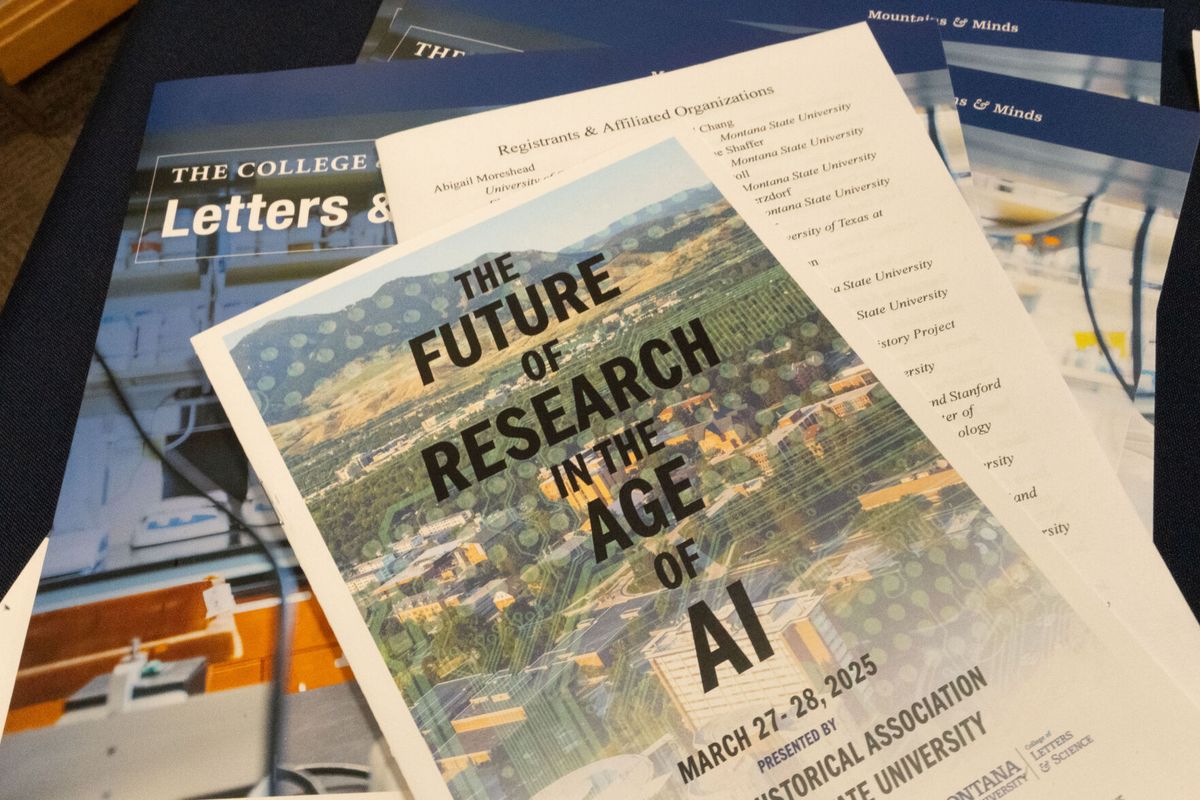
MSU and the American Historical Association (AHA) co-hosted “The Future of Research in the Age of AI” symposium at the Museum of the Rockies and the Black Box Theater on March 27 and 28. This symposium discussed the potential issues and challenges of using AI in conjunction with large-scale research, according to the AHA website.
The AHA is an organization that promotes historical thinking in public life, according to its website. The AI symposium was the first event in the three-part “Large Scale Research Symposia” to be presented across the country by the AHA. Professors and researchers from around the country collaborated to determine how AI is impacting higher education and research.
Relevant experts and researchers came to the symposium to host forums and present project findings. Each day also featured discussion panels involving researchers and professors with a focus on AI in their work.
The panel held on March 27 provided an overview of AI in higher education and current research regarding its use in the historical reconstruction of data. “Every answer you need is at your fingertips,” said Columbia University history professor and panelist Matthew Connelly.
He went on to discuss large language model (LLM) usage in research and education. An LLM is a type of software that is pre-trained on large datasets to learn the patterns and rules of human speech. It can then use this to understand user input and generate results, according to IBM.
“The problem with all of these systems is that they weren’t built for research and they weren’t built for education, and yet they are being marketed to our students,” Connelly said during his panel.
After the symposium, MSU history professor Katherine Johnston explained how AI is already being used to locate, transcribe and digitize documents in historical research. Specifically, she said it can classify and locate relevant photos from a database and transcribe handwritten documents.
While Johnston said she finds AI useful for certain forms of research, she steers clear of it in the classroom and in her personal research. “It can’t replace the ability of humans to do deep, smart analysis,” she said.
According to Johnston, when students use AI in their work, it can make mistakes and is often rooted in bias. “It can be racist, sexist and wrong,” Johnston said.
According to the Director of MSU’s Research Optimization and Data Science (ROADS) program, Jason Clark, writing professors have difficulty with generative AI because it can compose a finished product for a student without requiring critical thinking. “A teacher has to be careful and find ways to slow the system down to allow for thinking and learning to happen,” Clark said.
Despite being new technology, Clark said AI does have a place in education. “It’s useful technology when applied responsibly and in the right learning moment,” he said.
“AI is just advanced algorithms. There’s nothing magical there,” said MSU professor and AI researcher John Sheppard — who has been involved with AI research for more than 40 years — in an interview with the Exponent.
He said it would be a mistake to compare human intelligence to AI. “Historically, there have been people that try to relate AI to human intelligence,” he said. “[This] creates expectations that lead either to hype or to disappointment.”
Clark echoed this sentiment. “Current generative AI text systems are good at transformation, categorization, summarization, etcetera but not complex decision-making,” he said.
An AI text system is a broad category of AI that focuses on patterns and structures of the data it is given. LLMs like ChatGPT fall into the category of AI text systems.
Clark also explained that people should be cautious of the use of AI in place of natural learning and thinking processes. “You can make that choice, but understand what you are losing — or willing to lose — in making that decision,” he said.
“Be careful. Try to learn as much as you can about what these things not only can do but can not do,” Sheppard said. According to him, students using AI must first determine what they want to get out of it. “When they’ve answered that question, then they can assess, is this helping them educationally or is it hurting them?” he said.
The AHA has two more “Large Scale Research Symposia” scheduled for July 30 to Aug. 1 at Santa Clara University, and Oct. 16 and 17 at Johns Hopkins University Bloomberg Center in Washington, D.C. To learn more, visit https://www.historians.org/events/institutes-workshops/symposia-on-large-scale-research/.


Comments ()