
MSU research team partners with NASA to send computer to the Moon
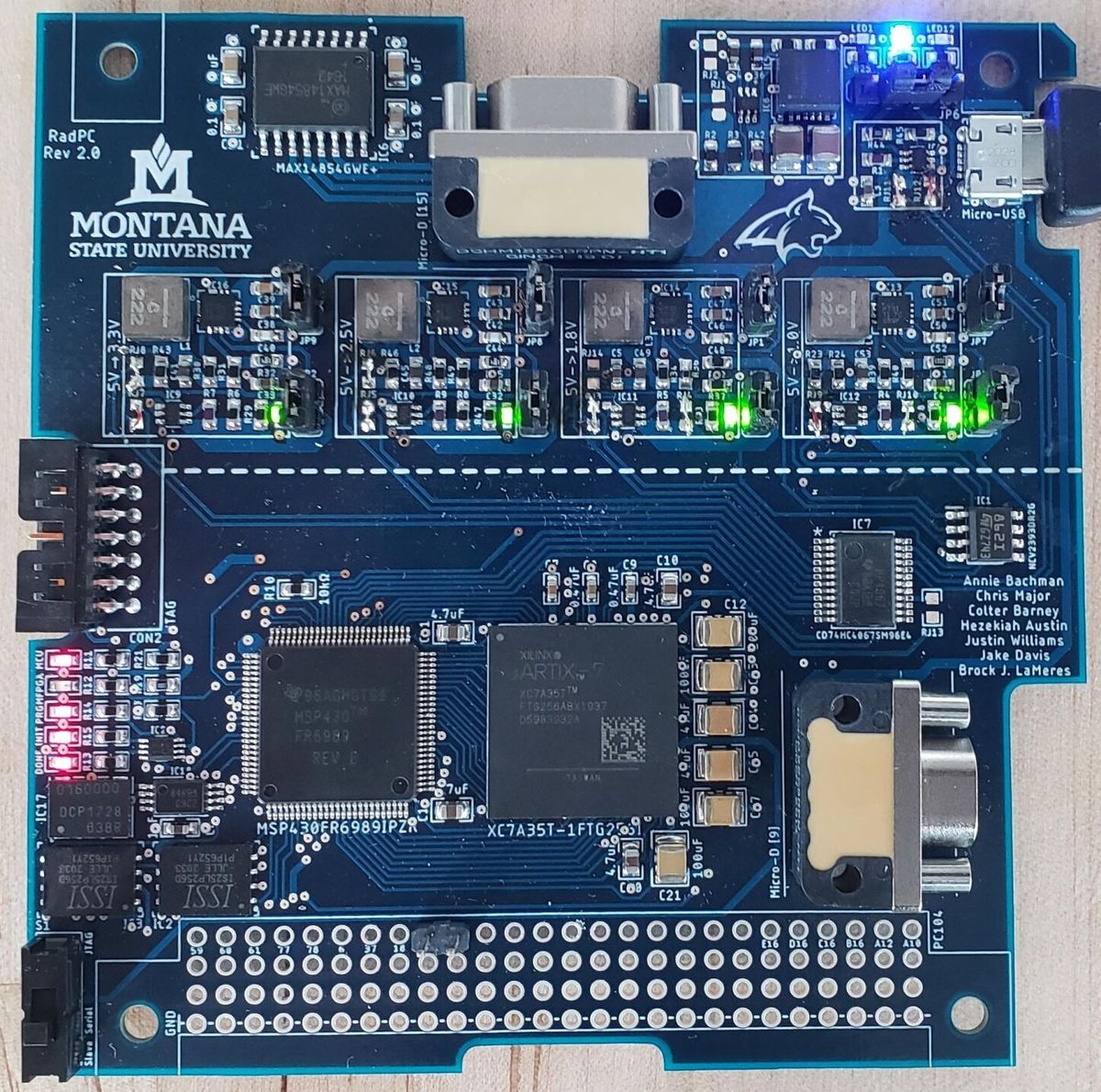
Over the last 12 years, MSU students and faculty have been designing, building and testing a computer aimed to better handle radiation-related disruptions in space. This spring, the computer will be shipped off to NASA, which will take it to the moon in 2023 aboard the XL-1 Lander mission launching from Cape Canaveral on a SpaceX booster. The spacecraft will land at the Hawthorn crater near the south pole of the moon, where it will operate for roughly 12 days before lunar nightfall. The goals of the XL-1 Lander mission are to assess the composition of the lunar surface, evaluate the radiation environment and test precision landing technologies. The project represents one of the most successful and high-profile research and development projects in MSU history.
The computer, named RadPC, seeks to remedy issues that many computers struggle with when used outside Earth’s atmosphere. In space, radiation can scramble computers and cause them to crash unexpectedly. Brock LaMeres has advised over a decade of research and development regarding RadPC, spoke with the Exponentabout the science behind the computer and the process MSU researchers followed to ready it for duty on the moon. “We found this niche where we had an idea to make computers more reliable in outer space and to recover from crashes caused by radiation,” LaMeres said. “NASA caught wind of it and they liked the idea, so they started funding demonstrations of it as a technology.” Proving that certain technology is worthy of use in space is a rigorous task, so MSU researchers had to demonstrate RadPC’s capabilities in an array of environments before NASA approved it for testing on the moon. “The last 12-plus years have been, ‘build a prototype of (the computer) and fly it on a balloon. Then build a prototype and shoot it up in a rocket,’” LaMeres explained. “Then two years ago we got the call from NASA that we got selected to go to the moon as part of a mission to test out a bunch of technology and science payloads.”
The area of computer technology RadPC is intended to advance holds significant importance in its field. Today’s space computers are expensive and slow compared to the computers used on Earth. Since Earth computers do not face harsh radiation exposure, they run without the disruptions computers outside our atmosphere are forced to contend with. “A typical computer is running at two to three gigahertz, which is a billion things per second. A computer on Mars can only do two or three million,” LaMeres said. Computers used in space are also much more costly to produce, with price tags in the six figures. Speaking about the computers used on current Mars rovers, LaMeres said, “They’re the equivalent to a 20 year-old computer that costs $200,000.” Ideally, RadPC would remedy both performance and cost issues, making it “An order of magnitude cheaper and faster” than current technology, according to LaMeres.
RadPC is a student project through and through. “I always highlight that the whole thing is designed and built by students,” LaMeres said. “I just guide the research.” Undergraduate and graduate students have collaborated on the project for over a decade with advice from faculty members like LaMeres. MSU graduate researchers Colter Barney and Chris Major spoke with The Exponent about their experience working on RadPC while they attempted to salvage computer chips from a scrapped project. Chris and Colter were patient as they described the intricacies of RadPC, and the depth of their knowledge was immediately apparent. “The project has changed my entire schooling,” Barney said of RadPC. “I probably wouldn’t be going to grad school if this project didn’t come through. Even in undergrad — being in the lab here with other students — you learn things that aren’t taught in class.” As graduate students, Barney and Major fullfilled leadership duties on the project along with their technical roles in building and designing RadPC. “Generally we’re overseeing the main design stuff to make sure it all comes together and the undergrads help take care of different components that match where they are in their classes but still play a big role in putting together the payload,” Major said. As the lead graduate student on the project, Major did the bulk of the development for the experiment. “It’s been an awesome project,” he said. “I work with an awesome team and I’m super happy to see this project get to its completion.”
Physically, RadPC is a box slightly smaller than a loaf of bread with a series of boards inserted within. One of these boards serves simply as a storage device for the computer, and it holds enough space to bring millions of images, messages and other content to the moon. “We have essentially infinite room,” LaMeres said. “I tell people that we have sixty-four iPhone 13’s worth of storage.” LaMeres hopes to fill RadPC with content from Montanans to create a time capsule for whoever opens it whenever it is opened. “It might be a thousand years before anybody walks up to (RadPC) and opens it,” LaMeres said. If RadPC’s time capsule does sit untouched for centuries, LaMeres wants its contents to reflect what life was like in Montana in 2022. “The aerospace community has a tradition of flying memorabilia on stuff,” he explained. “I thought ‘we have enough memory on this computer. Let’s have everybody who wants to upload a message or a picture upload something to it and then we have this time capsule of what’s going on in society right now.’”
The near-limitless storage provided by RadPC presents the MSU community with a once-in-a-lifetime opportunity to send personal writings and photographs into space. Students are encouraged to upload content they feel encapsulates their experience at MSU. Despite the excitement around RadPC, LaMeres has yet to receive the volume of submissions he hoped for. “I have 250 (submissions) right now, and it’s been two weeks,” he said. Students can upload as many submissions as they want, and they have until March 11 to do so. Submissions can be uploaded at https://www.montana.edu/blameres/moon.html.
So, Bobcats, what are you waiting for? Make sure that your words and images are included on this space mission, and tell your friends to do the same!


Comments ()