
MSU researcher highlights physiological differences between whitebark pine and limber pine
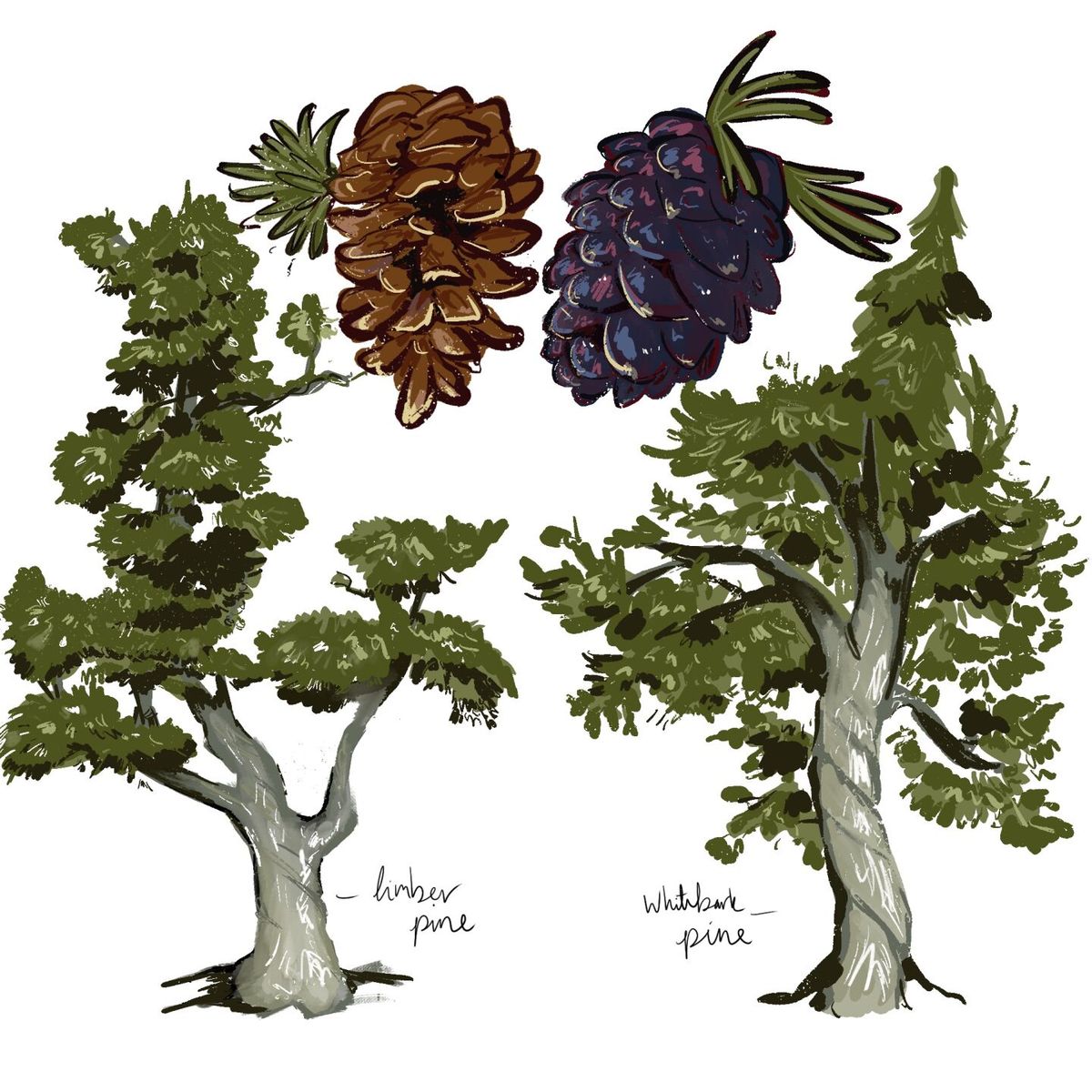
A recently-published study by an MSU professor highlighted the differences between two tree species common in the Greater Yellowstone Ecosystem (GYE). Dr. Danielle Ulrich, a plant physiologist and assistant professor in the Ecology Department, is the lead author of “Functional traits underlie specialist-generalist strategies in whitebark pine and limber pine,”which was published in the Forest Ecology and Management journal this past August.
The purpose of the study was to compare two high-elevation pine species — whitebark pine and limber pine. “I’m a plant physiologist, so I’m interested in how plants function and how they respond to their environments,” she said.
The goal of the study was to compare the physiology of these two species by comparing various traits linked to how the plant grows, how it acquires ingredients of photosynthesis — water, carbon dioxide and sunlight — and how it resists stress, she said.
“By creating these species-specific profiles, or fingerprints of each species’ physiological traits, we wanted to directly compare them and ask the question, are any of those traits linked to these species’ geographic distributions,” Ulrich said. “Are any of these traits linked to how and why they live where they do?”
Whitebark pine and limber pine are both found within the GYE, Ulrich said. Limber pine, however, tends to have a broader elevational range, meaning that it ranges from lower elevations all the way up to subalpine or upper treeline elevations, so it’s considered a “generalist” species.
Conversely, whitebark pine really only occupies those upper treeline elevations, making it more of a “specialist” species, according to Ulrich..
Generalist species can be good at both acquiring resources for photosynthesis and growing well, as well as resisting stress, Ulrich said. A specialist picks one or the other: it can be good at growing well or being stress-resistant, but not both, she said.
Whitebark pine and limber pine were compared because of their similarities. For example, both trees are five-needled pines and can’t be visually distinguished unless you can find cones. Additionally, both species are slow-growing and are threatened by the same things — including white pine blister rust, bark beetles and climate change, she said.
Whitebark pine was a species of interest to Ulrich’s research because it was listed as threatened under the U.S. Endangered Species Act in 2022. “It was a candidate species for a while and it’s declining at alarming rates due to a suite of factors,” Ulrich said. These factors include white pine blister rust, bark beetles, climate change, a history of fire suppression and competition with more shade-tolerant conifer species, she said.
“We’re losing whitebark pine, it’s now officially listed as threatened, so we need to be able to predict how our changing climate is going to affect whitebark pine and where we will find whitebark pine in the future,” Ulrich said.
For this study, Ulrich obtained five-year-old juvenile trees of both species from the U.S. Forest Service and grew them in the greenhouses at MSU’s Plant Growth Center. The trees were grown in a common environment in order to remove any “confounding factors,” or factors that would make interpreting the study’s results difficult. From there, Ulrich measured traits like morphology and tolerance to drought and heat stress to identify physiological differences between whitebark pine and limber pine.
Ulrich found that whitebark pine has similar stress-resistant traits that limber pine has, which could explain why both species live at higher elevations, she said. Given these results, Ulrich’s next step is to determine how each species responds to different stressors, specifically drought and heat stress. “We might hypothesize that limber pine, as the generalist that inhabits lower, warmer elevation habitats, might fare better under increasing drought stress than whitebark pine,” she said.
Although whitebark pine is listed as threatened, Ulrich pointed out that limber pine is not. Given the similarities between the two species, she said she believes that any lessons we learn from whitebark pine, maybe we could apply to limber pine in the future.
“If we can better understand their physiology, we can better understand how they live where they do, and better predict where they’ll be in the future and how they’ll fare under future climates,” Ulrich said.
If you want to read Ulrich’s study in full, students have access through the MSU library. Simply type the title into the CatSearch search bar at: https://www.lib.montana.edu.



Comments ()