
MSU student discovers new species of Tyrannosaur dinosaur
Imagine you are walking along the Judith River Formation in Valley County. It’s Northeastern Montana, the air is dry and the rocks crumble under your feet as you walk. The sandstone cliffs of this geologic site loom above you and you think about the fossils that have been discovered here. Perhaps you might find one. Then, you suddenly notice something sticking out of the cliff. Could it be…?
Perhaps this is what Jack P. Wilson was thinking when he saw part of a premaxilla bone sticking out of those same cliffs back in 2017 — a bone that researchers, including Elias Warshaw, now know belongs to a new species of T. Rex.
Warshaw, a student in the MSU Department of Earth Sciences Paleontology, is on the team that excavated the rest of the skeleton and is studying the fossil.
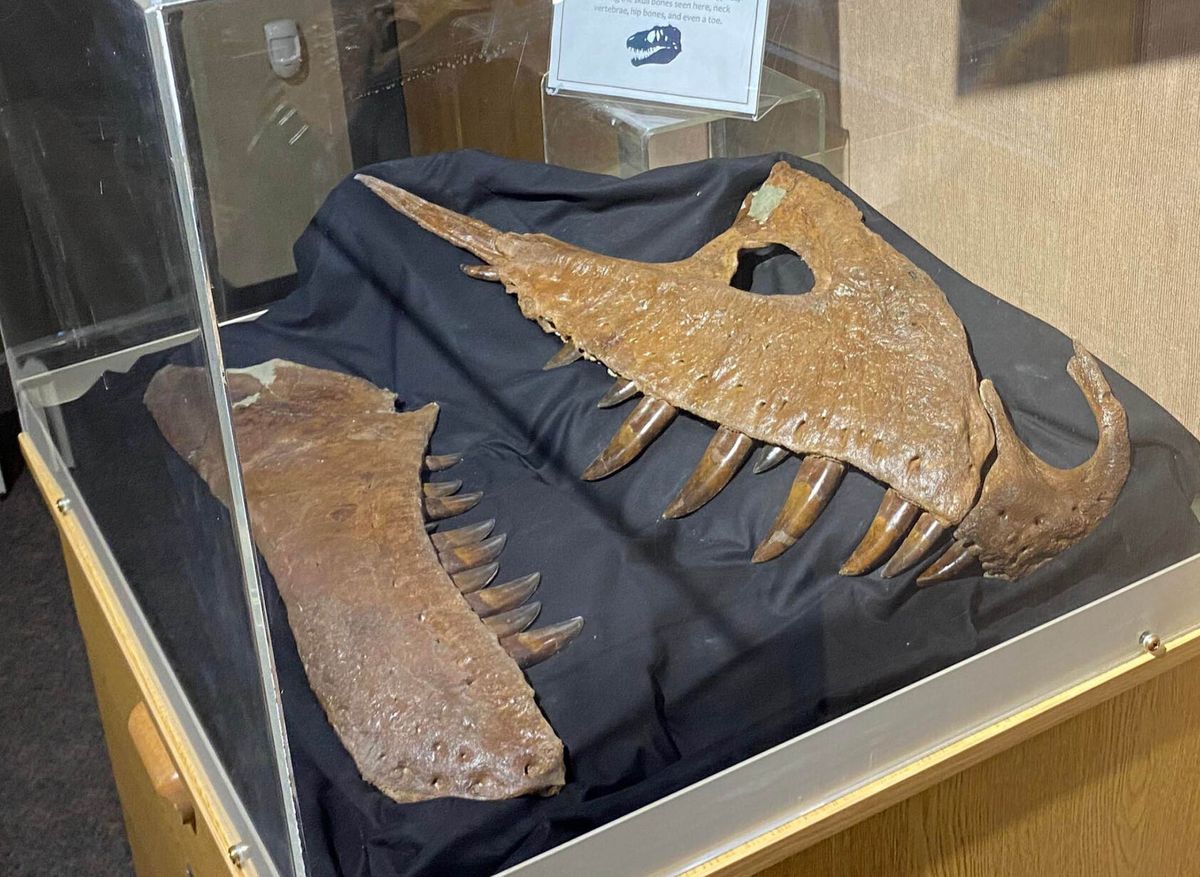
Named after its discoverer, Daspletosaurus wilsoni dates between two other types of Tyrannosaurids in the T. Rex family: its predecessor Daspletosaurus torosus and its descendent Daspletosaurus horneri.
D. wilsoni also falls in between its two relatives in terms of morphology – its bone features. This has led the research team to validate theories that began at Museum of the Rockies in the 90s.
On Friday, Nov. 25, Warshaw and co-author Denver Fowler, an MSU alum and Curator at the Dickinson Museum Center in North Dakota, published a paper in the journal PeerJ announcing their discovery.
“We hypothesize in the paper that [D. wilsoni] is actually just a missing link, a transitional fossil, along a single lineage of evolving tyrannosaurus in this area …The new fossils that we have now are sort of a confirmation… of the predictions that were made by those earlier studies which received some pushback over the year,” Warshaw said. “I think that the results that we present help to elevate it to a defensible idea.”
After the initial discovery of the fossils in 2017, excavation was put on hold as this site was only one of four of Badlands Dinosaur Museum’s fossil excavation sites. In 2020, excavation began in earnest. The team removed 25 feet of rock with small jackhammers, pickaxes and shovels, (garnering D. wilsoni the nickname Sisyphus). They collected the bones from the site. During the following summer of 2021, the excavation team took another 25 feet out of the cliff behind to ensure they hadn’t missed anything.
“It was on the bank of a 76.5 million-year-old river and we can see that water carried the bones and spread them across the bank… so all the skull bones were sort of scattered, none of them were found together in their life position,” Warshaw said.
In the summer of 2022, they cleaned out the quarry and closed the dig, though you can still see marks of jackhammers in the cliffside if you visit the site.
Not only is this a discovery of a new dinosaur, but it adds to a growing list of discoveries that support linear evolution in the larger paleontological conversation. “There’s been a debate within paleontology in terms of whether evolution is frequently branching and includes a lot of different species branching from each other, or if it usually progresses as single lineages changing through time,” Warshaw explained.
“In the study that we published, we hypothesize [there is] a single lineage of large Tyrannosaurus. It adds to sort of a growing list of lineages where that’s the case, especially dinosaurs from around the same time,” said Warshaw.
The paper published on Nov. 25 focuses mainly on the connection between D. wilsoni’s relatives and the evolutionary implications. Further research will focus on similar questions, and the “connection between this specimen and T. Rex specifically,” said Warshaw.
Additionally, the team and Warshaw plan to research the vertebrae and tailbone. They will “try to cut open one of the ribs and see if we can get a good idea of the age of the specimen – when it died,” Warshaw said.
While they don’t know how D. wilsoni died, “there are healed bite marks on the back of [the dinosaur’s] lower jaw,” Warshaw said.
“So it was getting scrappy with other Tyrannosaurus — but there is no way to say if that’s what finished it,” he said.
The research paper furthers research about Tyrannosaurus and evolutionary theory, but the broader study of paleontology has implications beyond just this species.
“I think that dinosaurs are the most charismatic fossil animals that we have. But I think fossils in general and paleontology is important because it’s the only way we can look at how life acts at large time scales,” Warshaw said. “There’s only so much we can learn from the singular slice of time that we live in right now, [so] it’s really important to look at these larger time scales that are only available in fossils.”
The upper and lower jawbones and the front of the snout are currently on display at the Badlands Dinosaur Museum in North Dakota. The rest of the skull is still in collections. Once the research team crafts models of the missing pieces of the skeleton, D. wilsoni will be mounted and available for public viewing.


Comments ()