
MSU topples the competition at annual Spring Rodeo
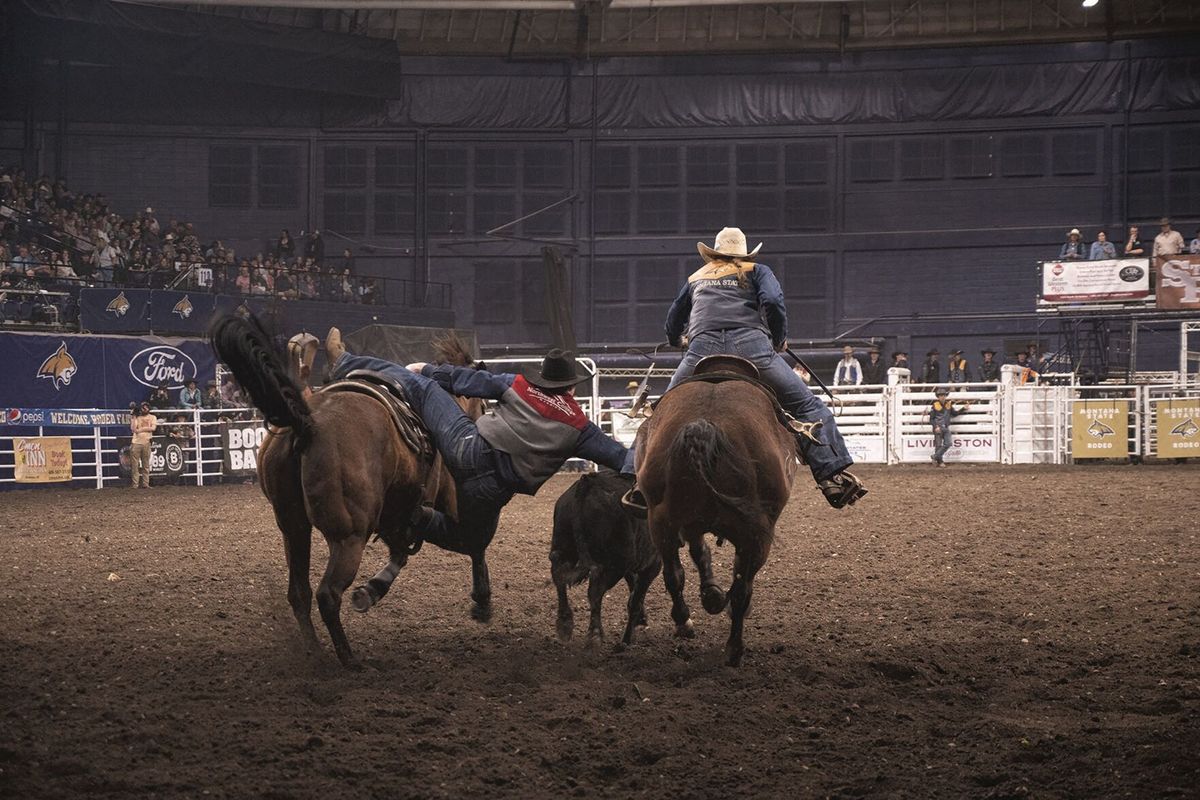
As Tate the Rodeo Clown entered the dirt floor of the arena, his voice boomed “Who's ready to rodeo?” This was just the beginning of the last day of the 2024 MSU Spring Rodeo. Sunday April 14, marked the all-too-anticipated rodeo championships, bringing together the best of the best in the Big Sky Region after three days of qualifiers — April 10 to 13 — in the Brick Breeden Fieldhouse.
This year’s event celebrated talented competitors from seven schools across Montana and Wyoming. By Sunday, a few athletes' victory laps would forecast the crownings to come with the familiar shades of blue and gold making their fair share of trips around the arena. In the end, MSU walked away with more individual titles than any other team, bringing home five belt buckles — the traditional trophies of rodeo.
By this point, Bobcat fans are used to stomping their boots and waving their hats for the team, with performances dating back to the program's inception in 1947. Their victories span over 77 years with some of their most notable accomplishments rolling in this decade. Last year, at the 2023 college finals, the women’s team took home the Women’s Team Reserve National Champions to complement National Champion titles in 2021 and 2011. In 2023, the men’s team took 9th place at nationals after 6th place finishes in 2012 and 2018 and 5th place finishes in 2006 and 2014. Since 1947, the team has claimed nine national team titles, 34 national championships, and a respectable amount of Big Sky Regional crowns.
Each year, the team hopes to bring the spirit of the rodeo to life by upholding the National Intercollegiate Rodeo Association’s (NIRA) vision: “One of the primary goals of the NIRA is to establish and maintain standards that promote rodeos on a national scale by bringing national recognition, interest, understanding, and appreciation for an organized collegiate sport in Western life and culture,” according to the NIRA website collegerodeo.com. Created in 1949, the MSU rodeo team outdates the NIRA, contributing to the organization’s exigence and importance in the West and across the U.S. The NIRA is divided into 11 regions, with over 135 registered colleges and universities and some unregistered colleges represented by independent members. Members will compete in approximately ten rodeos a year with hopes of earning a spot in the College National Finals Rodeo. The Ford Wyoming Center in Casper, Wyoming, has organized and hosted the event for 23 years. With impressive performances this year by the Bobcats, fans can expect to see some familiar faces in the National Finals on June 11-17 2024 in Casper.
This year over the span of four days 12,678 eager fans packed the Brick Breeden Fieldhouse, according to Tate the Rodeo Clown. Some traveled near and others far to see what rodeoing is all about. Norwegian exchange student Thyra Martinsen and her friend, Maxya Elise Knold are two of the sport's newest fans. “We loved the rodeo and the spirit of the crowd. We had a lot of fun,” said Martinsen in a post-rodeo interview.
The draw that makes a rodeo both successful and entertaining are the nine events that comprise it, each ranging in intensity, difficulty and skill. These events are a product of early Spanish and Mexican cattle ranching practices, which blended horsemanship and livestock handling. Over time, the emerging practice began to showcase events such as bronc riding, bull riding, and other higher-caliber performances and riders. In the late 19th and early 20th centuries, events like the “Pendleton Round-up” in Pendleton, Oregon, and the “Calgary Stampede” in Calgary, Alberta, began to spring up across the globe. This popularity in Canada and the U.S. led to the formation of organizations such as the Professional Rodeo Cowboys Association (PRCA) and The National Intercollegiate Rodeo Association (NIRA). Today, rodeoing is a well-loved practice with regulations set in place to promote animal welfare, safety and inclusivity, according to the website sportsfoundation.org.
Riders can compete in every event; however, mastering the skills required for each event takes time and dedication. Instead, riders began honing in on their best events. MSU’s Alexis McDonald is drawn to barrel racing, the fastest event in the circuit, because of her upbringing in equestrian sports: “Barrel racing is my main event. I’ve been doing it for six years now,” McDonald said.
Barrel racing is a timed women's event in which riders guide the horse around three barrels in a cloverleaf pattern with the fastest time securing the win. Barrels may be clipped or skimmed without penalty; however, if a barrel is tipped, five seconds will be added to the rider's time.
Going into the championship, all qualifying riders sat around the 14 seconds, with only 0.36 seconds between Saturday’s highest and lowest time. With the pressure on, MSU’s five riders put on quite the show. MSU's Rachel Ward flew through the arena with her legs bobbing up and down to the horses' movements, skimming off 0.8 seconds from the previous day and landing herself a 14.8-second score. With what would have been flying times, MSU riders McDonald and Shantell Brewer tipped the first barrel and walked away with no scores. Next up was a rider known for consistently low times and agile rides: Tayla Moeykens, the Reserve National Champion Barrel Racing in 2023 and the Barrel Racing Champion in 2021. Switching horses between Saturday and Sunday, an atypical move, didn’t stop Moekykens from doing what she does best. She earned herself the fast time of the night, 14.66 seconds, and an overall championship title.
Although McDonald couldn’t rope in a winning time, she still saw the competition as a success. “I didn’t have the best weekend myself, but the team had a great race. We are in Montana, so we can’t always practice year-round. We’ve been putting in a lot of work this spring. I think at our hometown rodeo, we all felt the pressure in the best way. We really shined through. All the teamwork and self work paid off. Everyone in the sport is so kind and supportive and just wants to see you thrive. It makes you want to do better,” McDonald said.
In the riders’ seventh event of the night, teamwork paid off for the five Bobcats who qualified for tie-down roping. Tie-down roping — an event similar to goat tying with the expectation that the rider must lasso an untethered calf, then dismount, tackle and tie three of the calf’s legs — is senior Bode Spring’s favorite event to tackle.
“I am drawn to it because of how faultless you have to be in order to be fast. In tie-down roping, there are so many components that have to work seamlessly together for you to be fast. My favorite aspect of competing is the exhilaration following a successful run, reaffirming that dedication and hard work in practice are worthwhile,” said Spring in a post-event interview. Last year, Spring earned 3rd place in the Men’s All-Around category, 6th place in “Steer Wrestling” and a top-ten finish in “Tie-Down Roping.”
After scoring exceptional times on Saturday, the Bobcats entered the tie-down roping championships with three riders in the top three: Ryley Mapston, Wyatt Jensen and Traver Johnson. Mapston put on a show with a fast approach and a seamless tie and landed himself a 10.4-second score and a tie-finish with teammate Wes Shaw. Although Johnson entered the competition with Saturday’s top finish, his lasso fell short, resulting in a no score. Tying all the loose ends together, Jensen, who came into the weekend ranked second in the Big Sky region, won the event and championship with a commendable 9.6-second score.
These are just two of the events competitors can choose from. MSU competitors also dazzled in the circuit's seven other events: bareback riding, bull riding, goat tying, team roping, saddle bronc riding, breakaway roping and steer wrestling.
The ‘Cats are scheduled to compete in Miles City beginning on April 18 and in Missoula from April 26 to 27. Missoula is the last qualifying rodeo of the year before riders and teams find out if they’ve qualified for nationals. As of April 15, the men’s team is ranked first in the Big Sky region with 5,017 points, with the women’s team holding second with 2,375 — only 33 points behind the leader, MSU-Northern, located in Havre, Montana.
All nine events in this captivating rodeo showed the riders' dedication, grit and bravery. Although Spring didn’t walk away with a title, his mentality is a good reminder to all athletes competing in intercollegiate sports. “I put pressure on myself to succeed. It’s easy to forget that I’m here not just to succeed but because I love the sport,” Spring said.

Comments ()