
Office of Sustainability shares success and challenges with long-term sustainability targets
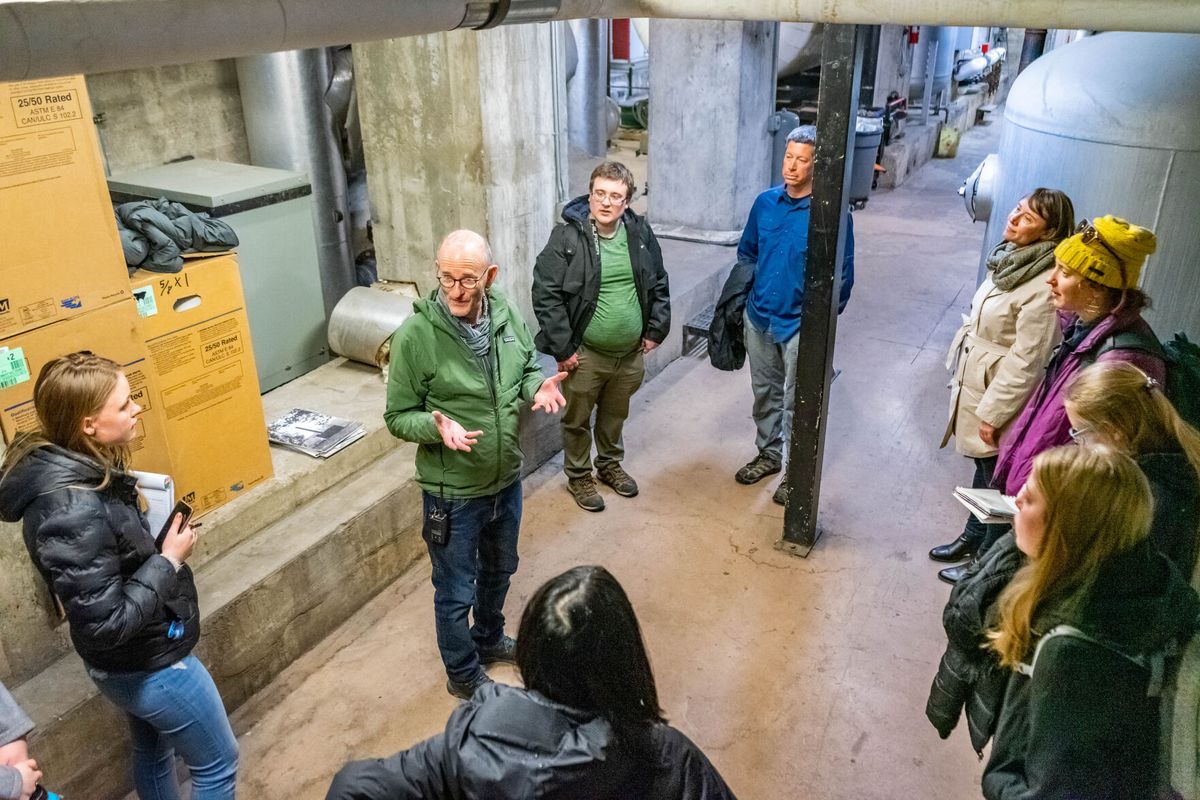
Kristin Blackler, director of the Office of Sustainability, imitated Oprah as she opened the inaugural MSU Sustainability Summit on Tuesday, April 19, saying “let’s get this show started and who gets an EV car.” The summit was designed to inform the public about MSU's Sustainability Framework, which established goals for the university to reach carbon neutrality by 2040, achieve zero-waste by 2035 and attain a Sustainability Tracking, Rating and Assessment System (STARS) platinum rating by 2035.
“Our intention with this summit is to inform and inspire,” Blackler said. “We want to welcome you to share the things that we've learned, the questions and solutions we are still exploring and the challenges we face in achieving the long-term targets in our campus sustainability framework.”
The summit kicked off the night of Monday, April 18, with a keynote speech from Chad Pregracke, 2013 CNN Hero of the Year and founder of the nonprofit Living Lands and Waters. In 1997, after years of ignored calls to the government about the trash he saw in the Mississippi River, Pregracke decided to clean up the river himself. Twenty-five years later, and with the help of over 120,000 volunteers, Living Lands and Waters has been able to remove over 12 million pounds of garbage from America’s rivers.
An audience member asked Pregracke how he copes when he feels defeated and overwhelmed by the scale of the problems he is working on. He faltered before saying that he doesn’t ever feel defeated because he is actively making a difference. Blackler highlighted Pregracke’s response the following day saying, “we hope you take a brief break from some of the climate doom and join us in the doing.”
Established in 2012 through a student-led initiative, the Office of Sustainability, is a hub for climate doing at MSU. Its Sustainability Framework, released in December 2021, is the first group of sustainability goals formally announced by MSU.
Data collection and reporting through STARS, an online tool that awards points for sustainability in categories such as operations, administration and leadership, has become an important tool for colleges as they seek to measure progress on sustainability.
Paul Edlund, Office of Sustainability program manager, described the STARS report as a way for sustainability to be quantified. MSU submitted its first STARS report in 2019 and achieved a silver rating. The next STARS report for MSU will be submitted in 2022, and the office is aiming for a gold rating.
“This process is new for most universities that are participating in the STARS report,” Rose Vejvoda, Office of Sustainability project coordinator, said. “The more we work on this and the more systems that we explore, the better we will be in the future.” Currently, 340 universities have participated in the STARS report, 45 universities have received a bronze rating, 141 universities have received a silver rating, 130 universities have received a gold rating and eight universities have received a platinum rating. Similar to other sustainability reporting systems, as more universities achieve gold and platinum, STARS makes it more difficult to achieve these ratings. “We don't shy away from a challenge. So [platinum rating is] what we're going to try and do,” Blackler said.
The summit did not focus on the framework’s zero-waste goal as MSU is “far along” on waste reduction, according to Blackler. Currently, 32% of waste at MSU is diverted away from landfills and instead is recycled or composted. “Next year, we'll come back with the next phase of how do we focus less on the recycling and more on what are we not going to bring to campus in the first place at all,” Blackler said.
At MSU, annual global greenhouse gas emissions are equal to 52,000 tons of carbon dioxide. Global greenhouse gas emissions are equal to 50 billion tons of carbon dioxide annually. “Some people look at this and say, why even bother? It's pretty insignificant,” Blackler said. “But we look at that and say … our true impact is the ability to practice this, to learn it, to prove that it can be done, to prove that there's still time, and to train all of the engineers, politicians, artists, communicators to go out into the world and teach other people how to do that all across our state, all across the world.”
The Office of Sustainability has approached this goal by breaking carbon emissions up into three scopes based on the origin of emissions. Scope one emissions are direct greenhouse gas emissions that occur from sources controlled or owned by an organization such as fuel combustion in boilers, furnaces or vehicles. “Scope one is about 45% of our overall greenhouse gas emissions,” Megan Sterl, director of engineering and utilities, said, and 91% of the emissions in that category are generated by MSU’s heating plant
MSU has extensive scope one infrastructure: 188 gas or steam building connections, 17 miles of steam/condensate return piping, 3 miles of natural gas piping and a central heating plant. “We know we have a lot of infrastructure in place already around scope one, and that the systems are complex, the answer may not be easy,” Sterl said. “So how do we actually transition to a cleaner energy and how do we transition away from scope one emissions?”
Over the past 10 years, MSU has installed equipment to transition scope one emissions away from steam and gas. This has included overall electrification, heat pump systems, geothermal wells, solar wall preheating, roof mounted photovoltaics and creating energy districts. “The way MSU views our buildings, not as standalone objects, but as part of a living energy district is actually really revolutionary,” Blackler said. “Our use of geothermal wells and ground source heat pumps is among the most progressive approaches to energy conservation and climate change mitigation in the country.”
An energy district connects multiple buildings together which allows for energy to be transitioned from building to building. This helps cut down on energy waste. However, these revolutionary approaches are costly. “The biggest reality is also coming up with our construction costs and timelines,” Sterl said.
Another challenge is that electrifying scope one emissions increases scope two emissions, which are indirect greenhouse gas emissions associated with the purchase of electricity, steam, heat or cooling. The university must purchase electricity through utilities that often don’t use renewable energy. “So, we're really not eliminating those emissions. We're just transitioning them to a different type,” Sterl said. “And hopefully one that will accept renewable sources at some point, but it doesn't eliminate them altogether.”
In 2019, scope two emissions were 21% of MSU’s total emissions. The university purchases energy from Northwestern Energy and from the Western Area Power Administration. “Because we are purchasing this electricity and the generation from Northwestern Energy, any efforts that we undertake to try to reduce our carbon footprint are constrained by what is in their generation portfolio,” Eric Austin, professor of political science, said.
MSU has a threefold approach to reducing scope two emissions: making buildings more efficient, transferring extra energy between buildings and using renewable energy sources. In 2020, 0.4% of MSU’s electricity was supplied by on-campus solar panels. One challenge with the use of solar energy is that “we are a winter peaking utility, which means that our peak electrical load happens in February, in the middle of the night, when it's 28 degrees below zero,” Austin said. “If we are going to grow our ability to utilize particularly wind and solar as a source of decarbonization, storage is going to have to go along with that.”
Energy can be stored in batteries and used later, but this technology needs advancement. Fortunately, “there are a ton of folks around the country and around the world that are working on these challenges,” Austin said. “We're seeing new and increasingly cost-effective storage technologies being tested and coming online routinely.”
However, our capacity to utilize solar is limited and likely cannot be the only solution to reducing scope two emissions. “If we were to try to generate our entire electrical need on campus through PV [photovoltaic] sources, we would basically need to cover not only the entirety of the campus with solar cells, but that would have to extend west of campus all the way past the BART Farm,” Austin said.
While there are big challenges involved in reducing scope two emissions, “it is a place, where unlike major infrastructure changes, we have an individual level agency to take action,” Austin said.
Scope three emissions, which account for 34% of MSU’s emissions, are all emissions that are not included in scope one and two and are often referred to as “everything else.” “Most institutions do not address scope three emissions because they’re pretty difficult to quantify,” EJ Hook, facilities services director, said. In 2019, 48% of MSU scope three emissions were due to air travel, 33% were due to commuting and 14% were due to waste.
Education and awareness is crucial for reducing scope three emissions at MSU, including expanding incentives for alternative modes of transportation, improving infrastructure for bikes and pedestrians, and improving awareness of current programs. “These are carbon emissions that we all contribute to every day, whether it's in our personal lives or our shared experience,” Hook said. “These are emissions you and I can influence by the choices we make.”
One way that students are helping to reduce scope three emissions is through sustainability related research projects. During the summit, seven students from various academic backgrounds presented on topics ranging from city walkability, sustainable food systems, sustainable investing, electrifying off-grid remote areas, community health, enzymes that eat plastic and the power of collective action. These presentations reflected Pregracke’s closing note in his keynote speech: “They say students are the future. Yeah, it's true. You're the future. But you're really the present.”


Comments ()