
Presidential finalists visit campus, answer community questions
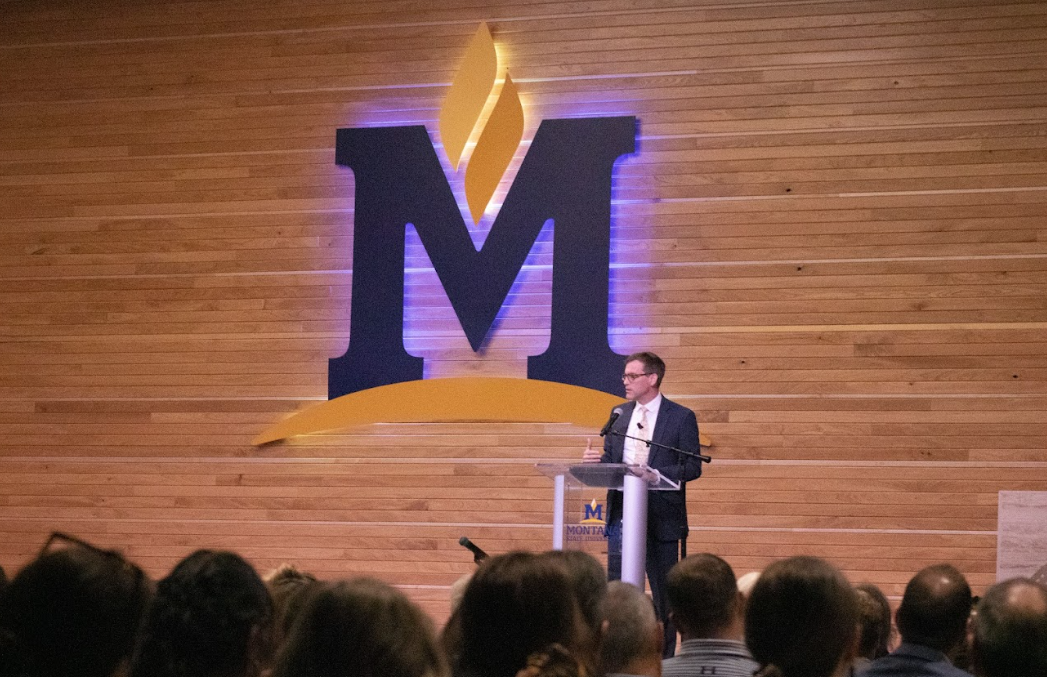
President Waded Cruzado announced her intention to retire in August 2024, setting into motion the process of selecting the next president of MSU.
On March 21, the MSU Presidential Search Advisory Committee announced MSU’s two presidential finalists. Each finalist spent two days at MSU during the week of March 24, during which both candidates attended forums open to staff, students, faculty and community members to address some of their questions and concerns.
The first candidate, Kurt Schnier, has been an economics professor since 2014 at the University of California (UC), Merced, where he also serves as the Chancellor for Planning and Budget and the Chief Financial Officer. His professional experience extends beyond UC Merced, as he has held faculty positions at the University of Rhode Island and Georgia State University.
Schnier holds a B.S. in Management Sciences from the University of California, San Diego, an M.A. in Environmental Studies from the University of Pennsylvania and a Ph.D. in Economics from the University of Arizona, according to his bio on the MSU presidential search website.
The second candidate, Brock Tessman, is the current president of Northern Michigan University (NMU). Before his time at NMU, he was the deputy commissioner of higher education for the Montana University System (MUS). He has also worked as a professor of political science and as dean of the Davidson Honors College at the University of Montana and as an International Relations professor at the University of Georgia.
Tessman received his B.A. in international relations from Brown University and his M.A. in International Affairs and Ph.D. in Political Science from the University of Colorado Boulder, according to his bio on the MSU presidential search website.
Hundreds of people from MSU and the wider community attended each candidate’s forum, some with questions for the presidential finalists. Many of the questions focused on the University’s land grant mission, student affordability and the changing landscape of American higher education.
At the beginning of his forum on March 25, Schnier connected his economic experience with the position of the MSU presidency by comparing the structure of a university to that of a business.
“When I was a faculty, if somebody had told me higher [education] was a business, I would want to strangle them,” he said during the forum. “Now that I've been on the finance side, I actually see it actually kind of is, but there's a way of doing it where you don't have to lose what the core of the institution is.”
Schnier expanded on this idea following a student's question concerning how he would balance treating MSU like a business while addressing the needs of underrepresented students on campus.
“You have to have the goals of the institution first, and then you've got the budgeting and the structure around that,” he said. Schnier also noted the importance of prioritizing the core values of a university while preserving the underlying business structures that it relies on.
On March 27, Tessman opened his forum by detailing his admiration and commitment to MSU’s land grant mission and its role in getting more students into Montana’s universities.
“The opportunity to come back to Montana and to lead an institution that really demonstrates excellence in all three legs of the land-grant mission is something that I can't pass up,” Tessman said. “MSU is the ultimate version of a land grant because those doors have remained wide open over the 130 years or so history of the University.”
A land-grant university is an institution that has been selected by its state government to receive the benefits outlined under the Morrill Acts of 1862 and 1890. The three legs of the land grant mission are education, research and community engagement, according to the MSU website.
Tessman said that if he were selected as president, his focus would be on increasing enrollment and continuing to improve educational outcomes and achievements for students.
Both candidates also fielded questions about their plans to address housing issues for students, faculty and staff. During his forum, Schnier acknowledged that housing is a grave concern in Montana and that there is no singular solution.
He cited land as a resource to help alleviate the pressure of high housing costs. “If [the University] had access to land, there are actually a lot of different ways you can actually provide affordable housing for faculty and staff,” Schnier said.
In response to the same question, Tessman cited NMU’s response to the housing issues in Marquette, Minnesota. His administration has made plans to break ground this coming summer on a new housing complex for third and fourth-year students. According to him, 10 percent of those units will be set aside specifically for faculty and staff.
“It allows faculty and staff to get their feet under them and land in a high-quality, reasonably-placed living situation,” Tessman said. “We believe that that's going to give them an advantage and give them a couple of years to try to figure out a more permanent solution.”
With recent cuts to the Department of Education, many in attendance were concerned about how the candidates planned to protect the interests of MSU in the face of possible changes to American higher education. In response, Tessman remarked on the far-reaching influence of research done at MSU as a way to shift the public’s perspective.
“MSU has a tremendous opportunity, even as we see a lot of uncertainty with respect to public trust and public belief in the value of higher education,” Tessman said. According to him, the University should prioritize research that can improve people’s day-to-day lives.
When faced with a similar question regarding the government’s shifting view of public higher education, Schnier emphasized the importance of realistic expectations for enrollment growth and the ambiguity of the changing educational landscape.
“We need to be modeling out what are the revenue losses that could happen under different scenarios,” Schnier said.“We just need to know what possible outcomes are, think of strategies around that, work with our state legislatures [and] work with our government to try to work on solutions around this.”
However, not all questions were about the future of MSU. Carter Berg, a graduate student in the Department of History and Philosophy, stated his concern regarding Schnier’s affiliation with The Property and Environment Research Center (PERC) — formally the Political Economy Research Center — where Schnier is still a senior research fellow, according to the PERC website.
PERC is a Bozeman-based environmentalist think tank known for promoting “free-market environmentalism,” the concept that by privatizing public lands and encouraging an exchange of those resources, conservation efforts can make money rather than spend it, according to the PERC website.
“I am a strong advocate for privatization of resources in fisheries management,” Schnier answered. According to him, private fisheries demonstrate the most ecologically successful fisheries, provided they are managed correctly.
“So I actually was an advocate for that market-based environmental management from the perspective that you have an efficient market structure for managing a resource, and at the same time you have the highest quality and most sustainable level of that resource,” Schnier said.
Tessman received a similar question about his affiliation with the Montana Office of the Commissioner of Higher Education (OCHE), with which Tessman worked closely during his time as the deputy commissioner of higher education for the MUS.
During his panel, a faculty member expressed concern that the OCHE’s actions don’t always align with MSU’s best interests and asked Tessman about his commitment to MSU despite his ties to the OCHE.
“My interview here and my desire to pursue this opportunity is because I want to lead MSU in the best interests of this campus and our affiliates,” Tessman responded. “I think it's a tremendous advantage to understand the system from the inside out because I think that's how MSU gets even more done down the road.”
According to Leanne Kurtz, the communications director for OCHE, the Presidential Search Advisory Committee is still deliberating and has no official date for when their final selection will be made.


Comments ()