
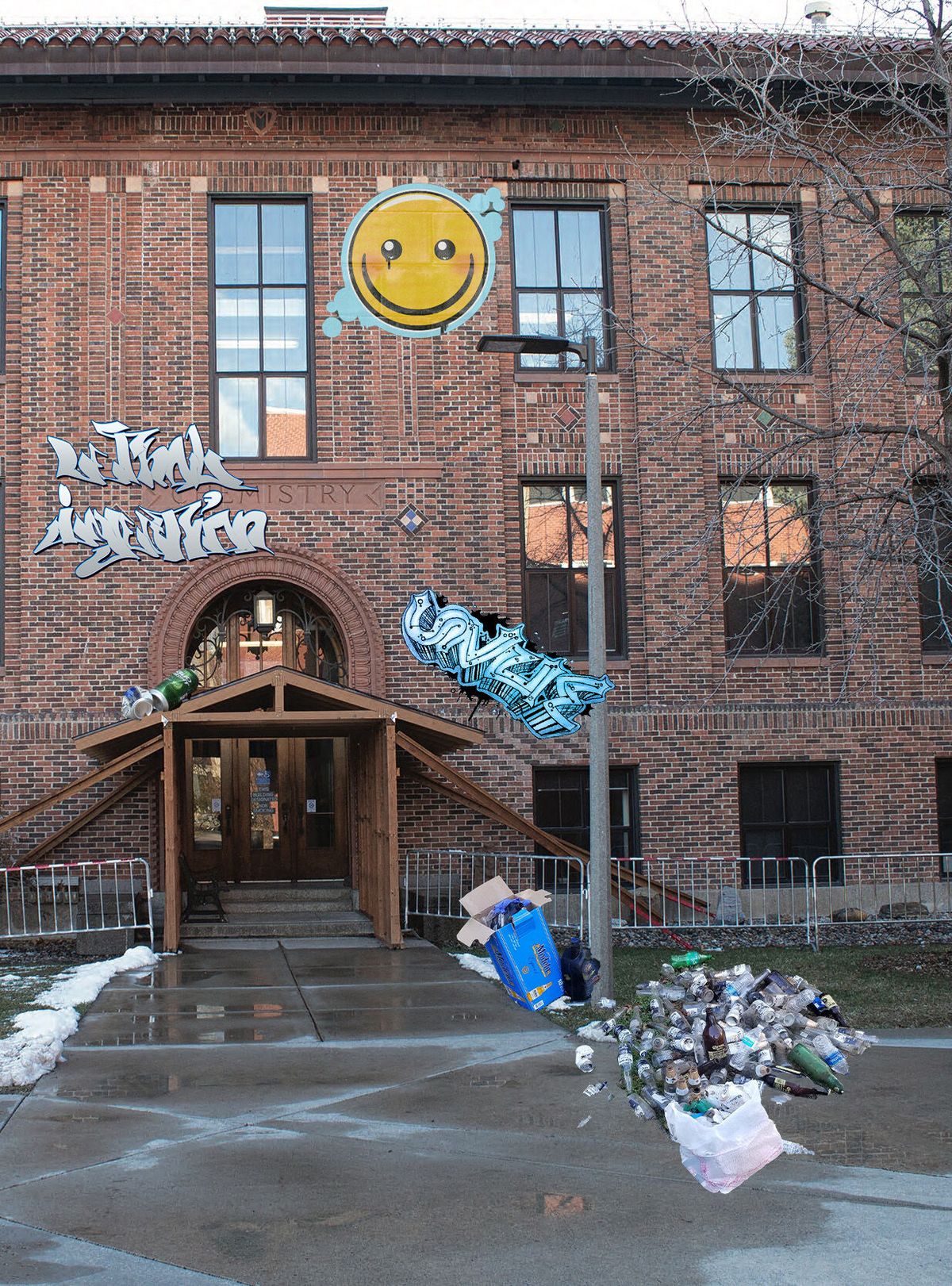
Putting the “trap” in Traphagen Hall
DISCLAIMER: This is a satirical piece. It does not necessarily represent the views of the Exponent or its writers and should not be construed as truth.
Saturday, March 23, 1996 started like any other day for the school’s starting quarterback, neurobiology student Rodney Finch. He grabbed his backpack and headed to Traphagen for his weekly experiment. He walked up the marble staircase to the shadowy fourth floor, spread his paperwork on the metal examination table and waited for his first experimentee — a fresh-faced nineteen-year-old psychology student named Jimmy Brighton. Brighton had signed up for extra credit and to find out more about the rumor that’d been spreading like wildfire across campus.
The building — named after former football coach and MSU’s first chemistry and natural sciences teacher, Frank Traphagen, in 1893 — wasn’t always so ominous. For the five male and three female students who attended MSU in 1893, the building represented the financial surplus created in Montana’s economy by war-inflated commodity prices in wheat, livestock and copper, according to MSU psychology faculty professor John Butler. By 1900, the red-light district had reached Bozeman with crates of cheap beer, penny entertainment and loads of tobacco.
“Those were the days. Cheap beer, cheap cigarettes, cheap movies. It didn’t get much better than that,” Butler said in an Excrement interview conducted on May 9, 1996.
In 1919, construction workers — built like linemen — restored the building brick by brick after a fire broke out in the chemistry lab three years earlier. The workers slabbed the southern wing in lower quality bricks and the northern in higher, creating an odd juxtaposition between the wings. This created the modern-day Traphagen; the southern wing with its new couches and light fixtures, the upper with its dark, rigid laboratories.
Worker Tony Gills found the work anything but satisfactory. “We lost a man in the process, fell from a fourth floor window the fourth day of construction. One of our best men. The project always felt wrong after that. Like everything we did was in vain,” Gills said in a 1996 interview.
On March 23, the building's dim hallways, ill-lit rooms, and sterile white walls connected the two wings in eerie silence. Fisher pulled his chair up to the table, his ribs digging into the edge, and scooped up one of the rats scurrying around his chair leg. He placed the rat in a 6x6 inch wire cage and asked baby-faced Brighton to administer the rat’s first dosing; a 100 ml syringe of clear, odorless liquid and a small ingestible tablet. Soon thereafter, Fisher dismissed the boy, sliding him a signed slip of paper and a hand-rolled cigarette.
In speaking with the freshman, he confirmed the rumor that all the students secretly spoke about in passing. “I didn’t know what it was at first. I didn’t even know why I was there. What was I doing? Administering some unknown substance to a rat? It didn’t feel right. So I went back later that night and saw what all the kids had been talking about.”
Walking up the marble staircase to the testing room he sat in earlier that day, he saw the first of many rats burst through the door. The rat had bloodshot eyes, sprinting past him to a nearby stow-away closet. The others came flooding down the hallway, scurrying over his sneakers in the same direction as the first until the last disappeared into the closet. When Brighton opened the door, he saw Fisher sitting on a whiskey crate up against a Bob Marley poster, smoke rising from his mouth and through his nose. The boy saw the rats pile onto his lap as the smoke formed white ghosts in the darkness.
“He wasn’t alone. The room was packed full of rats and students. I couldn’t believe it,” Brighton said.
That day, the name “The Traphagen Trap House” was etched in pencil on the white walls. Other students, such as sophomore psychology student Madi Minton, have tried to find that stow away closet. “I looked for days and days with no luck. My classmates and I haven’t stopped searching. It’s been years at this point” Minton said.
Nobody’s ever been able to find that closet again, and Rodney could no longer be seen roaming the halls in his lab coat or with the hundred of rats Brighton so distinctly remembers. The mystery of Traphagen has haunted the school for more than three decades with new rumors marking each anniversary. Perhaps we will never know the truth buried behind Traphagen’s brick slabs.


Comments ()