
“Reflections of parts of me”: Reframing Indigenous narratives through art
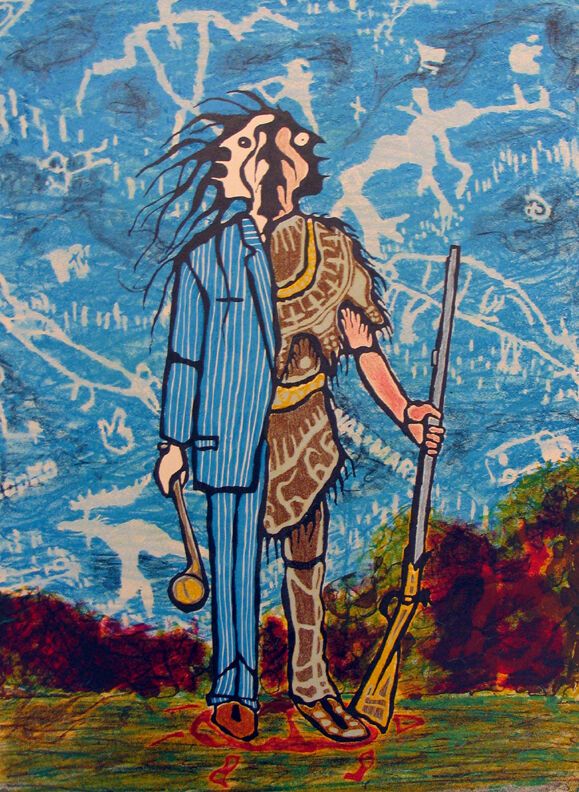
Picture this: a man is split down the middle. One half dons traditional Native American regalia while the other half sports a modern business suit. In one hand, he holds a rifle, and in the other, what appears to be a club. His face is similarly divided, but both sides look to the sky. Swirling around him are both traditional and contemporary symbols of the world, including corporate logos alongside pictographic animals.
This is “The Battle Over Tradition,” a screen-printed piece by the printmaker Jason Elliott Clark which is currently on display in his temporary exhibit “Myths and Legends” in the Helen E. Copeland Gallery in Haynes Hall.
According to Gallery Director Caleb Fey, the Missoula Art Museum put a traveling exhibit together two years ago. After seeing the proposal at a Montana Art Gallery Directors Association Conference, Fey decided to host it at the Copeland Gallery.
The exhibit information states that Clark was born and raised in rural California near the Tule River Indian Reservation, although his heritage lies with the Algonquin people, who now live in eastern Canada and parts of the U.S. Clark went to Brigham Young University in Hawaii to work under a Māori artist and study Northwest Coast Native art before moving to Missoula to pursue a master's in fine arts at the University of Montana (UM).
After college, he managed printmaking studios in Louisiana and Minnesota before ultimately returning to Missoula in 2012. He now works as an adjunct professor and technician at UM’s School of Visual and Media Arts.
Clark explained in his artist statement for the Missoula Art Museum that his work is deeply rooted in his Algonquin heritage. “My work deals with subjects that I have observed or experienced firsthand,” he said. “They illustrate how I see the world around me and how I have learned to respect it. The images and stories in my work are reflections of parts of me.”
In his statement, he explained that his work serves as both a personal exploration and a critique of how Native American identities are portrayed by Western narratives — be it film, advertising, textbooks and, in his words, “other transmitters of misinformation.”
Gesine Janzen, a professor of art and head of printmaking at MSU, said she met Clark years ago when he came to MSU as a visiting artist. “I feel like [Clark] is working with his own identity and trying to relate that to the story of Native Americans in Montana,” she said. “I find that with so many artists — their artwork comes out of their heritage, their past, how they see who they are as people and are trying to communicate that.”
MSU student Kariah Slagel, who is doing an independent study in ceramics, explained that art plays a role in portraying sociological perspectives. ”I think art is one of the most honest ways of portraying that,” she said.
“Art has a wide range. It can be the keeper of the status quo — especially with how it's linked to money — but it can also be incredibly disruptive depending on how it frames things,” she said.
Slagel feels that Clark’s intent for this exhibit was to elicit unease. “There’s a lot of horror in them,” she said. “They all feel like they're moving — screen printing lends itself to that, like the color and the layering can make something feel 3D. I feel he does that on purpose.”
Senior in studio arts Bianca Everts offered a parallel perspective. “To me, they're pretty playful, even though they are very heavy topics,” she said. “I think it’s a beautiful combination of the two opposites.”
She said that Clark’s pieces reminded her of various works created post-war.
“In peacetime, art gets a little boring and then a war happens and it gets more into social turmoil,” she said, describing the art as reactive — almost as if it reaches out to grasp empathy from its viewers.
Many of the exhibit’s viewers spoke in depth about the form and physicality of the pieces. “Looking at the colors, the patterning and the abstraction of the animals — I love the way all these elements interact with each other,” Janzen said.
Everts also noted the classic feel to the pieces. “While they have a lot of contemporary elements for context, the form and style is very traditional,” she said.
Slagel emphasized the impact of symbolism and how it can add to the emotions of an art piece. “I like how art brings dreams and fantasy into real life and how impactful that can be. I feel like [Clark] does a really good job of doing that,” she said.
Ultimately, Fey wants viewers to consider the perspectives of the cultures around them. “The Helen E. Copeland Gallery is a space on our campus where conversations about diverse voices and perspectives are encouraged and supported,” Fey said. “I hope that the viewers can be aware of the many layers of the artist's identity and his critique of the modern dilemma faced by his people.”
Along that line, Janzen encouraged every student to check out the gallery, no matter how artistically inclined they might be. “Even if you don’t know the story that’s being represented, there is still just visually a lot to look at and imagine,” she said.
At the time of this publication, the Exponent could not reach Clark for comment.
Students can view “Jason Elliott Clark: Myths and Legends” Monday through Friday from 9 a.m. to 5 p.m. until Feb. 21. For more information, visit https://art.montana.edu/copeland-gallery/index.html.



Comments ()