
Reforming recovery: PERC leader urges ESA update as rare bipartisan consensus emerges in Senate hearing
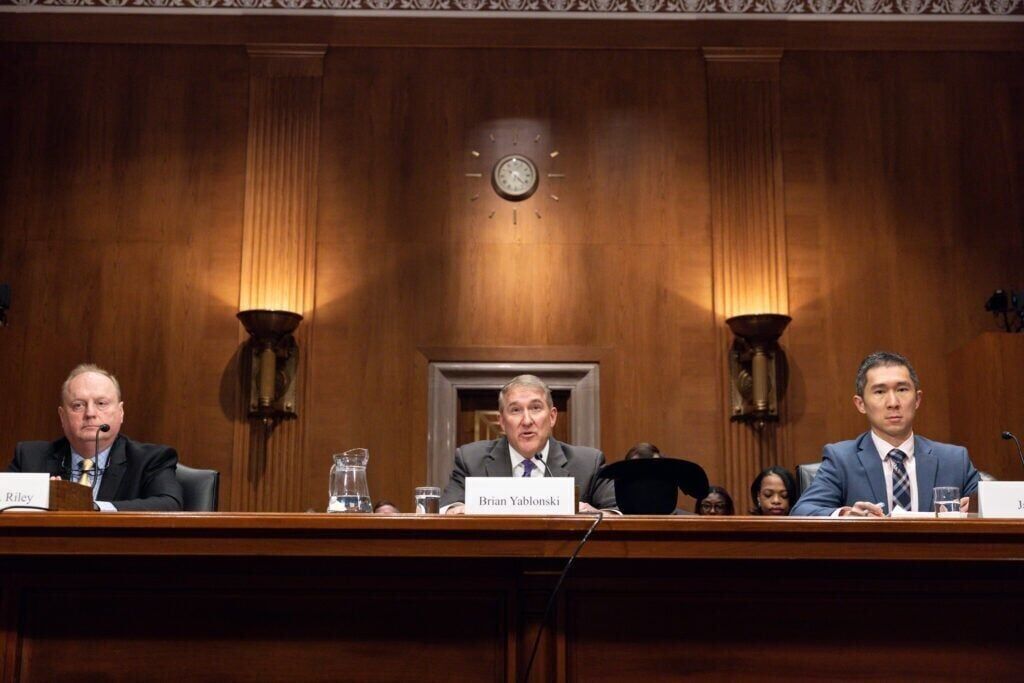
Brian Yablonski, the CEO of Bozeman-based conservation group Property and Environment Research Center, served as the majority witness in a March Senate hearing on ways to update the Endangered Species Act.
The Senate Environment and Public Works Subcommittee on Fisheries, Water, and Wildlife hearing marked an increasingly rare moment of bipartisan agreement in the legislative branch.
“A lot of times in Congress, witnesses stand up and posture and get their sound bites in, but this was a hearing where members of the Senate saw two organizations really working to find common sense reforms they could agree on,” Yablonski told the Chronicle.
The subcommittee hearing was an opportunity for senators and panelists to consider changes to the ESA, addressing challenges in implementing the act.
During his five-minute statement, Yablonski called for a policy that emphasized species recovery rather than extinction prevention.
More than 1,300 species in the United States are listed as endangered or threatened, according to the Environmental Protection Agency.
“Ninety-nine percent of species on the endangered species list have not gone extinct, but with only 3 percent on the list ever recovering and getting off the list, we know that’s an area we can do better in,” Yablonski said.
To make this change, Yablonski advocates PERC’s incentive-based conservation approach. Rather than focusing solely on punishing organizations for failing to uphold regulations, he suggests rewarding efforts to recover species.
PERC, founded in 1980, established a new framework for conservation called “free market environmentalism”. Rather than relying on government responses to environmental problems in the public sector, PERC focused on private-sector, incentive-based conservation initiatives.
“The ESA provides too many sticks and too few carrots,” Yablonski said in the hearing. “Rigid regulations are tools for preventing extinction, not supporting recovery. To recover species, we must encourage and reward — make species an asset, not a liability.”
To do so, Yablonski suggested three approaches: Rewarding recovery progress with regulatory relief, favoring bottom-up conservation leadership rather than top-down edicts from Washington, and reducing the temperature around recovering species.
“We are talking about a cooling-off period. If you have a species recover and there’s a delisting, the first thing that happens is there are groups that come in and sue to stop it and put the species back on the list,” Yablonski said. “It becomes a vicious cycle. Wash, rinse, repeat.”
Rather, Yablonski said getting a species off the endangered species list should be celebrated as a restoration success story.
“We’ve seen this with grizzly bears. The biologists in charge of recovery have said they’ve recovered. These are the people who work with the bears day in and day out. They’ll say the grizzly is recovered, and then there’ll be a suit,” Yablonski said. “Then we’ll go through what I call judicial roulette, and a judge puts them back on the list, and throws out some other marker that has to be hit.”
Yablonski said having a mandatory “cooling off” period after delisting could allow species recovery to be celebrated. If the species population declines, it can be re-listed.
Grizzly bears were first listed as threatened in 1975. In 2007, they were delisted in the Greater Yellowstone Ecosystem due to population recovery before being relisted in 2009 per a Montana District Court order.
In 2017, GYE grizzlies were delisted again, transferring management to the states. A federal judge overturned the delisting in 2018, formally relisting them in 2019. Today, grizzly populations in the GYE have increased significantly, sparking controversy over their status as a threatened species.
The ESA was passed in 1973 under the Nixon administration. The ESA grants the federal government responsibility for conserving endangered and threatened species, as well as their critical habitats.
The U.S. Fish and Wildlife Service and the National Marine Fisheries Service are the two primary federal agencies tasked with enforcing the ESA through listing, protection, and recovery efforts.
An endangered classification identifies a species in danger of extinction throughout all or most of its range. Threatened species are at risk of becoming endangered in the foreseeable future, according to USFWS.
In Montana, the ESA is primarily enforced by the USFWS Montana Ecological Services Field Office. USFWS determines the threshold that must be met for a species to be delisted, as well as whether a species should be placed on the list.
USFWS works with Montana state agencies like Montana Fish, Wildlife & Parks to help manage specific recovery projects.
“(FWP) is involved in the on-the-ground management and response and conflict prevention efforts when it comes to grizzly bears,” Morgan Jacobsen, the information and education program manager for Montana Fish, Wildlife & Parks in Bozeman, said.
Between responding to and preventing conflicts between wildlife and the public and doing educational outreach, Jacobsen said FWP plays an important role in helping reduce bear mortality rates.
“The conflict prevention and management is making a difference on the ground, and the education is helping raise awareness and our ability to live with grizzly bears and minimize conflicts that way,” Jacobsen said.
Additionally, FWP works on protections and preventative measures for hunting, fishing, and trapping regulations.
“Before a hunter can purchase a black bear hunting license, they have to take a test to prove they can distinguish between black bears and grizzly bears,” Jacobsen said.
Fishing regulations also protect bull trout, another species on the threatened list.
In Montana, endangered species include the whooping crane, white sturgeon, northern long-eared bat, and black-footed ferret, which has remained on the list for nearly three decades.
Threatened species include bull trout, grizzly bears, Canada lynx, and piping plovers.
The bald eagle, gray wolf, and peregrine falcon have all been delisted in the state.
During his Senate testimony, Yablonski called for the revitalization of ESA federalism, a model in which the federal government sets standards for species protection and the states manage species within their jurisdiction.
“Of the species that have recovered, none have back-slid under state management and gone back on the list,” he said. “If you want to get species to a number robust enough to get them off the list, you’ve got to provide the incentive to the state to say ‘we trust you to take over management’.”
If species populations fall, Yablonski suggests reinvoking federal enforcement. If populations rise, he suggests providing regulatory relief.
“The more progress we can show, the more benefit there would be in terms of regulatory relief,” Yablonski said.
Jake Li, the vice president of conservation policy for Defenders of Wildlife and minority witness during the hearing, suggested relieving project consultation requirements with FWP on federal units exhibiting healthy populations of species on the endangered or threatened species list.
Last fall, Li lost his job with the Fish and Wildlife Service as part of the Trump administration cuts. During his testimony, Li highlighted the importance of supplying agencies with the necessary resources to fulfill their ESA obligations.
“Unfortunately, FWS’s capacity is more diminished than ever to meet its mission, deadlines, and the ever-growing expectations of the agency,” Li said during the hearing.
Last year, nearly 25% of FWP’s staff departed the agency, including nine of 23 of the senior executive service leaders, according to Li.
“Ecological Services alone has lost several centuries of institutional knowledge. To make matters worse, almost none of the departures benefited from the normal succession planning to transition knowledge and work to the staff who stayed. Agency staff were left aghast and bewildered,” Li testified.
Yablonski said the hearing was a rare moment of bipartisan consensus, with witnesses from the majority and minority reaching common ground.
“Li is probably one of the top experts in the country on endangered species policy,” Yablonski said. “What we saw on the panel was mutual respect between Jake and PERC. “There were areas of agreement and consensus emerging from witnesses that came from both the majority and the minority.”





Comments ()