
Solito author opens Hispanic Heritage celebration month at MSU with discussion
“I feel alone, lonely, solo, solito, solito de verdad,” wrote Salvadoran Javier Ramora in his New York Times Bestselling book “Solito.” Zamora was only nine years old when he set out for thousands of unaccompanied miles across a desert to meet his parents in Central California.
This year, MSU had the privilege of hosting him for the keynote address for Hispanic Heritage Month. The presentation revealed that after reading “Solito” last year, President Waded Cruzado was so inspired that she moved to host the author and poet during MSU’s next celebration of Hispanic Heritage Month.
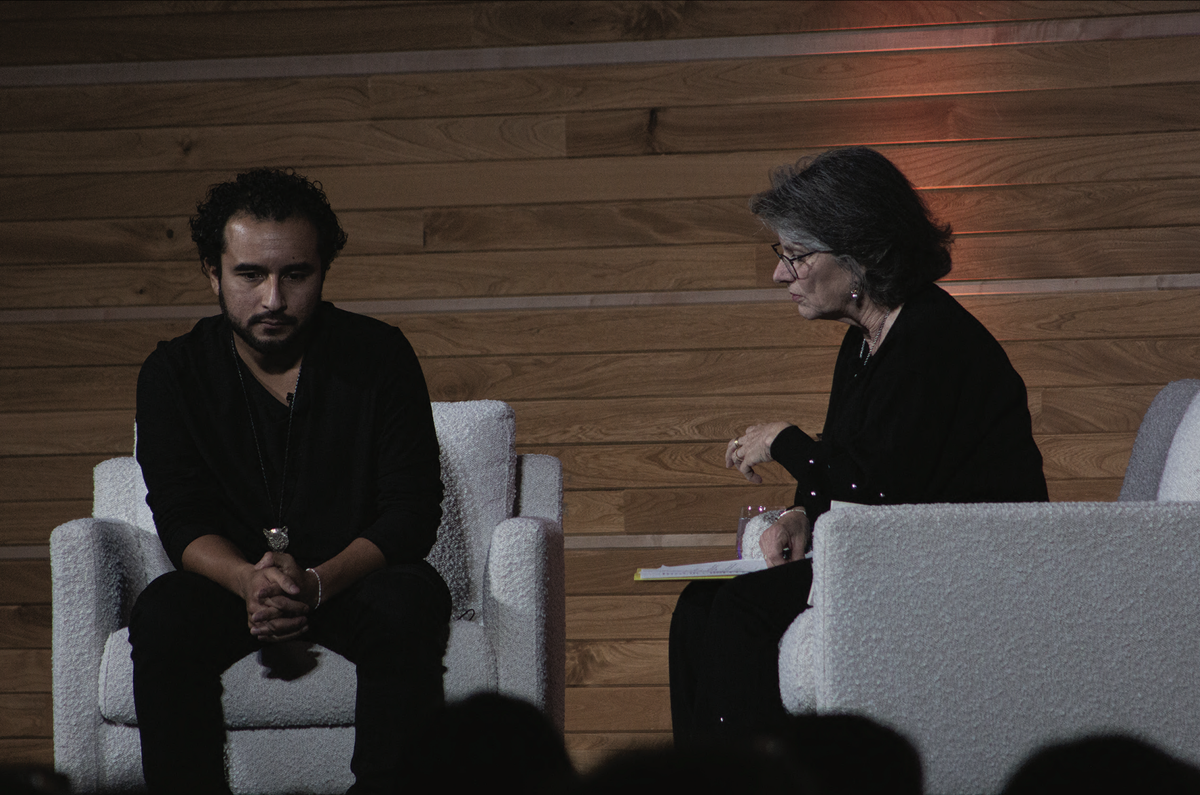
The Office of the President and The Office of Diversity and Inclusion collaborated to bring Zamora to Bozeman this week for a discussion about Javier Zamora’s memoir, “Solito.” Onstage, Zamora had a mediated conversation with Cruzado where they explored themes from his memoir. The conversation was held in the SUB ballrooms on Tuesday, Sept. 19 and it was free entry and open to the public.
The SUB Ballrooms were electric with anticipation Tuesday night. People from all around Bozeman came together to listen to the discussion between Zamora and Cruzado. The presentation showed that Zamora’s journey is an inspiring story of hardship that seemed to have hit home with many people in the audience, with community members coming forward to ask questions of their own at the end. Zamora responded in both Spanish and English, making sure to be mindful of possible language barriers.
Every year, the U.S. celebrates Hispanic Heritage Month between Sept. 15 and Oct. 15 and this is the second year that MSU has publicly observed the month.
These dates, in particular, are significant because they encapsulate the independence days of many Latin American countries — including Costa Rica, El Salvador, Guatemala, Honduras, Mexico and Chile.
Zamora is originally from a rural, coastal fishing town — La Herradura in El Salvador. When Zamora was only nine years old, he set out on his own to immigrate to the United States to meet his parents in California, according to his website.
After finishing high school on an athletic scholarship as a soccer player in Marin County, California, he earned a BA at the University of California-Berkeley and an MFA at New York University before his fellowship from 2018 to 2019 as a Radcliffe Fellow at Harvard University, according to Zamora’s website.
Zamora spoke in an interview with the Exponent on Sept. 19 about the many struggles he faced during his time at UC Berkeley. “I had a huge chip on my shoulder because one, I knew that I wanted to outperform everybody else, but two, I was also annoyed that I felt like I didn't have the privilege to just play beer pong on a Monday night, you know?” he said.
He said that he originally wrote poetry to express his 10-week experience crossing the Sonoran Desert, a region stretching from Southwestern Baja California through Southeastern California. He has only recently — in Sept. of 2022 — published his memoir.
“I think I wrote poetry because it's fast. You can sit down and write and create at least a line or two and step away and call it a poem. Prose seems impossible when you don't have the privilege of time,” he said.
“I don't think I would have written this book without the poetry first or with all of those privileges. It was a natural thing born out of privilege, which is weird to say because in my most privileged state of life, I could write [about] the most unprivileged ten weeks of my life,” Zamora said.
Zamora stated in his interview that he didn't always love writing and didn't find poetry as an outlet until the age of seventeen. “Writing found me. I am not one of those cases that grew up reading novels and always knew I wanted to be a writer. No, I hated writing and I hated reading. I used SparkNotes for everything.”
Because Zamora is a first-generation college student, he spoke about many struggles he faced during his time at UC Berkeley. He offered a piece of advice and insight to other first-generation students on the different stressors and emotions that many immigrants face during college.
“Keep fighting, it sucks. Giving language to the feeling of eventually surpassing your parents is a sort of grief. You are your own parent, and learning things your parents don't know. You become your parents' parents,” Zamora said during his interview with the Exponent.
At the age of 29, Zamora was granted the Extraordinary Ability Visa (EB-1), which granted him lawful permanent residency, according to the U.S. Citizenship and Immigration Services.
“Another way to view immigrating to this country is to consider every immigrant a survivor. I am a survivor of the ten weeks that it takes to get here. When you are a survivor of a certain type of trauma, you don’t have the privilege of a timeline,” he said. Throughout the memoir “Solito,” Zamora references Superman and Goku. During the discussion with President Cruzado, she asked about the emergence of hero figures and themes in his book.
“What is the most immigrant narrative but Goku and Superman? Coming from one world into another where you feel like an outsider,” he said. “But these two individuals don't only feel like an outsider, but they have superpowers. They're better than where they are. And I think that is the most immigrant thing around because it takes them a while to realize what makes them different is the precise thing that makes them strong, not only strong but stronger than those around.”
La familia — or the family — was a constant theme throughout his presentation in the SUB and his memoir. “Home is the people that you cry for when you leave,” Zamora explained. He spent much of his youth under the care of his grandparents, thousands of miles away from his immediate parents, who had immigrated to California shortly after he was born, according to his website.
“Family is not necessarily by blood. It is usually found. Our blood family members don't have a choice, but in this lifetime, we have choices. I have found that it is the people that choose you, or that you choose yourself that show you something new in yourself,” Zamora said.
Zamora is currently a permanent resident of the U.S. but the memory of the desert crossing still stays with him. “I really remembered the traumatic events. I can still taste the dust when I was facedown in Oaxaca. That never leaves you.”
Zamora’s discussion was not the only event MSU is hosting for Hispanic Heritage Month. For the remainder of the month, the Office of Diversity and Inclusion is hosting many events to celebrate. Currently, the College of Arts and Architecture is hosting a month-long exhibit in their Dean’s Gallery in Cheever Hall, Room 215. The exhibit is showcasing work from recent alumni. The gallery is open to the public Monday through Friday from 8 a.m. to 5 p.m. from Sept. 15 to Oct. 16.
On Sept. 28 and Oct. 12 from 4-5 p.m., the Spanish Club at MSU will host two Mesa Españolas, which are “sort of open-door gatherings for conversation in Spanish, no matter your level. [And] for food, games, and conversation,” Program Coordinator for the Office of Diversity and Inclusion Maggie Richardson said.
Additionally, there are volunteer opportunities for English speakers in the Gallatin Valley through a local business called English Para Todos. They were founded by two MSU graduates Vanessa Zamora Moreno and Kassidi Thompson. The organization strives to provide affordable English education to Latinos and immigrants, according to their website. They have opened their doors to volunteers to help their students practice English conversation on Mondays between Sept. 18 and Oct. 9 from 7-8 p.m.
To wrap up the on-campus events, there is an “Encanto” sing-along at the Brick Breeden Fieldhouse on Oct. 11 at 6:30 p.m. The next day, the MSU Library will host a book group discussion of “Solito” on Oct. 12 at 4 p.m.
For more information about this year’s events, go to: https://tinyurl.com/yc3z3pvy


Comments ()