
Sorry not sorry: Lori Addicks’ communication workshop
It's a tried-and-true fact that social media has negative impacts on the mental health of students. Students feel the consequences of excessive social media use every day — and if they haven't felt it, they know someone who has.
Often, slang from social media bleeds over into situations intended to be formal. I know I am not the only one who has accidentally called something “slay” to a professor a time or two. However, as students graduate and join the professional workforce, using informal language may adversely impact their job performance and overall confidence.
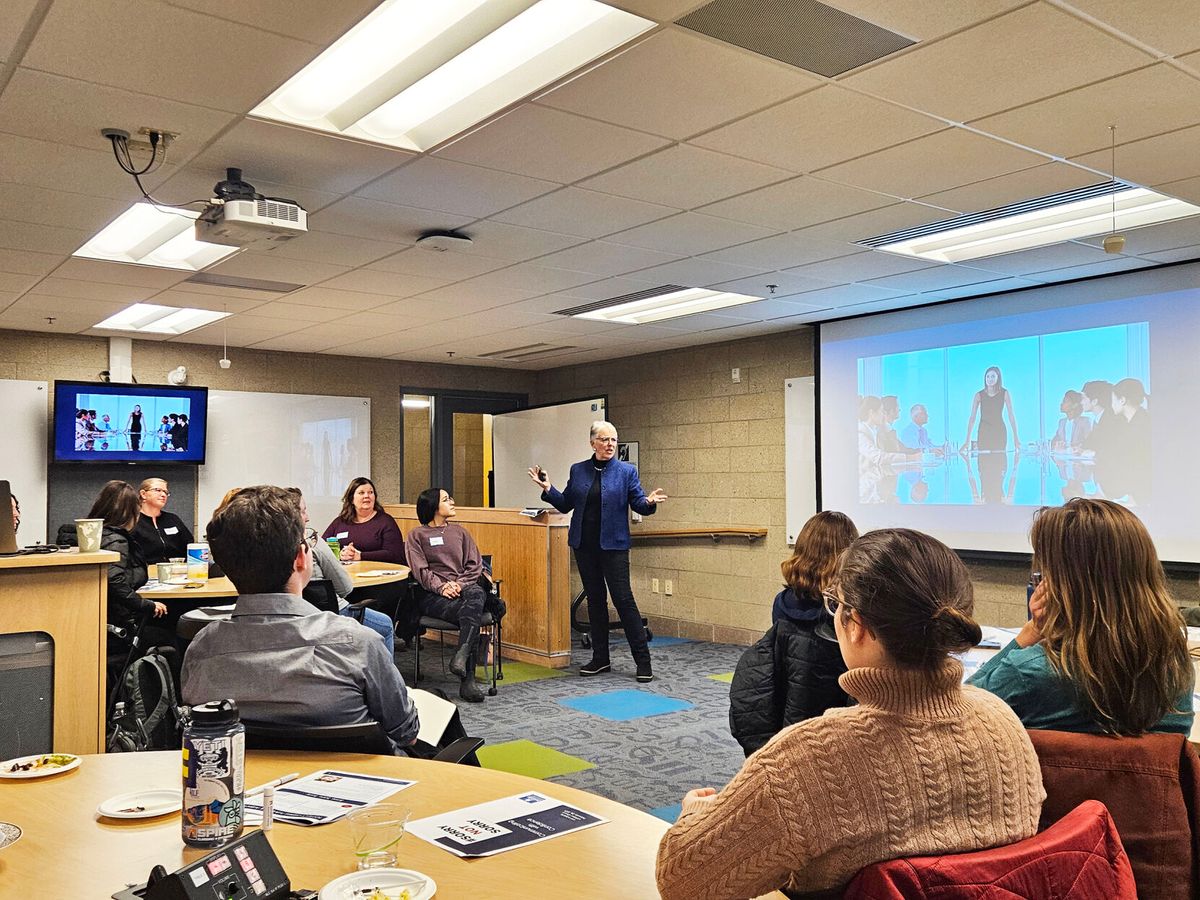
Recognizing the growing need to empower students in public communication skills, the MSU Leadership Institute hosted “Sorry Not Sorry: Communicating With Confidence,” an interactive workshop designed to help students speak professionally, provide suggestions about building self-assurance and offer skills to identify habits that weaken communication. The seminar was held last Wednesday, Feb. 28 and was facilitated by Lori Addicks, CEO of Larkspur Group.
Larkspur Group began in 2009 and works around the globe consulting companies on various aspects of effective management and ways to achieve desired results. Addicks works as a performance consultant and executive coach. She also serves as a TEDx Speaker Coach.
“It takes using [tools] to develop a skill,” Addicks said. “We are in a skill deficiency when it comes to communication. People don’t know how to communicate with their bosses, they don't know how to communicate with coworkers. There can be significant fear about confrontation.”
“The addiction to our devices is so great. You can’t go to a restaurant and not see people on their devices, especially kids. If they communicate they text,” Addicks said. “I'm generalizing, but what I am seeing in the workplace is we have a whole generation of folks who do not know how to communicate.”
While Addicks’ career thrives off her acute ability to speak in front of audiences, she confessed this wasn't always the case.
“In high school, I always sat in the back row and I never raised my hand,” she said. “I waited ‘til my senior year to take a speech class, thinking no one will be older than me. I thought I would be less intimidated. It was the first time I ever spoke in an auditorium.”
Addicks further explained how she grew into her voice and found her true calling. “In college, I didn’t really speak up,” Addicks said. “I was a clothing and textile major and I worked in a fabric store. I wanted to learn and get certified to teach classes. I started teaching, something I knew well — sewing — and I saw people wanted to learn. I loved it. It’s almost like I fell into it. I found that if [the subject was] something I know, I’m comfortable speaking in front of others. I found I had an affinity for teaching, and that evolved into the training world of the workplace.”
During her seminar, Addicks discussed the importance of recognizing aspects of communication that sabotage credibility. She explained that words and phrases we use, often unconsciously, undermine the overall effectiveness of speech. Filler words — such as uh, um, like, so, you know — often roll off the tongue like muscle memory. Using them while speaking is not an easy habit to break.
“We all use filler words, it's like — I just did one there,” Ella Morton, a freshman and intern for the Leadership Institute, said. “It's about finding out what you're trying to say and making sure it makes sense.” Morton started at the Leadership Institute in August and led the coordination for the event.
“Everyone says [filler words],” Morton said. “It’s just about making them as minimized as possible to make your speaking more effective. Being more aware can help you get that job, or get you a leg up. It makes you more confident.”
Addicks suggested that reducing the use of filler words begins with acknowledging their presence. She recommends having someone else listen to your speech and track the use of filler words or phrases. She then invited students to record themselves speaking and use it to identify which words are in terms of the main message. She also cites that during speeches or just a conversation with your boss, it is vital to remember to slow down, pause and breathe. Further, it is important to project your voice as it makes it harder to add those pesky filler words while focusing energy into volume.
Another aspect of speech Addicks identified is the pervasive habit of over-apologizing. “It weakens your message,” Addicks said during her presentation. “To the women of the room, do you hear the men apologizing?”
She further explained that saying sorry before giving a message to someone weakens credibility and compromises the authenticity of an apology. Her message was clear: don’t apologize unless you should be sorry.
“Words have power,” Addicks said. “[Apologizing] has become a greeting. Substitute another greeting, like good afternoon or, if you have a minute, I'd like to ask you a question — not sorry to bother you. It makes us appear smaller, it puts too much stake in the power difference. Be real, and don’t overdo it. Just simply say, you got a minute?” If they don’t have time, they'll tell you. You just don’t have to apologize about these things.”
Addicks also explained that our proclivity to add useless adverbs and adjectives often undermines authenticity. Overused adverbs — such as just, almost, basically, actually, awesome, great, fantastic — do not benefit main messages and distract from the importance of that message. When we overuse these words, they lose meaning.
“Set your intentions,” Addicks said “[As] you get up in the morning and you're thinking about the day ahead, ask yourself, where are the opportunities [in which] I am going to have to interact with people? Think about what you're after.”
The impact of Addicks’ tips and tricks seemed to resonate deeply with attendees. Many had questions for Addicks about areas they felt they could improve on.
“I’ve never really gone to any of these types of events,” senior Aidan Stevens said. “I was [a freshman] during [the COVID-19 pandemic], so it was kinda hard to get myself back out. This one stuck out to me and pertained to my major. [I am interested in] being more conscious about the speech I am using, especially in college.”
Steven further explained his interest and identified areas where conscious speech would benefit his future career in architecture. “In [architecture], we do a lot of presentations and self-reflection,” Stevens said. “It’s very helpful to represent yourself and your work in the right way by speaking fluently. I think it’s common in our generation, simply as a result of being on our phones a lot. I sound like a [baby] boomer — but it definitely helps to have a breakdown of the language that we should be using, and being aware of our filler words. We should think about how to speak authentically.”
If you feel that negative speech habits could hinder your future, Addicks recommends various resources. The books “How to Say It for Women: Communicating with Confidence and Power Using the Language of Success” by Phyllis Mindell, “Girl, Stop Apologizing — A Shame-Free Plan for Embracing and Achieving Your Goals” by Rachel Hollis, the articles “6 Ways to Look More Confident During a Presentation” by the Harvard Business Review and “11 Powerful Ways to Fix Bad Body Language” by Peter Economy for Inc.com are just a few helpful resources to start on your professionalism journey.


Comments ()